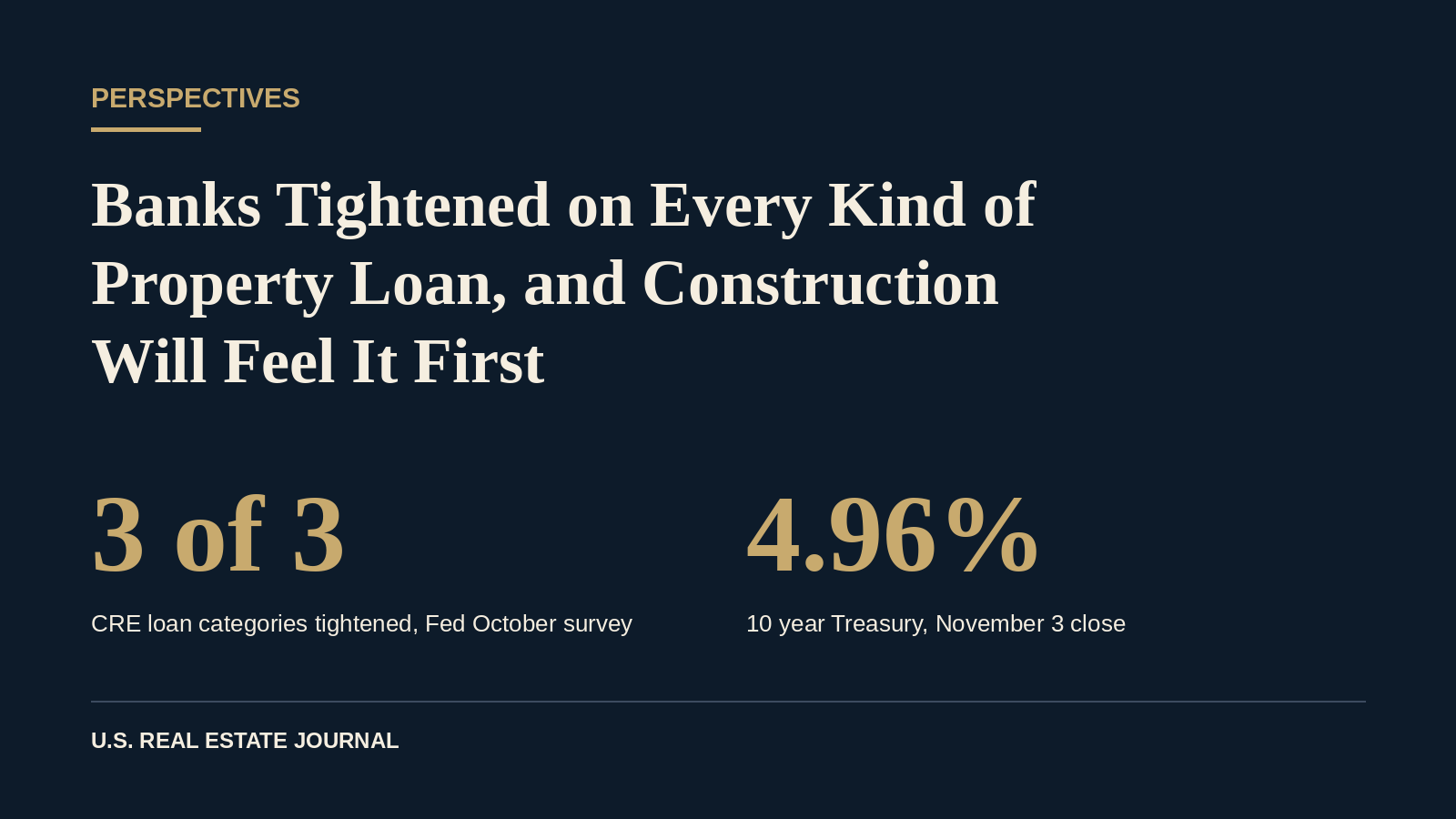

The Federal Reserve released its October Senior Loan Officer Opinion Survey on November 2, and the commercial real estate section reads like a door closing quietly. Banks reported tightening standards, on net, for every category of CRE loan the Fed asks about: construction and land development, nonfarm nonresidential, and multifamily. They also reported weaker demand in all three. As CRE Daily pointed out in its national newsletter, that reverses the April survey, when big banks had been loosening terms on construction, core commercial and multifamily loans as competition from private credit pushed pricing down.
Most of the coverage will treat this as a refinancing story, and it is one. But the category I care about most is the first one on the Fed's list. Construction and land development loans are where the next cycle of supply gets financed, and that is where tighter bank credit does its most lasting damage.
What the Survey Actually Says
The Fed heard from 61 domestic banks and 18 U.S. branches and agencies of foreign banks, with responses due October 5, so this is a read on the third quarter. On business lending, the most frequently cited reasons for tightening were a less favorable or more uncertain economic outlook and worsening problems in specific industries. Standards for loans to large and midsize firms held steady, while standards for small firms tightened. Foreign banks were the one exception on demand, reporting stronger CRE demand even as they tightened too.
The part that deserves more attention is a special set of questions on lending to nondepository financial institutions. According to the Fed, banks tightened standards on every type of loan to that group, including business credit intermediaries and private equity funds, citing the outlook and weaker financial strength among those borrowers. At the same time, demand for bank loans from business credit intermediaries and private equity funds strengthened. Put plainly, the private lenders that have been filling the hole banks left behind are asking banks for more leverage just as banks are getting stingier about providing it.
Why Construction Feels It First
An owner of a stabilized building facing a maturity has options, even if none of them are pleasant: pay down the loan, bring in preferred equity, negotiate an extension, or sell. A developer with land and no construction loan has a carrying cost. When banks tighten on construction and land development, the first projects to stall are the ones that were already marginal, with a high land basis, thin contingency, and rents underwritten at the top of the range.
The rate backdrop does not help. CRE Daily's market snapshot put the 10 year Treasury at about 4.96% and one month CME Term SOFR at 3.90% as of the November 3 close. A floating construction loan priced off SOFR, with a wider spread and a lower loan to cost ratio, forces more equity into every deal. That equity is the scarcest capital in the stack right now.
Tight construction credit does not cancel demand. It postpones supply, and postponed supply is how the next shortage gets built.
We have watched this sequence play out in local markets before. Starts fall, deliveries fall a year or two later, and rents firm up right around the time everyone has decided the sector is overbuilt. CRE Daily reported that Apartments.com has already raised its rent growth forecast to 2.6% for 2027, up from 1.9%, because demand is outpacing a shrinking delivery pipeline. Tighter construction lending pushes that pipeline lower still.
Who Is Positioned to Win
The winners in a tight credit window are not necessarily the biggest players. They are the ones who already control the hardest part of the process. Land that is entitled, zoned and served by utilities is worth more when credit is tight, because a lender asked to take construction risk will start with the deals that have the fewest open questions. We think land and entitlement are the real bottleneck in American housing. Tighter bank credit makes that bottleneck more expensive to clear, and more valuable to have cleared already.
Employer anchored and workforce housing projects also look better in this environment than purely speculative product. A credit committee sorting through construction requests will favor projects with identifiable demand, a committed anchor, or a public partner willing to share infrastructure costs. Lower leverage sponsors with patient equity will have chances to buy land and stalled projects from groups that cannot close their capital stack.
The Risks the Headline Misses
The first risk is that private credit does not fill the gap this time. If banks keep tightening on loans to nonbank lenders, the cost of the money behind bridge and construction lenders rises, and those terms flow straight through to borrowers. CRE Daily also noted that Blackstone's BCRED filled just 49.9% of its third quarter redemption requests, a reminder that some private credit vehicles face liquidity limits of their own.
The second risk is demand. CRE Daily summarized a warning from Harvard's Joint Center for Housing Studies that a sharp slowdown in immigration will fall mostly on renter household growth. Softer rental demand combined with tighter construction credit could mean fewer projects and slower lease up for the ones that do get built. Smaller developers are most exposed, given the survey's finding that standards tightened for small firms while holding for larger ones.
The third risk sits on the residential side. The Fed found that banks eased standards on jumbo mortgages and tightened on subprime. That is the K shaped housing economy in one line: credit gets easier at the top and harder at the bottom, and the households who most need workforce housing are the ones least able to borrow.
What We Are Watching Next
Three things. First, the January survey, to see whether this is a one quarter reaction to an uncertain outlook or the start of a longer retreat. Second, construction loan spreads and loan to cost ratios on new deals, which will show tightening faster than any survey can. Third, land pricing in Sun Belt growth markets, where many sellers still price land for the credit conditions of a few years ago while buyers underwrite the credit conditions of today.
The practical lesson for operators is to line up construction capital before it is needed, and to treat a lender's appetite as a variable in the pro forma rather than a given.
For more on how we think about financing, rates and lending, visit Daniel Kaufman's capital page.
Sources
- Fed Survey Shows Banks Pulling Back on Commercial Property Loans, CRE Daily, November 4, 2026
- The October 2026 Senior Loan Officer Opinion Survey on Bank Lending Practices, Federal Reserve Board, November 2, 2026