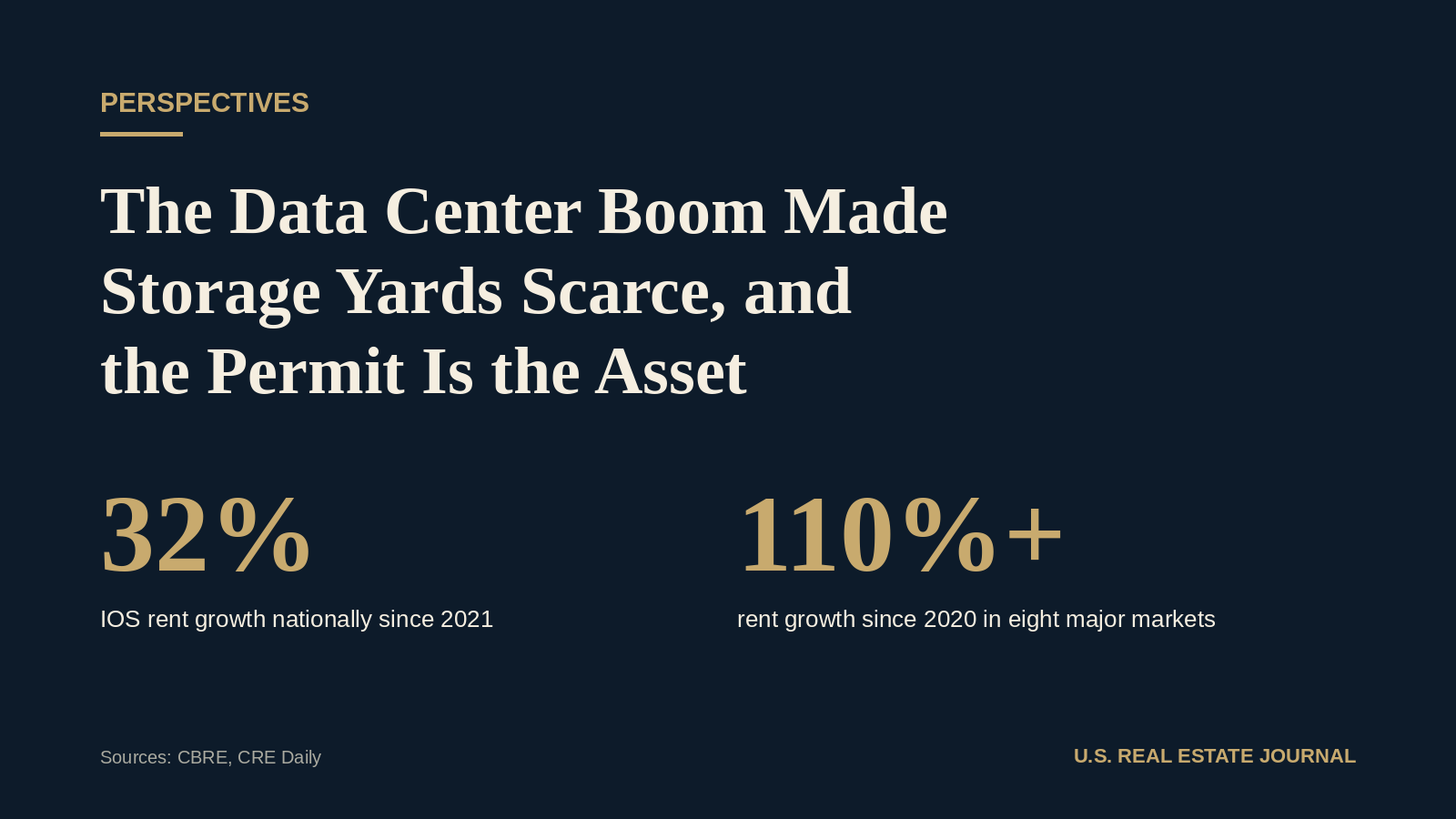

CRE Daily ran a piece this week on industrial outdoor storage, the fenced and mostly paved yards where contractors park trucks, stack materials and stage equipment, and the numbers deserve more attention than this corner of the market usually gets. Citing CBRE, the newsletter reported that national IOS rents have climbed 32% since 2021. It also reported that in eight major markets, including Houston, Savannah and Norfolk, rents are up more than 110% since 2020. The driver it names is the data center build out, which needs an enormous amount of laydown space long before a single server goes in.
I read this as a land story more than an industrial story. A storage yard is close to raw land with a fence, some gravel and a permit. The building is not the product. The permission to use the dirt is.
Why a gravel yard is suddenly scarce
The demand side is easy to see. CRE Daily cited DAT Freight and Analytics estimating roughly 100,000 truckloads of materials for every gigawatt of new data center capacity. Those loads have to land somewhere close to the job site, and they often sit for months. The same pull shows up in buildings. Bisnow, using JLL data, reported that U.S. industrial leasing reached 202.6 million square feet in the third quarter, up 38.5% from a year earlier and the strongest quarter since 2022, with construction materials and building fixtures tenants accounting for 14.7% of that activity. Savills research cited in the same Bisnow story found that data center adjacent businesses leased 69 million square feet of large block warehouse space between the third quarter of 2024 and the second quarter of 2026, concentrated in Dallas, Houston, Austin and the East Bay.
The supply side is where it gets interesting. CRE Daily noted that strict zoning and local opposition make new yards difficult to develop, and that data centers are consuming existing industrial land outright. In Manassas, Virginia, more than 200 acres of outdoor storage are slated for data center conversion, which the newsletter said removes over 20% of local supply. Few towns want a new truck yard, and almost none will rezone for one when a data center developer will pay more for the same parcel.
The same boom that creates demand for storage yards is quietly paving over them.
Who is positioned to win
Institutional capital has noticed. CRE Daily listed Brookfield’s $1.2 billion acquisition of Peakstone Realty Trust, a J.P. Morgan venture with Zenith IOS assembling roughly 100 properties across 33 markets, a $1.4 billion Catalyst Investment Partners portfolio, and Blackstone financing more than $1 billion of IOS deals. The newsletter put the U.S. IOS market at around $300 billion, much of it still held by small local operators. That fragmentation is exactly what the large platforms are buying.
On the ground, the clearest winners are owners who already hold permitted yard land near power, highways and data center corridors. Their approvals are the scarce input, and a consolidator will pay for that certainty. The second group is counties that plan for this on purpose. A jurisdiction that designates contractor yard and laydown areas near its data center campuses keeps trucks off residential streets and captures tax base instead of fighting the same zoning battle parcel by parcel. The third is contractors who secure yard space early. CRE Daily made a point I agree with: storage is a small share of a data center contractor’s total cost, which is why landlords have pricing power and why waiting for a better rate is usually a losing trade for the tenant.
What the headline misses
Staging demand is temporary by design. A contractor needs a laydown yard while a campus is under construction, then moves on. If a market’s data center pipeline stalls, because of power interconnection delays, a pullback in AI spending or a local moratorium, the yard demand behind it goes with it. Rents set at a build peak are not the same as rents supported by a durable tenant base, and I would be careful with any underwriting that capitalizes 2026 yard rents as if they will hold indefinitely.
Tenant credit is the second gap. The hyperscaler is usually not the tenant. The tenant is a general contractor, a subcontractor or an equipment supplier, and those balance sheets look very different from the companies whose names go on the campus. Third, yards carry real site exposure: stormwater rules, fuel and materials storage, soil conditions and paving costs can turn a cheap acre into an expensive one. Finally, the land under a well located yard may simply be worth more as something else. That is good news for the owner and bad news for any market counting on that yard as permanent supply.
There is also pricing risk at the consolidation level. When large platforms compete for fragmented assets, cap rates compress quickly, and buyers today are underwriting continued rent growth on top of rents that have already more than doubled in some markets. This is where data has to win over emotion. A 110% move tells you where a market has been, not where it is going.
What we are watching next
At Kaufman & Company, we are watching four things. First, data center pipeline changes at the county level, because yard demand follows ground breakings, not announcements. Second, zoning actions, specifically whether local governments start carving out laydown districts or tighten outdoor storage rules further, which would push the value of existing permits even higher. Third, renewal terms on yards leased in 2023 and 2024, which will show whether rents hold once the first wave of campuses tops out. Fourth, whether conversions like the one in Manassas spread to other tight corridors, since every yard that becomes a data center removes supply for good.
The broader lesson fits a pattern we see across property types. When land and entitlement are the real bottleneck, the most valuable thing in a deal is often the approval, not the improvement. IOS just makes that unusually visible, because there is barely any building to distract you.
If you own industrial or yard land near a growth corridor and are sorting through entitlement, repositioning or development questions, Kaufman Real Estate and Consulting is where we work through that kind of decision.
Sources
- Industrial Outdoor Storage Rents Climb 32% on the Data Center Boom, CRE Daily, October 27, 2026
- Data Centers Fuel Busiest Industrial Market Since 2022, Bisnow, October 23, 2026