

The usual rule in construction is simple. When building slows, bids soften, and the developers who waited get cheaper buildings. 2027 is shaping up to break that rule, and the reason is not lumber or rates. It is who gets the crew.
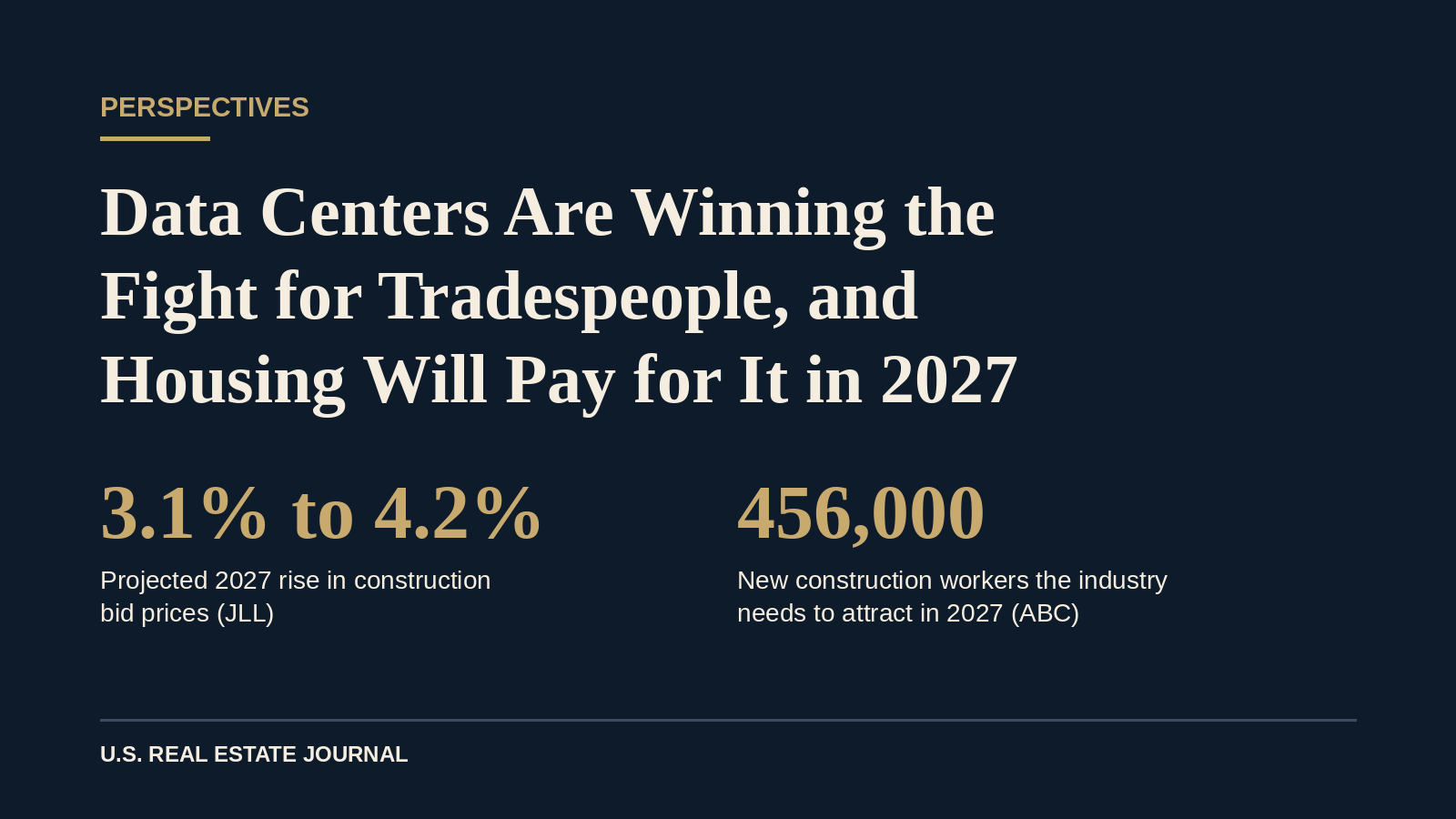
CRE Daily's national newsletter this morning laid out the numbers. JLL projects construction bid prices will rise 3.1% to 4.2% in 2027, still above historical norms, even as real construction spending stays below its 2024 peak. Associated Builders and Contractors data shows construction input prices were flat in October but still 11.5% higher than a year earlier, with tariffs pushing steel, iron and copper up while oil and energy fell. And data centers are the only sector expected to post real construction spending growth in 2026, with that activity spreading into power and infrastructure next year.
Total demand is soft. The demand that sets the price, the demand for skilled hands, is not.
The Crew Is the Constraint
Realtor.com reported this weekend on the Home Builders Institute's effort to train veterans for residential construction. An HBI study found the skilled labor shortage added nearly two months to the time it takes to build each home and cost the country roughly 19,000 homes in 2024, an economic loss of more than $8 billion. ABC estimates the industry needs to attract about 349,000 net new workers this year and 456,000 in 2027.
Now layer the AI buildout on top. A hyperscale campus or a new substation does not compete with a subdivision for land. It competes for the same electricians, pipefitters and superintendents. Those projects run on schedule, not on margin, so they can pay up and still pencil. A 200 unit workforce rental cannot. When an electrician can choose between a data center job with steady overtime and a garden apartment job, the apartment loses.
That is why another JLL finding matters: material costs have outpaced contractor bid prices since the middle of 2025. Contractors have been absorbing part of the squeeze, and CRE Daily notes more of it could be passed along to developers. ABC's confidence index shows contractors still feel good about margins, which tells me they expect to pass the cost through.
The scarce input in 2027 is not steel or money. It is the electrician who gets to choose which job site to show up to.
The South Gets the Work and the Bill
The regional split is where this becomes the Southern Squeeze. JLL expects the South to lead construction activity, with output per worker projected to reach 11% above the 2025 national average by 2028, and with lower projected bid price increases than other regions. On the ground it is more mixed. CRE Daily points out that the region still faces labor shortages and scheduling problems, particularly around data center development, and the metros landing those campuses and the power to run them are often the same metros where housing demand is strongest.
So the South gets more productive and more crowded at the same time. A builder outside Atlanta or Dallas may see a reasonable bid on paper and then watch the framing or electrical sub disappear for six weeks to a campus job down the highway. That schedule risk never shows up in a bid index, but it shows up in carry costs and lease-up timing.
Who Is Positioned, and Who Is Exposed
The owners best positioned here are the ones who control their own schedule. That means land already entitled so a crew can start the day it is available, design and construction under one roof so value engineering happens before the bid instead of after it, and a long hold so a few points of cost inflation get absorbed over decades of operation rather than wiped out at a sale. At Kaufman & Company we build this way because we keep what we build, and for a long term owner a delay costs more than any line item.
The exposed are easier to name. Merchant builders who underwrote 2027 starts on 2025 costs and planned to sell at completion. And attainable and workforce housing in general, where rents are capped by local wages, so every dollar of cost inflation comes straight out of feasibility. That is the hard edge of the K shaped housing economy: luxury product can carry rising costs, while the housing working families need is the first to be shelved.
There is also a quieter risk the headlines miss. Data center demand is not guaranteed to stay at this pace. In the same newsletter, CRE Daily raised questions about how willing one major chipmaker will be to keep backing data center developers after a sudden leadership change. If the AI buildout pauses, trades could flow back to housing quickly, and anyone who locked a high fixed price contract early in 2027 would be paying peak rates into a softer market.
The Workforce Fix Is Real, but Slow
The HBI program is the kind of effort I want to see more of. It trains transitioning service members, veterans and spouses and connects them with local contractors, and Invitation Homes just added its support. One graduate profiled by Realtor.com went from Army infantry to an electrical contractor in southern Georgia, which is exactly the region and exactly the trade where the shortage bites hardest.
But a three month training program does not produce a master electrician, and the gap ABC describes runs to hundreds of thousands of workers a year. Programs like this compound over a decade, not a year. Employers have a role too. The data center and utility operators driving this demand also need housing for the people who will run those campuses, and employer anchored workforce housing is one of the few ways to build homes that the local labor market can actually afford.
What We Are Watching
First, the gap between material costs and bids. If contractors start passing through what they have been absorbing, spring bids will show it quickly. Second, Southern data center pipelines, because a pause there would be the fastest relief housing could get. Third, rates. CRE Daily's market snapshot had the 10-year Treasury near 5.15% at Friday's close, so there is no financing cushion to offset higher hard costs. Projects have to work on cost and schedule alone.
Data over emotion says what it usually says. Slower demand does not mean cheaper buildings when the scarce input is people. Plan for the crew, not the index.
For more on how we approach building and owning through cycles like this one, visit Kaufman & Company.
Sources
- Builders Brace for Another Year of Rising Prices in 2027, CRE Daily, November 16, 2026
- How Training Veterans in Skilled Trades Could Speed Up Homebuilding and Ease Housing Costs, Realtor.com, November 15, 2026