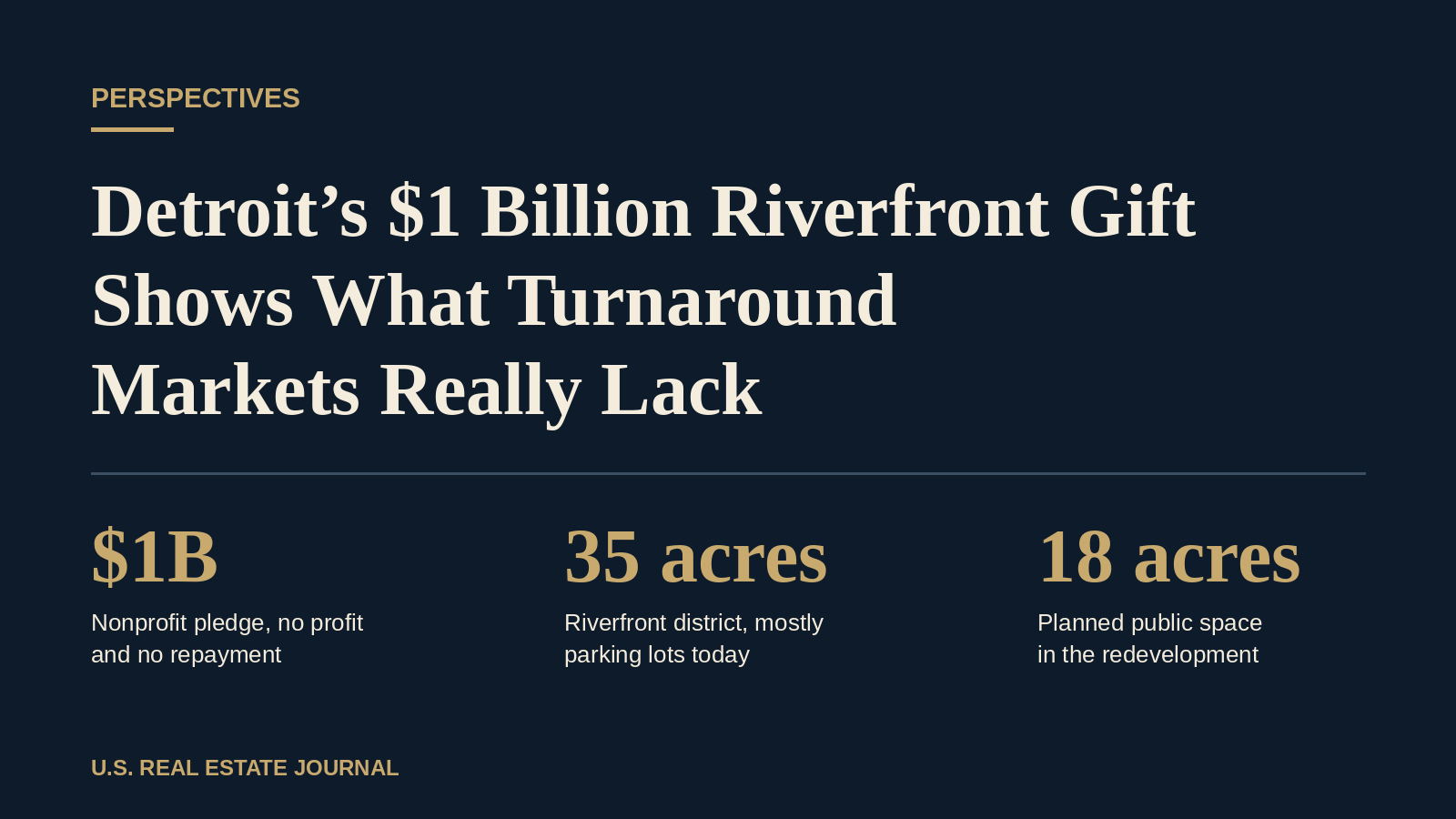

Parking lots are the most honest land use in a struggling downtown. They tell you the ground is worth more as a holding pattern than as a building, because nobody can make the numbers work on anything vertical. That is what I see in the 35 acres around Detroit’s Renaissance Center and East Riverfront, and it is why Dan Gilbert’s latest move deserves a closer read than the headline number.
As CRE Daily reported on October 21, Gilbert has pledged $1 billion to form a nonprofit that will redevelop the Renaissance Center and the East Riverfront. Commercial Property Executive reports the entity will be a 501(c)(4) social welfare organization, with Wendell Anthony, president of the NAACP’s Detroit Branch, and former Rocket Cos. CEO Bill Emerson on its board. Gilbert takes no profit, and the money is not repaid. A Bedrock release, as cited by Commercial Property Executive, calls it the largest contribution ever made to a nonprofit redevelopment effort in an American city.
What the Structure Actually Says
Strip away the philanthropy framing and look at the capital stack. According to Commercial Property Executive, the plan calls for new waterfront amenities, affordable housing, dedicated space for Detroit small businesses and 18 acres of public space. Once complete, project revenue is expected to cover operating costs, debt service, reserves and reinvestment, with any surplus going back to the community.
Read that the way an underwriter would. The district is designed to be self-sustaining at the property level, but not to pay a return on the founding equity. Equity that requires no yield is the only kind of equity that pencils on this site today. Market rate capital needs a return on cost that clears its own cost of funds, and that bar has moved up sharply this year. CRE Daily’s market snapshot had the 10-year Treasury at 5.121% at the October 21 close, and Realtor.com reports that 30-year mortgage rates have stayed above 7% since the last week of September, with the Mortgage Bankers Association’s chief economist expecting them to hover above 7% through 2027.
When the risk free rate sits above 5%, a waterfront district built on former parking lots, with an aging office complex at its center, does not attract conventional equity at scale. Somebody has to absorb the gap between what the land can earn and what capital demands. In Detroit, that somebody is a billionaire choosing to absorb it permanently.
Equity that asks for no yield is the only kind of equity that pencils on this site today.
The Gap Is Not Only Money
The more important detail sits further down in CRE Daily’s coverage. Bedrock CEO Jared Fleisher, speaking on the No Cap podcast in August, called the 5.5 million square foot Renaissance Center “the most complicated adaptive reuse project in the country.” He said GM is contributing $250 million plus property, that Gilbert is putting in more than $1 billion of equity and debt, and that the riverfront work depends on Michigan’s brownfield financing, which a standoff with state lawmakers is holding up. CRE Daily also notes that the new announcement does not explain how the nonprofit fits with the GM partnership or the state financing.
That is the part I would underline. Even patient capital does not replace the public layer. Brownfield financing exists because remediation, infrastructure and site preparation on old industrial and parking land cost more than the finished product can carry. GM’s own $1.6 billion plan from December 2024, per CRE Daily, would have demolished two of the five towers, kept the 73-story tower and sought $350 million in public subsidy. The question now is whether Lansing shows up.
This is the same lesson we keep relearning in land and entitlement work across the country. The binding constraint on a site is rarely the idea, and often not even the equity. It is the public approvals and public dollars that turn raw ground into buildable ground. In Detroit, that constraint has a name and a vote count.
Who Is Positioned to Win
If the structure holds, the obvious beneficiaries are the people who already own or operate near the riverfront and the downtown core. Eighteen acres of public space and new waterfront amenities lift everything within walking distance, and those owners pay nothing for the lift. Detroit small businesses get dedicated space they could not easily afford at market rents.
There is a broader point for anyone watching turnaround markets. Gilbert has been running this playbook for years. Commercial Property Executive notes his earlier $500 million, 10-year neighborhood commitment from 2021, Bedrock’s delivery of the office component of the 1.5 million square foot Hudson’s Detroit in October 2025, and the conversion of eight acres in Brush Park into City Modern, with 450 residences. Each project lowered the risk on the next one. That is how underpriced markets actually turn: an anchor absorbs the early risk, comparable sales and leases appear, and conventional capital follows once the evidence exists.
Where It Could Break
I see three risks the headline misses.
First, the public financing. If the brownfield standoff drags on, the nonprofit owns a very expensive set of plans. Second, the operating math. Revenue that covers debt service and reserves assumes leasing and occupancy that a downtown office complex has struggled to deliver, and the Renaissance Center itself is the hardest piece of the puzzle. Third, governance. A 501(c)(4) offers flexibility, but it also means a single philanthropic sponsor and a small board will make choices that would normally run through a public authority or a market-tested capital partner. Good intentions are not a substitute for disciplined capital allocation over a decade-long build.
There is also a replication problem. Most struggling downtowns do not have a hometown billionaire willing to give up a return. The cities that need this model most are the least likely to get it, which is another face of the K-shaped housing economy. Places with a deep-pocketed anchor get a second act. Places without one keep their parking lots.
What We Are Watching
We are watching three things: whether Michigan resolves the brownfield financing, how the nonprofit and GM formalize who owns and pays for what, and what the first phase actually includes. If affordable and workforce housing arrive early, alongside the public space, the district builds a resident base that supports everything else. If the first phase is mostly amenity, the operating math gets harder.
The data point I care about most is not the pledge. It is the first conventional loan or equity check that lands on a neighboring parcel because of it. That is how we will know the gift did its job.
For more on how we think about turnaround markets and sequencing risk on complicated sites, our broader strategy work is at Kaufman & Company.
Sources
- Dan Gilbert Pledges $1B Nonprofit to Redevelop Detroit Riverfront, CRE Daily, October 21, 2026
- Dan Gilbert Pledges $1B for Redevelopment of Detroit District, Commercial Property Executive, October 20, 2026
- Top Housing Economist Issues Grim Forecast Revision as Higher Rates Slam the Market, Realtor.com, October 21, 2026
- Apartment Concessions Decline, but Discounts Remain at 15-Year Highs, CRE Daily, October 22, 2026