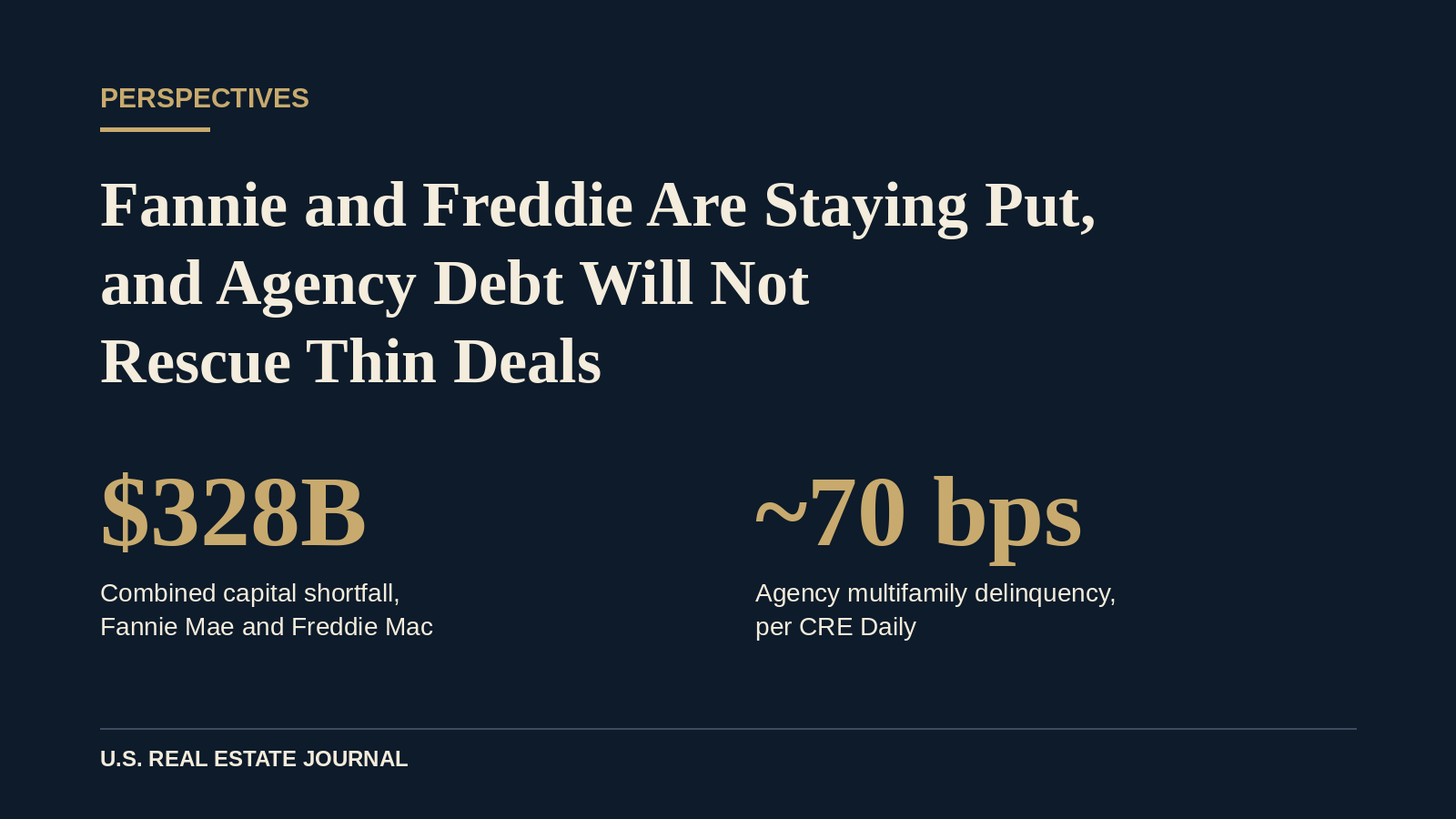

Fannie Mae and Freddie Mac have been under federal conservatorship for 18 years, and this month the case for ending that arrangement any time soon got noticeably weaker. CRE Daily laid out the arithmetic on November 16. The two companies would need roughly $187 billion and $141 billion of capital, about $328 billion combined, because Treasury’s $192 billion senior preferred stake does not count as regulatory capital. A planned offering of around $30 billion does not come close. Mizuho, as cited in the same CRE Daily brief, cut its odds of a release by 2028 by about 12 points.
Realtor.com News supplied the politics in its November 11 report. Treasury has collected more than $300 billion from the pair since the 2008 bailout. Treasury Secretary Scott Bessent has pointed to 2027 or 2028 as a possible window. And with Democrats set to control Congress starting in January, key members want any release tied to congressional oversight and safeguards for affordable housing.
I am not going to predict the politics. The headline, privatization stalled, hides a more useful story for anyone who builds and owns housing. The agencies are staying, but they are underwriting like a lender that expects trouble, and that changes who can get a deal done.
The Real News Is in the Multifamily Numbers
The same CRE Daily brief carries the details that matter on the ground. FHFA set each agency’s 2026 multifamily purchase cap at $88 billion, up 20.5%. Yet agency origination growth of 7.1% trails the roughly 20% increase across all multifamily capital sources, CRE Daily reports. Agency multifamily delinquency has climbed to nearly 70 basis points. And on New York rent stabilized buildings, Shimon Shkury of Ariel Property Advisors says new agency underwriting assumes no rent growth for five to seven years.
Put those together and the picture is clear. The capacity is there. The appetite is selective. The agencies have room to do more and are choosing to underwrite harder. That is a rational response from a guarantor watching delinquencies rise while the 10-year Treasury sits above 5%, which CRE Daily’s market snapshot put at 5.145% as of the November 13 close.
Who Is Positioned, and Who Is Exposed
The owners best positioned in this environment are the ones who never needed rent growth to make the math work. Low leverage, long holds, and product priced for the middle of the local income distribution. Workforce and attainable housing sits squarely inside the agencies’ public mission, and as long as the agencies remain under federal control, mission aligned product is the last place they will pull back. That is the logic behind how we approach Haven, our attainable and workforce housing brand: rents set by what local paychecks support, not by what a spreadsheet hoped for.
The exposed group is just as easy to identify. Buildings bought or refinanced at the top of the last cycle on assumptions of steady rent increases now face refinancing into agency underwriting that assumes none. CRE Daily notes that some owners are already turning to private label CMBS instead. That can fill a gap, but it is a different lender with different terms, and no loan structure fixes a property whose income does not cover the debt it needs.
This is the K shaped housing economy showing up in the debt markets. Owners with equity and patience get agency terms and time. Owners stretched on leverage get pushed toward other lenders, more equity, or a sale they did not plan for.
What the Privatization Headline Misses
The agencies are staying, but they are not going to rescue deals that only worked on optimistic rent growth.
Most of the privatization debate has centered on share prices and valuations. CRE Daily reports that on November 11 Fannie traded around $4.43 and Freddie around $3.98, each down more than 60% from its 52 week high. For buyers and renters, the more important question is the cost of a mortgage. Realtor.com notes the central worry: without government backing, mortgage rates could rise. Frank Cassidy, a former Federal Housing Commissioner, told the outlet that the current structure works as an implicit government guarantee. Mortgage rates have already topped 7%, according to CRE Daily. A release structured without an explicit federal backstop would add risk to a market that already has very little room.
The other thing the headline misses is that capital is not the binding constraint on new housing supply. Land and entitlement are. Even with $88 billion of capacity per agency, nothing gets financed until a site is zoned, engineered and approved, and that process runs on municipal calendars, not Treasury’s. A stalled privatization keeps the debt side stable. It does not shorten a single rezoning or add a single buildable lot.
What We Are Watching Next
First, FHFA’s 2027 multifamily caps, and whether the share reserved for affordable and workforce units holds or grows. Second, agency delinquency. If it keeps climbing from the current level near 70 basis points, expect underwriting to tighten further, especially on older buildings with flat rents. Third, the new Congress in January, and whether any release proposal comes with an explicit, paid for federal backstop. Fourth, the 10-year Treasury. With it above 5%, most other variables are secondary.
Our approach does not change with any of these outcomes. We buy land, entitle it, build and hold for the long term, and we test every project on flat rents and today’s rate environment. If conditions turn out better than that, it is upside. If they do not, the project still has to work. Data over emotion, applied to the debt markets.
If you are testing whether a site or an existing building still works on flat rents and today’s rates, that is the question our Site and Feasibility Review at Kaufman Real Estate and Consulting is built to answer.
Sources
- Fannie and Freddie Privatization Stalls on $328B Capital Gap, CRE Daily, November 16, 2026
- What’s Next for Fannie Mae and Freddie Mac After the Midterm Elections, Realtor.com, November 11, 2026
- Builders Brace for Another Year of Rising Prices in 2027, CRE Daily, November 16, 2026