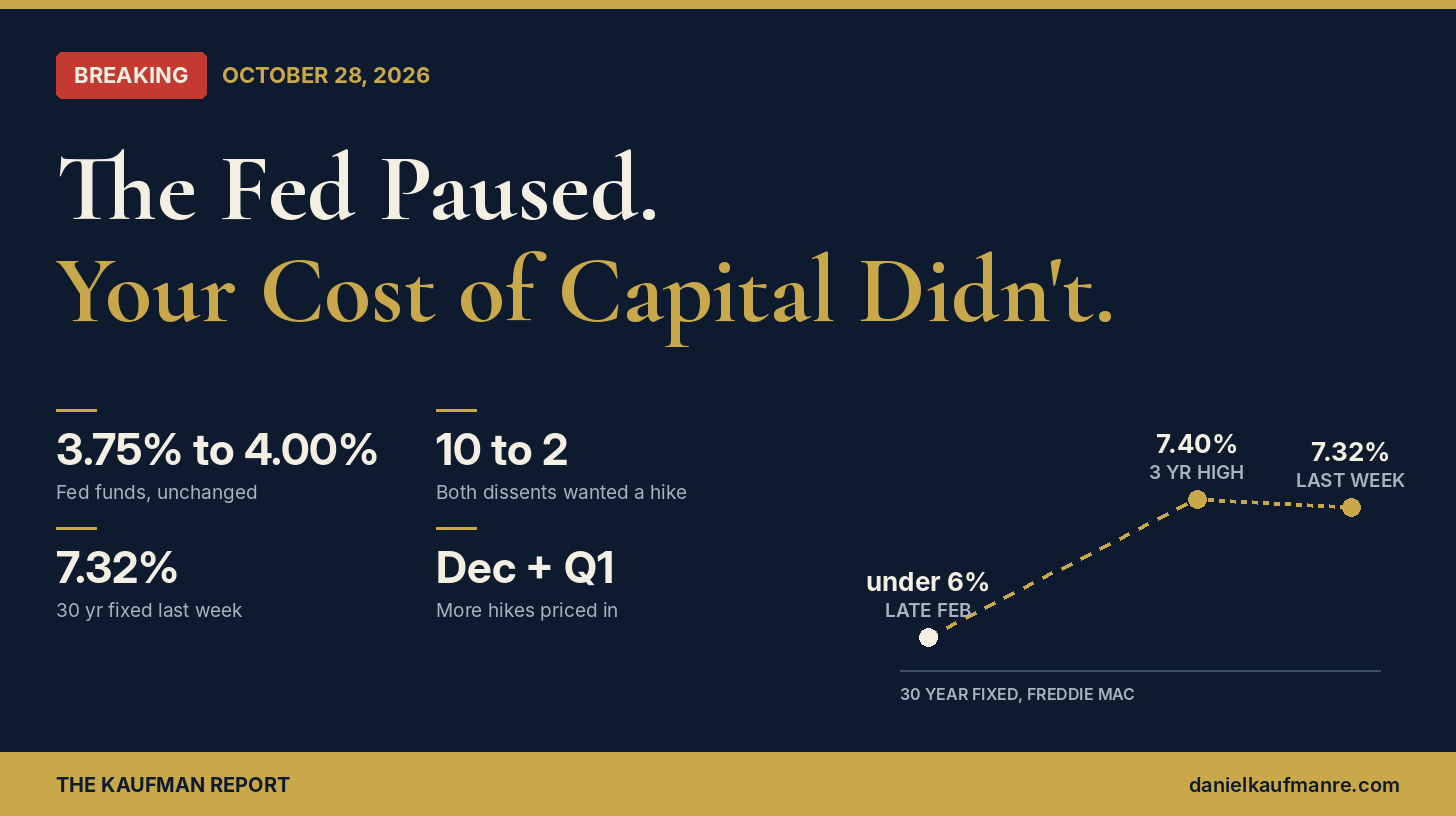

The Federal Open Market Committee left the federal funds rate unchanged on Wednesday afternoon at 3.75% to 4.00%. The vote was 10 to 2, with Chair Kevin Warsh in the majority. Governor Lisa Cook and Cleveland Fed President Beth Hammack dissented, and both wanted another quarter point increase, according to Realtor.com’s coverage of the decision.
The dissents were not for a cut. They were for a hike. That is the detail that matters most for real estate.
The numbers that matter today
- Fed funds: 3.75% to 4.00%, unchanged
- The vote: 10 to 2, both dissents in favor of raising rates
- Last month: the first rate hike in three years
- 30 year fixed: 7.32% last week per Freddie Mac, just off a three year high of 7.40%
- Late February: mortgage rates briefly dipped below 6%
- Market pricing: another quarter point in December, and at least one more in the first quarter of 2027
A pause, not a pivot
The midterm elections are less than a week away. Holding steady keeps the Fed out of the headlines while voters head to the polls. That is timing, not a change in direction.
Nothing in this vote says inflation is beaten. Two members wanted to hike, and the market is pricing two more increases. I am underwriting as if the tightening cycle is still running, because the people setting the price of money are telling us it is.
The Fed doesn’t set your mortgage rate. The 10 year Treasury does.
Watch the bond market, not the press conference
Bankrate’s Jeff Ostrowski made the key point in Realtor.com’s report: after the Fed raised a quarter point last month, mortgage rates jumped three quarters of a point in a month. Mortgage rates follow the 10 year Treasury, not the overnight rate.
Bond investors have been pricing inflation risk off rising oil prices tied to the war with Iran. If oil cools, the 10 year can come in even while the Fed is hiking. If it doesn’t, a pause today does nothing for anyone’s borrowing cost.
The trend line
Since late February, the 30 year fixed has gone from under 6% to above 7.3%. That is more than a full point in about eight months, and it lands directly on buyer affordability and on the exit assumptions behind every deal in a hold. Realtor.com Chief Economist Danielle Hale noted that rates have not returned to their mid September level and the housing market is feeling it.
What it means for investors
Stop underwriting a refinance. If a deal only works when rates fall back under 6%, it is a bet, not an investment. Underwrite at today’s rate and stress it higher.
Fix or cap floating rate debt. Two more hikes are priced. Anything floating without a cap is exposed to the part of the curve the Fed controls directly.
Higher rates thin the buyer pool. Leveraged buyers step back when debt costs this much. That leaves better pricing for cash and patient equity, and it surfaces sellers who need to transact, especially in land and stalled projects.
Rental demand holds. With mortgages above 7%, would be buyers rent longer, and workforce rentals near real job centers stay full.
What it means for developers
Construction carry is tied to short rates. Construction loans price off SOFR and prime, which move with fed funds. This pause buys about six weeks. December is the next test.
For sale product has to get smaller and sharper. Buyers are qualifying at 7% plus, and rate buydowns keep getting more expensive. Attainable, right sized product near employment is where absorption is.
The margin is in the land basis. In many markets, land sellers still haven’t repriced to a 7% world. That gap is closing. Buying land at the right basis, entitling it, and being ready when the cycle turns is how to win this stretch.
Equity over leverage. In this rate environment, the capital stack is the strategy. Less debt, more control, and terms that survive a December hike.
What we are watching next
- The midterm elections next week
- The next inflation prints heading into December
- The December FOMC meeting
- Oil and the 10 year Treasury yield
- Freddie Mac’s weekly mortgage rate survey every Thursday
The pause is a breath, not a turn. Price deals for the rate you have, buy basis instead of hope, and let the people who need rates to fall be your sellers.
To track land and housing fundamentals market by market, use LandBriefing. For a second set of eyes on a deal in this rate environment, Kaufman Real Estate and Consulting is where we work through those decisions. The full breakdown is also on The Kaufman Report.
Sources
- Fed Pauses Interest Rate Hikes for Now as Key Midterm Elections Loom, Keith Griffith, Realtor.com, October 28, 2026
- Freddie Mac Primary Mortgage Market Survey, as cited by Realtor.com