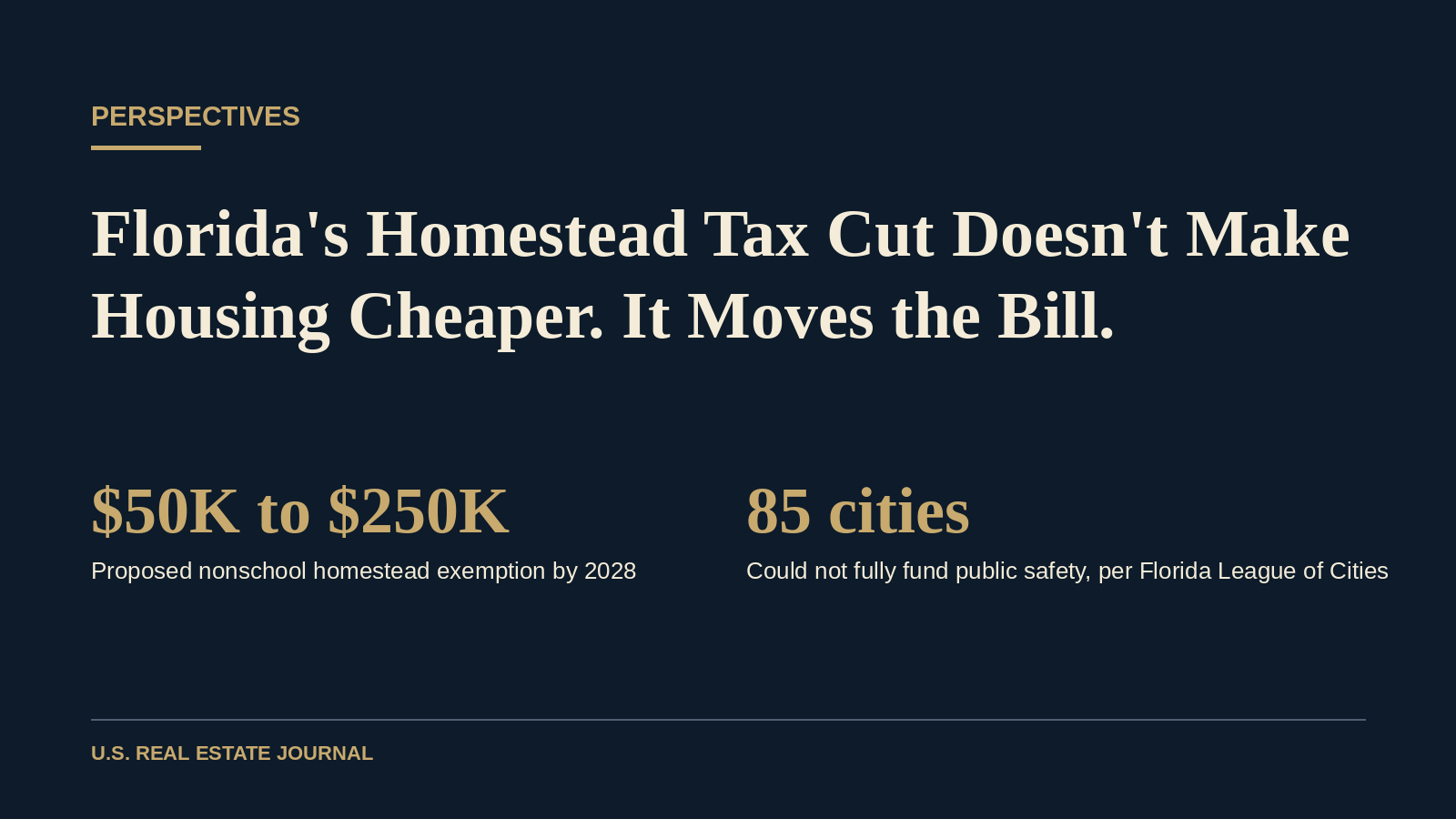

Florida voters decide on November 3 whether to rewrite how the state pays for local government, and most of the coverage frames it as a homeowner tax cut. Realtor.com News laid out the mechanics last week. Amendment 3 would raise the homestead exemption on nonschool property taxes from $50,000 today to $150,000 in 2027 and $250,000 in 2028, cap annual assessment growth on nonschool levies at 5%, and make people who move to Florida wait five years before they can claim the larger benefit. School taxes are untouched.
I read this as a housing and land story more than a tax story. A property tax does not disappear when you exempt it. It gets shifted to someone else, or it gets capitalized into the price of the house, or local services shrink. Usually it is some mix of all three, and in each case the people who end up paying are not the ones being offered the relief.
What the Numbers Actually Say
The revenue pool is large and growing fast. Realtor.com cited state figures showing local governments and schools collected about $32 billion in property taxes in 2019 and $59.17 billion last year, on pace for roughly $83 billion by 2032. Homestead residential property makes up about a third of local property tax revenue. The Florida League of Cities found 85 cities, Pensacola, Fort Myers, and Key West among them, that could not keep funding public safety at current levels even if they cut every other service property taxes pay for.
The household side is real too. The National Association of Realtors found that median real estate taxes for Florida owners with a mortgage rose 48% from 2019 to 2024, to about $3,353 a year. In its model, a $200 a month tax cut lowers the income needed to buy the median Florida home from about $133,800 to $125,200 and lifts roughly 242,000 more households over the affordability line. That is the best version of the case for yes, and I take it seriously. Florida owners have watched tax bills climb alongside insurance premiums and HOA dues they cannot control.
Follow the Bill
Here is what the headline misses. A cut that only established, homesteaded owners can use is a transfer, not a housing subsidy. If a county has to backfill lost revenue by raising millage, that higher rate lands on everything without a homestead exemption: apartments, single family rentals, retail, office, industrial, and second homes. Rental owners pass a large share of that through to tenants over time. The 5% cap on assessment growth gives rental and commercial owners some predictability on value, a point Florida Realtors made in its case for the measure, but a cap on assessments does nothing to cap the rate.
Then there is the five year wait. Picture two identical houses on the same street, one owned by a family that has been there a decade and one bought last spring by a nurse who relocated for a hospital job. Under Amendment 3 their carrying costs could look nothing alike for years. Florida already rewards staying put through its existing homestead assessment cap. This widens the gap. It is the K shaped housing economy written straight into the tax code, with incumbents on the upper arm and newcomers and renters on the lower one.
Exempting a tax does not make it go away. It moves the bill to whoever has not arrived yet.
Capitalization is the other leak. Realtor.com senior economist Joel Berner estimated that eliminating property taxes entirely could push Florida home values up 7% to 9% right away, adding $200 billion to $250 billion to the housing stock and making entry harder for first time buyers. That analysis modeled full elimination, not Amendment 3, and supporters are right to say so. But the direction holds at a smaller scale. When the cost of holding a house falls, sellers capture part of it in price, and land captures the most.
The Southern Squeeze Context
All of this is happening while Florida's growth engine is cooling. CRE Daily reported on October 14 that Florida's net domestic migration has fallen about 80% from its 2022 peak, and that rising housing costs, insurance premiums, and lower immigration are weighing on renter demand across the Sun Belt. That is the Southern Squeeze in plain numbers. The state's problem is not that existing owners pay too much to stay. It is that the cost of arriving has gotten too high.
Amendment 3 lowers the cost of staying and, relative to incumbents, raises the cost of arriving. The people Florida most needs to attract are teachers, nurses, line workers, police officers, and firefighters, and Democratic nominee David Jolly has pointed out that police and firefighters have come out against the measure. If local services get cut and local rents absorb the backfill, the workforce housing gap in places like Fort Myers and Key West gets wider, not narrower. That makes employer anchored housing, where a hospital system, school district, or large employer controls the land and the rent, more important in Florida, not less.
Where I See Opportunity and Risk
The clear winners if it passes are long tenured owners of higher value homesteads in counties with heavy nonschool millage, and builders selling move up product to buyers who already live in the state. Small cities with thin commercial tax bases are the most exposed, along with the residents who depend on their services. Rental and commercial owners face rate risk either way, and I expect bond investors to start looking harder at the credit of the most homestead dependent municipalities.
A failed vote does not end the uncertainty. The Florida Chamber of Commerce told Realtor.com that clearing the required 60% will be hard, but Republican nominee Byron Donalds has said he will pursue homestead tax reform whether the amendment passes or not, and the state's Taxation and Budget Reform Commission could bring back a new plan in 2028. Jolly has floated a first time buyer exemption instead. When we look at income property in Florida, I would assume the tax line goes up under either outcome and treat any relief as upside.
What I am watching next: the November 3 result, how counties set millage rates in their 2027 budgets, whether the legislature creates a revenue replacement mechanism, and whether Florida's migration numbers stabilize once the insurance market settles. Data over emotion. The vote will feel like a referendum on fairness, but the market will judge it by who ends up carrying the bill.
If you are underwriting a Florida project and want a second set of eyes on how tax policy, insurance, and local budgets change the feasibility math, that is the kind of review we do at Kaufman Real Estate & Consulting.
Sources
- Florida Homestead Tax Sparks Debate Over Who Will Pay for Local Services, Realtor.com News, October 16, 2026
- Sun Belt Apartment Recovery Turns Sharply Uneven, CRE Daily, October 14, 2026