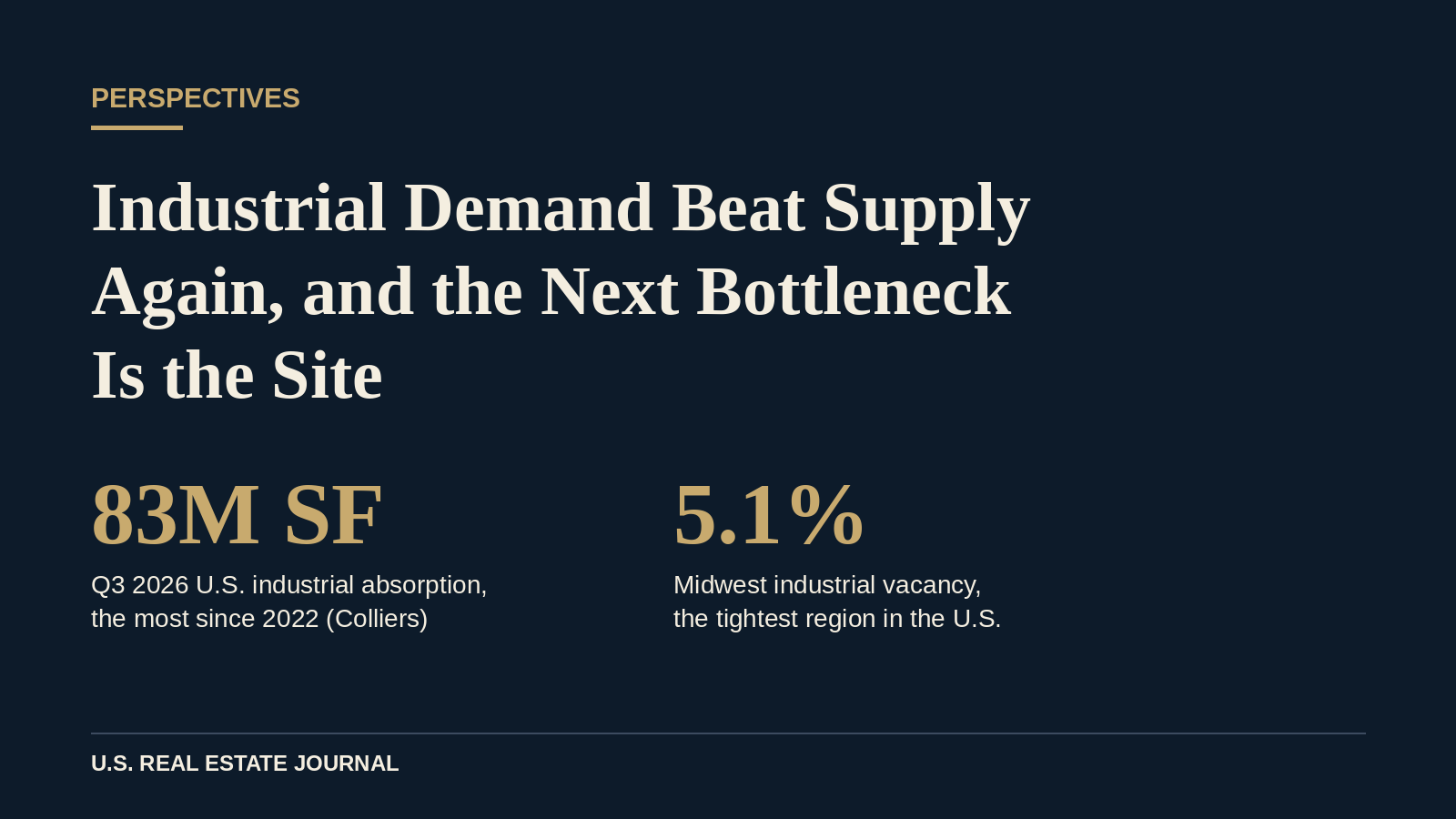

The industrial market has spent two years being described as overbuilt. The third quarter numbers say that story is aging fast. According to Colliers data reported by CRE Daily, U.S. tenants absorbed 83 million square feet of industrial space in the third quarter, the most since 2022, against 71 million square feet of new deliveries. It was the second straight quarter in which demand outran supply, and national vacancy slipped to 7.2%.
I read this less as a warehouse rebound and more as a land story. The construction pipeline Colliers tracks is 329 million square feet, up 19% from a year ago but still 54% below the 711 million square foot peak at the end of 2022. Developers stopped starting buildings when money got expensive. Tenants did not stop needing them. When those two decisions drift apart long enough, the scarce input is not steel or concrete. It is a site with the right zoning, enough utility capacity and a road that can carry trucks.
Where the demand actually went
The geography matters more than the national total. CRE Daily reports that Dallas Fort Worth absorbed 15.4 million square feet in the quarter, Chicago 8.8 million and Houston 8.3 million, and that the Midwest and South together took nearly 80% of national demand. The Midwest is now the tightest region at 5.1% vacancy, and Colliers saw vacancy fall in 34 of its 79 markets, led by Columbus, Indianapolis and Memphis.
That list is worth sitting with. Columbus, Indianapolis and Memphis are not glamour markets. They are logistics crossroads with cheaper land, deep labor pools and local governments that still know how to approve a building. This is the Southern Squeeze in industrial form, joined by the Midwest: demand moving toward the places where land, labor and approvals still pencil, and away from metros where every acre comes with a fight.
The other detail I would not skip is who the new tenants are. Colliers points to companies tied to data center construction, the makers of power, cooling and electrical equipment, as a growing source of demand. AI infrastructure is not only consuming land for the data halls themselves. It is pulling a supply chain of manufacturing, assembly and staging space behind it, and those suppliers want to be close to the work.
Who is positioned to win
The winners in the next stretch are owners who already control entitled, serviced land in the Midwest and South and can deliver a building before the pipeline refills. With deliveries well below the peak, modern existing stock in tight submarkets should hold occupancy. Warehouse and distribution asking rents averaged $10.43 per square foot, only slightly above a year earlier, according to the same Colliers figures. That tells me rent growth has not yet caught up with the tightening. The lag between occupancy and pricing is usually where the opportunity sits for an owner who builds to hold rather than to sell.
Smaller industrial also looks better positioned than the big box headlines suggest. Flex and light industrial buildings serve contractors, electricians and equipment suppliers, which are exactly the tenants a wave of data center construction creates. They need space near the job, not two hundred miles away, and that product has been built far less often than the giant distribution centers of the last cycle.
The scarce input in industrial is no longer the building. It is the powered, entitled site.
What could break
The absorption headline misses the rate environment. In a separate brief, CRE Daily reports that JPMorgan cut its fourth quarter forecast for capital markets revenue at the largest brokerages to flat from 10% growth, after the 10 year Treasury topped 5.3% in early October before sliding back to about 4.8%. MetLife says higher rates are prompting retrades on roughly half of deals under contract, and CRE Daily notes that more than 80% of traders tracked by CME FedWatch expect a quarter point Fed hike in December. Strong leasing does not help a developer whose construction loan reprices or whose buyer walks.
Second, the demand mix cuts both ways. If a handful of data center campuses slip, stall waiting on power or get cancelled, the equipment and staging tenants following them will feel it quickly. Colliers itself expects weaker metros to lag even as national vacancy trends lower through 2027. Over the past 12 months, deliveries of 261 million square feet only narrowly outran 255 million square feet of demand. That is a balanced market, not a starved one, and anyone underwriting a speculative building on runaway rent growth is reading balance as shortage.
Third, and the risk I think matters most, the 19% rise in space under construction means the restart has already begun. A developer who starts today on land that still needs rezoning, utility extensions and traffic studies may deliver into the next wave of supply rather than ahead of it. In industrial, as in housing, entitlement time is the real cost.
What we are watching next
First, whether fourth quarter absorption again beats deliveries, which would make three quarters in a row and turn a bounce into a trend. Second, rent growth in the Midwest markets where vacancy sits near 5%, because that is where pricing power should show up first. Third, utility interconnection timelines in the corridors where data center suppliers are clustering, since power, not zoning, may become the gating item for the next round of buildings. Fourth, the December Fed decision and the 10 year yield, which will decide how many of today's retraded deals close at all.
At Kaufman & Company we look at industrial the way we look at housing. The building is the easy part. The land, the power and the approvals decide who gets to build at all, and when. Data over emotion means treating one strong quarter as evidence, not proof, and watching the land pipeline as closely as the leasing numbers.
If you want to follow which metros are adding entitled land and where approvals are moving, the free watchlist at Land Briefing tracks exactly that.
Sources
- Industrial Absorption Hits 83M SF, the Strongest Quarter Since 2022, CRE Daily, November 11, 2026
- CRE Brokerages Cut Q4 Capital Markets Forecasts, CRE Daily, November 11, 2026