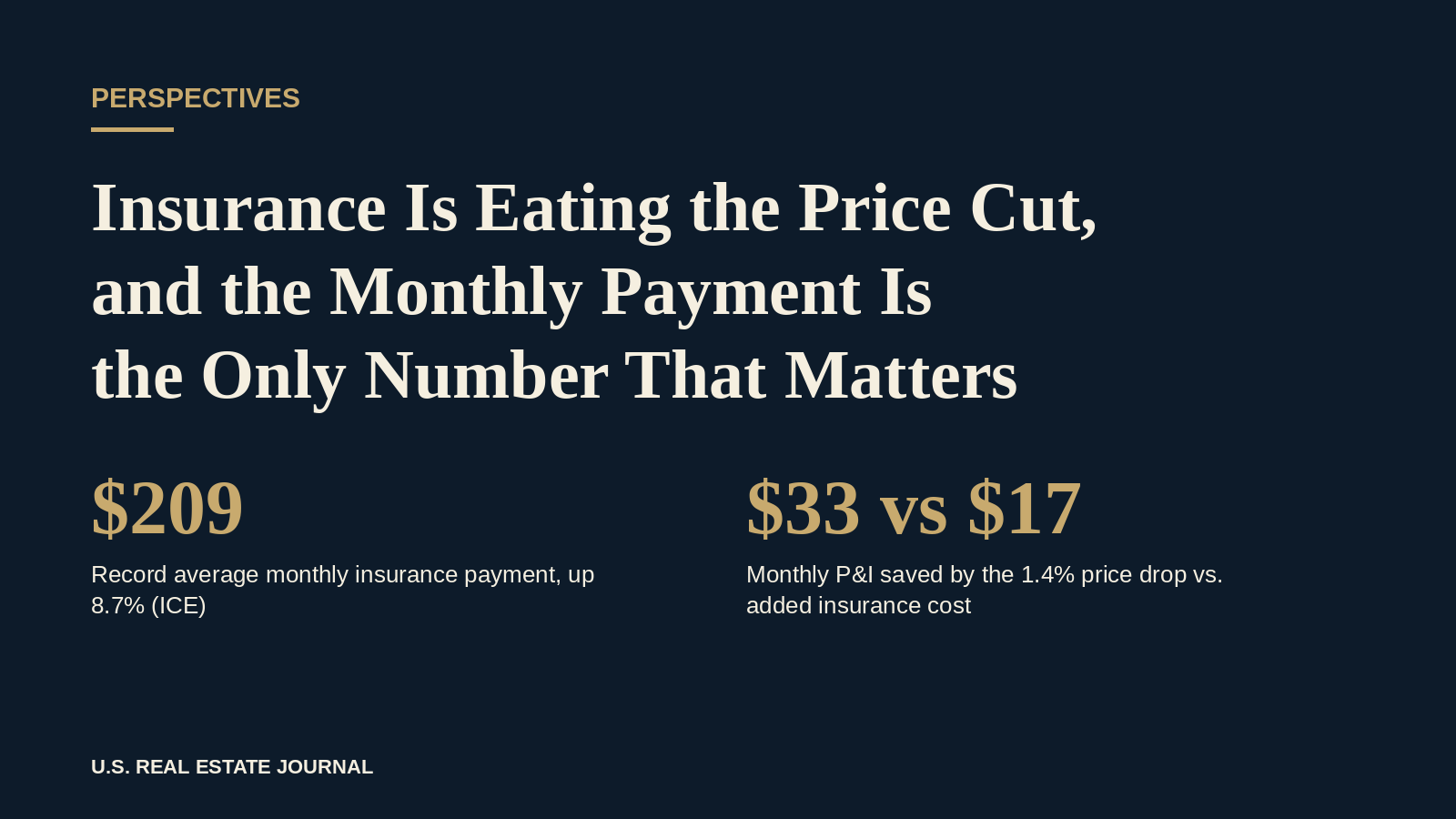

Realtor.com published a piece this week that every buyer, lender and builder should read twice. Its data shows the national median listing price fell 1.4% year over year in September to $419,250, the 11th straight month of annual declines, with the Northeast down 3.8%. That sounds like relief. Then the article lays out the other side of the ledger, citing ICE Mortgage Technology: the average single family mortgage holder now pays a record $209 a month for property insurance, up 8.7% from a year ago and nearly 80% since 2020, when the figure was $121.
The arithmetic in the piece is the part that stuck with me. On that $419,250 median, the year over year discount works out to about $6,000. With 20% down on a 30 year loan at 7.3%, that trims principal and interest by roughly $33 a month. Meanwhile the average insurance payment rose about $17 a month on ICE's latest measure. Half the price cut is gone before the buyer pays a dollar more in taxes or HOA dues.
Price is the land, insurance is the building
The most useful idea in the article comes from an insurance broker quoted there, and it is one we lean on in our own underwriting. A sale price reflects what buyers will pay for the whole property, including the land and the local demand for it. An insurance premium reflects what it costs to rebuild the structure and how likely the insurer is to have to do it. Those are two different things moving on two different clocks.
When a market softens, the land and the demand premium give up value first. Rebuild costs do not. Labor, lumber, roofing and code requirements set the replacement figure, and none of those have come down in any meaningful way. So a falling list price can coexist with a rising premium for years, and the two numbers say very little about each other.
That disconnect is why the national price decline overstates the improvement in affordability. Realtor.com senior economist Jiayi Xu makes the point directly in the piece: premiums follow climate risk and rebuild costs, so they do not fall in proportion to prices.
A price cut is a one time discount on the land. An insurance increase is a permanent raise in the cost of keeping the building.
The markets where the math flips
The national average hides the places where this gets ugly. Realtor.com pairs its own price data with ICE's insurance figures. In Minneapolis, the median list price fell 4.1% while the average insurance payment for mortgage holders rose 13.1%. Sacramento showed prices down 2.6% and insurance up 12.5%. San Diego had prices down 6.3% and insurance up 12.4%.
The article also cites Insurify, which estimates Minnesota premiums rose 12.9% in the first half of 2026 alone to an average of $3,987, the largest increase of any state, driven largely by hail and wind. In Hennepin County the average reached $4,545 after a 20.9% jump in six months. Nearly 1,900 counties saw increases over that period, more than 130 of them by double digits.
Florida is the instructive case. Statewide, Insurify puts the average premium at $8,486, the highest in the country, but the first half increase was a modest 2.3% as that market stabilized. Collier County, by contrast, jumped 25.3% to $10,052 in six months. State averages are almost useless for underwriting. The county, the roof and the flood map are the unit of analysis.
This is where the K shaped housing economy shows up in a monthly statement. Insurance is mostly a function of the structure, so it is a much bigger share of the payment on a modest home than on an expensive one. Realtor.com notes that its 2025 climate risk research found insurance weighs most heavily on lower value, high risk markets, naming Louisiana and Florida. That is the core of what we call the Southern Squeeze: the places that were supposed to be the affordable option are where carrying costs rise fastest relative to income.
Who is positioned, and who is exposed
The winners are the people who underwrite the full monthly payment rather than the purchase price. For builders, that means pricing new homes with the insurance advantage that modern codes, newer roofs and hail resistant materials can earn, and showing buyers a complete payment figure instead of leading with a rate buydown. For owners of single family rentals and small multifamily, it means treating insurance as a growing operating line, not a fixed assumption carried over from the last deal. Insurance has gone from 7.2% of the average mortgage payment in 2018 to 9.6% today, per ICE, and that drift belongs in every pro forma.
The exposed group is larger. Recent buyers who stretched to qualify have escrow accounts that reset every year. The Federal Reserve found that 14% of insured homeowners struggled to afford their premiums in 2025 and 20% wanted more coverage but could not afford it, according to the Realtor.com piece. That second figure worries me more. Underinsurance does not show up in any delinquency report until a storm turns it into a loss the owner cannot cover.
Rates are not coming to the rescue soon either. CRE Daily's market snapshot showed the 10 year Treasury at roughly 5% at the October 27 close, which keeps mortgage rates high enough that a modest price cut buys very little payment relief.
What we are watching
First, whether ICE's annual insurance growth, which peaked at 15.1% at the end of 2024, keeps cooling or picks back up after another storm season. Second, county level premium data in the Upper Midwest, where hail is turning historically inexpensive insurance markets into costly ones. Third, whether lenders and appraisers start reflecting insurance cost more directly in what they will lend against a property. Fourth, how much of the coming price softness lands in exactly the lower value, high risk places where insurance takes the biggest bite.
The practical takeaway is the one the broker in the article gives his clients: get the insurance quote before making the offer, not after. That is data over emotion in its simplest form. A list price tells you about the past. The monthly payment is the cost of the future.
If you are working through how insurance, carrying costs and shifting prices change a housing strategy, Kaufman & Company is where we think through those questions.
Sources
- Home Prices Are Falling in These Markets, but Rising Insurance Costs Are Eating Into the Savings, Realtor.com, October 28, 2026
- New York's Office to Apartment Conversions Restart After the Pfizer Scare (market snapshot), CRE Daily, October 28, 2026