
The White House signed an executive order this week that puts manufactured housing at the center of its affordability push, and I think the instinct is right. Factory built homes are the cheapest new housing product this country makes. But the order mostly works on the house itself and on the mortgage paperwork around it. The part of the cost stack that actually decides whether a manufactured home gets built, the lot and the permission to put something on it, is still a local problem, and no task force in Washington can sign it away.
What the Order Actually Does
As Realtor.com reported on October 22, the order creates a Task Force on Manufactured Housing Innovation, chaired by FHFA Director Bill Pulte and HUD Secretary Scott Turner, to recommend ways to modernize standards and speed approvals across government. It also directs FHFA to set up a Fannie Mae and Freddie Mac pilot that uses automated valuation models to cancel mortgage insurance once borrowers reach the required equity, expands automated title reviews in place of lender’s title policies on refinances, and waives appraisals and documentation for certain refinances.
Those are real savings for people who already own a home. They do much less for someone trying to get into one. The mortgage insurance and title provisions mostly help existing borrowers and refinancers, and with mortgage rates still near decade highs, as Realtor.com noted, refinancing is not where most households are. The manufactured housing piece is the part aimed at new supply, and for now it is a recommendation process, not a rule.
The Box Is Already Cheap
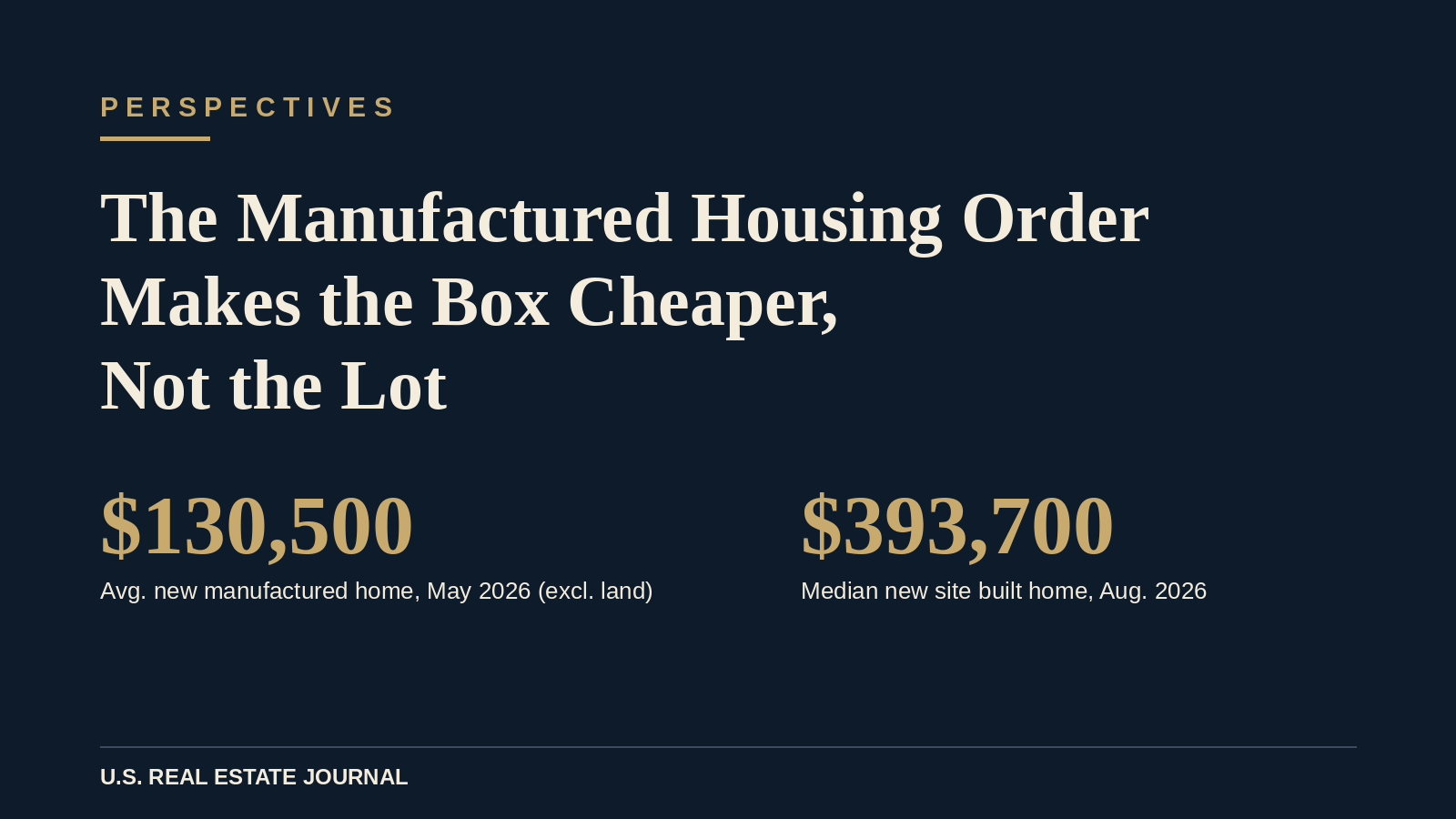
The economics of the factory product are not really in question. The Census Bureau’s Manufactured Housing Survey, published through the St. Louis Fed’s FRED database, put the average sales price of a new manufactured home at $130,500 in May 2026. The Census Bureau’s August new residential sales report put the median price of a new site built house at $393,700. Those two numbers are not apples to apples, because the manufactured figure excludes land and site work. That gap is exactly my point.
Congress has already done some of the heavy lifting on the structure. Realtor.com reported in September that the 21st Century Road to Housing Act removed the requirement that a manufactured home sit on a permanent chassis, a change housing advocates said can cut up to $10,000 per home, and one that opens the door to multistory product. A factory builder interviewed for that piece described a home assembled in about six months, against roughly 18 for a custom build, because site preparation and vertical work happen at the same time. Speed and cost on the structure are largely solved problems. What is left is everything that happens before the module arrives.
A cheaper box on an unentitled lot is still a box sitting in a factory yard.
Land and Entitlement Are the Real Bottleneck
When we look at a workforce housing site, the house is rarely the line item that kills the deal. It is the land basis, the infrastructure to serve it, and the time it takes to get a yes. The same Realtor.com reporting said it plainly: experts identified local zoning as the main barrier, with code differences from city to city making it hard to build one panel or module design that works across many jurisdictions. A factory only gets cheap when it can run the same product over and over. Fifty municipal codes means fifty products.
That is why the state level moves matter more to me than the federal ones. Virginia and North Carolina have legalized manufactured homes within single family zoning across much of each state, according to Realtor.com. That removes a discretionary hearing from the process, and in practice the discretionary hearing is where projects die. North Carolina sits squarely in what we call the Southern Squeeze, where job growth and in migration have outrun the supply of attainable lots, and by right placement of factory built homes on infill and small lots is one of the few tools that can move at the speed that market needs.
Who Is Positioned to Win
The winners here are not the people with the best press release. They are the operators who already control land in places that allow by right placement, or who can get water, sewer and roads to a site quickly. Owners of entitled small lots and infill parcels in states that have legalized the product gain real optionality. Employers who need workforce housing near a plant or a hospital and can contribute land are in a strong position, because employer anchored projects solve the land problem first and then let the factory solve the cost problem. Lenders could benefit too if the definitional reforms make it easier to finance manufactured homes titled as real property on conventional terms, since much of this product has historically been financed with personal property loans rather than mortgages.
What Could Break
There are real risks. An executive order is only as durable as its follow through, and this one leaves the substance to a task force whose recommendations do not exist yet. Timing it days before the midterms invites fair skepticism that it is more signal than structure. Automated valuations that cancel mortgage insurance early work well in a rising market; in a softening one, they can overstate equity right when the lender’s cushion matters most. The American Land Title Association has warned that cost cutting should not shift fraud risk onto families, and that concern deserves weight.
On the supply side, new factory capacity chasing a federal tailwind could run straight into the same local approval walls. If cities do not change their codes, factories will be built for demand that cannot get permitted. And the K shaped housing economy does not go away because a home costs less to build. Buyers at the bottom still need financing that works at today’s rates, on a lot they can actually afford.
What We Are Watching
At Kaufman & Company, we are watching three things: whether the task force’s recommendations reach the HUD code and chassis definitions in a way that makes multistory product financeable, whether more states follow Virginia and North Carolina with by right placement, and whether lot prices in those states start to reflect the new optionality. If the second and third happen, the federal piece matters. If they do not, the order will have made a cheap product slightly cheaper and left the expensive part untouched. The data, not the announcement, will tell us which.
If you are working through land, entitlement or construction questions on a factory built or workforce housing project, Kaufman Real Estate and Consulting is where we help owners and communities sort through them.
Sources
- Trump Launches Task Force on Manufactured Homes and Orders Affordability Reforms, Realtor.com, October 22, 2026
- Big Changes Could Be Coming for Manufactured Housing Under Trump Admin, Experts Say, Realtor.com, September 1, 2026
- Average Sales Price of New Manufactured Homes: Total Homes in the United States, U.S. Census Bureau via FRED, October 25, 2026
- Monthly New Residential Sales, August 2026, U.S. Census Bureau, September 24, 2026