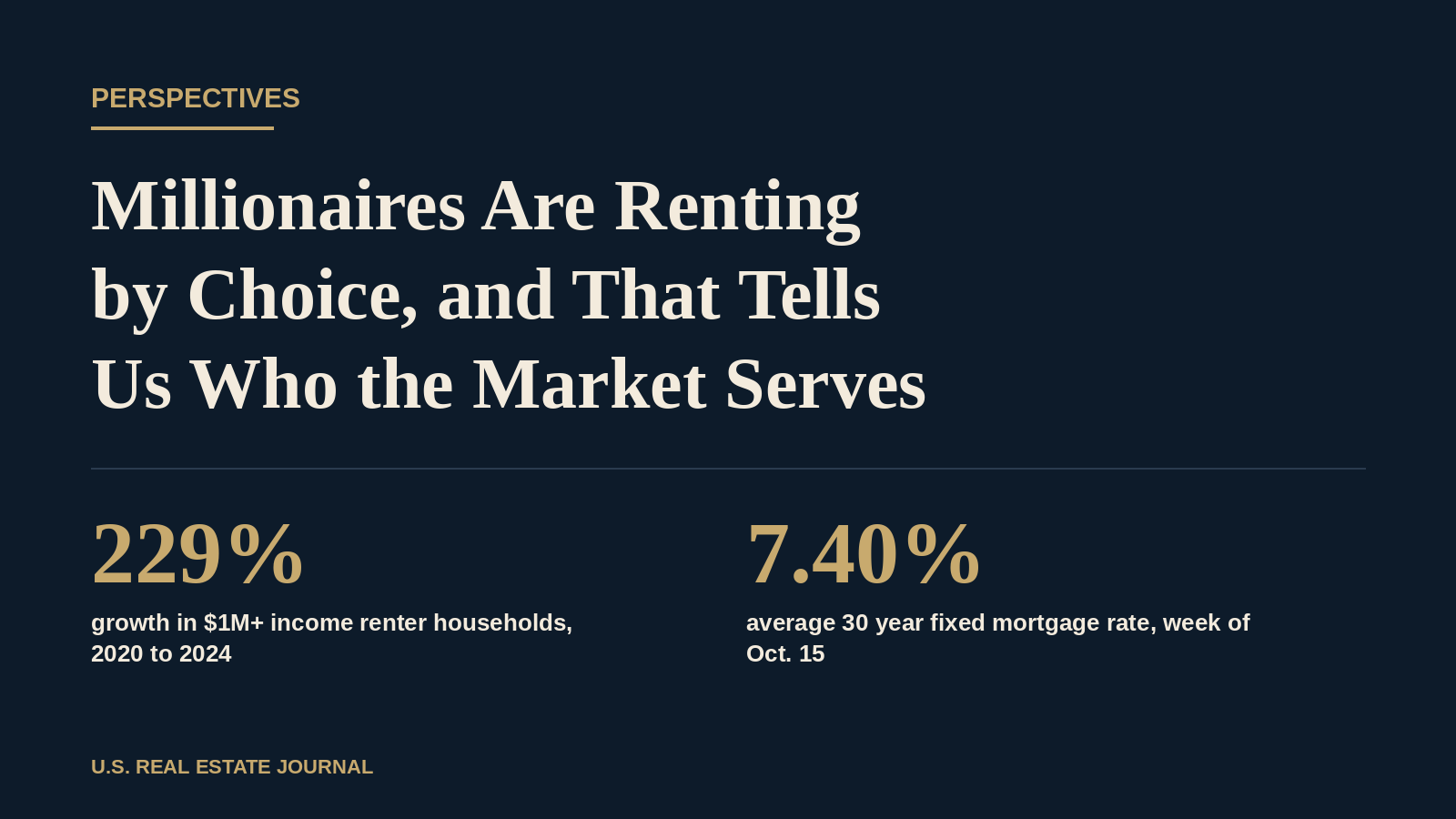

Realtor.com News ran a story this week that looks like a curiosity and reads to me like a map. Citing a new RentCafe analysis of Census Bureau data, it reported that U.S. households earning at least $1 million a year while renting their home rose 229% between 2020 and 2024, to roughly 18,400 households. Nearly half are Millennials, and the group is packed into a handful of coastal metros led by New York.
The number is small. The signal is not. When the households with the most purchasing power in the country treat ownership as optional, it tells you how the rent versus own trade is being priced at the top of the market.
What the Data Says, and What It Does Not
I want to be careful, because headlines like this get stretched. Realtor.com senior economist Hannah Jones laid out the caveats herself. Part of the growth is a base effect, since renters started from a tiny count. The $1 million line is nominal, so inflation pushes more households across it every year. And millionaire homeowners grew too, up 193% over the same window. In absolute terms, Realtor.com reported, renters added about 12,800 households while millionaire owners added roughly 125,000. The renter share of million dollar households moved from about 8% to just under 9%.
So this is not the wealthy abandoning ownership. It is a rising minority at the top choosing to keep capital liquid and addresses flexible.
Why Renting Wins at the Top
The logic gets simple once you look at where these renters live. Realtor.com reported that roughly 74% of millionaire renter households sit in eight metros, with New York alone holding about four in ten. These are markets with very high price to rent ratios, deep luxury rental stock, and jobs that move. San Francisco went from 499 such households in 2020 to 1,863 in 2024, and San Jose from 284 to 895, while Realtor.com data showed September asking rents up 6% year over year in San Jose and 4.8% in San Francisco as AI hiring pulls workers into the Bay Area.
Then layer in the cost of money. Realtor.com, citing Freddie Mac, reported the 30 year fixed rate holding at 7.40% for the week ending October 15, against 6.27% a year earlier, with September CPI running at 3.7%. At those levels, parking seven figures of equity in a coastal condo carries a real opportunity cost, even for a household that can write the check. Renting a top tier unit keeps that capital working and keeps the option to move when the next job, or the next tech hub, shows up somewhere else.
When the households with the most choice decide ownership is optional, the rent versus own math has quietly flipped at the top of the market.
The K-Shaped Housing Economy, From Both Ends
We wrote recently in these pages about the other leg of the K, where middle income renters keep losing ground. This story is the upper leg, and the two are connected. Realtor.com reported, citing Moody's data via Fannie Mae, that about 86.3% of apartments completed in the first quarter of 2024 were Class A. The last supply wave was built for the top of the income ladder, and the top of the income ladder is now showing up to rent it.
CRE Daily's coverage of a new Hines retail outlook points the same way from a different sector. Hines found that wages have mostly kept pace with prices, but wealth gains are concentrated among higher income households, and it argues that retail near affluent shoppers should prove more resilient. Capital is following the income, in apartments and in shopping centers alike.
Where We See Opportunity
First, well located luxury rental in high cost job centers has a deeper tenant pool than the old renter by necessity models assumed. Owners who deliver service, amenities, and flexible terms to executives and relocating professionals are competing for a customer who has alternatives and will pay for convenience.
Second, the relocation bridge. Realtor.com passed along RentCafe's observation that affluent newcomers in Houston often rent first and decide later whether to buy. That supports furnished, high finish, shorter commitment product in growth metros, and build to rent communities aimed at upper income households testing a new city before they commit.
Third, timing. CRE Daily reported that national apartment deliveries are projected to fall from 696,000 units in 2024 to 421,000 in 2026, with another steep decline expected in 2027. Less new Class A supply arriving just as a sticky, high income renter cohort grows is a constructive setup for the best assets in the right submarkets.
Where It Breaks Down
Scale is the first problem. Even in Miami, the count rose from 51 to 538 households. That is a lease up story for a few towers, not a reason to rewrite a regional thesis.
Supply is the second. Realtor.com reported that luxury apartments under construction equal 4.6% of existing inventory in San Jose and 6% in Miami, compared with a 1.8% average across cities CoStar tracks. That is a lot of developers chasing the same narrow tenant. If AI hiring cools, or the recent selloff in tech stocks that Realtor.com noted deepens, the top of the K feels it fast, because so much high earner income is tied to equity markets.
The third problem is what this mix of supply leaves out. Every Class A unit that leases to a household earning seven figures is a reminder that the middle still has nothing new to rent at a price it can carry. That gap is where employer anchored workforce housing belongs, and it is where land and entitlement, not demand, remain the binding constraint.
What We Are Watching
I am watching whether the next Census release shows this trend holding once you adjust for inflation, how quickly the luxury pipelines in San Jose and Miami lease up, and what happens to these renters if mortgage rates come down meaningfully. A real drop in rates could turn some of this cohort into buyers and loosen the top of the for sale market. Until then, the data says the best financed households in America are renting by choice, and the households in the middle are renting because they have no choice. Underwrite both legs of that K honestly, and do not confuse one for the other.
If you are working out where your next project fits in a market that is splitting by income, the broader strategy work we do across our platform is laid out at Kaufman & Company.
Sources
- A Generation of Young Millionaires Is Choosing Rent Over Ownership, Realtor.com News, October 16, 2026
- Mortgage Rates Hold Steady at 3-Year High as Bond Market Stabilizes, Realtor.com News, October 15, 2026
- Hines Says Retail Recovery Is an Income and Scarcity Call, CRE Daily, October 16, 2026
- Sun Belt Apartment Recovery Turns Sharply Uneven, CRE Daily, October 14, 2026