
For five years, North Texas land only went one direction. That run is ending. At Bisnow’s Texas Residential Summit, as CRE Daily reported on November 13, Rex Real Estate owner Rex Glendenning said asking prices and buyer bids have drifted so far apart that the market needs roughly 18 months to rebalance. He also said something I think matters more: developers have overbuilt lots before, and they did it again.
I read that as the most useful land signal out of Texas this year. Not because prices are collapsing, because they are not, but because the gap between what sellers want and what the math supports is now wide enough to stop deals. When trades stop, the people who set the next price are the ones who do not need a trade.
What the numbers actually say
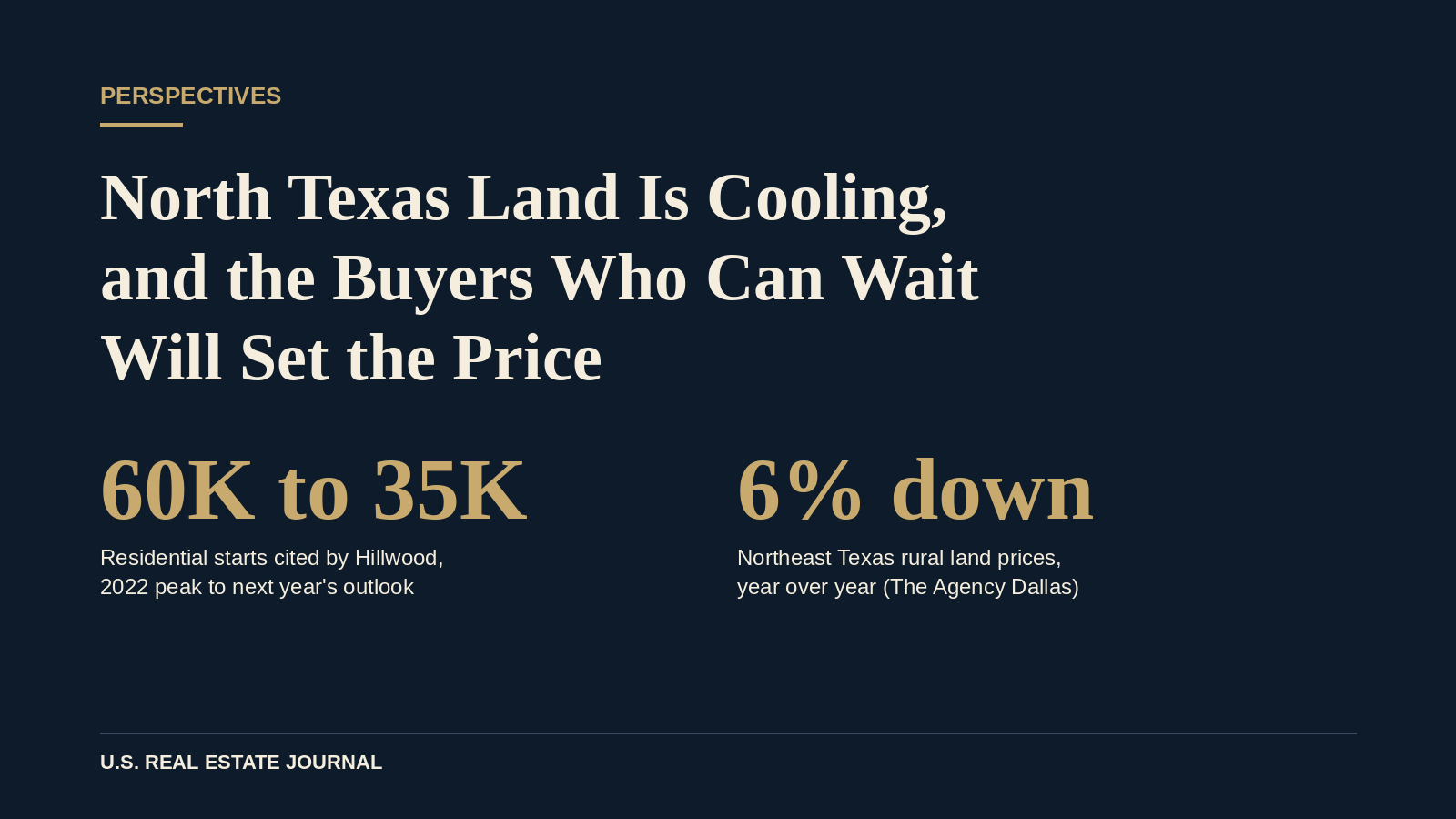
The price picture is split, not broken. The Agency Dallas fall land price report, cited in the same CRE Daily brief, shows Northeast Texas farmland and rural parcels down almost 6% year over year, while West Texas gained more than 14% and statewide prices rose more than 3%. That is a regional rotation, with the rural ring northeast of Dallas giving back gains as the fringe stops absorbing new subdivisions at the old pace.
The demand side explains why. The residential starts figures Hillwood Communities President Fred Balda shared at the summit peaked at 60,000 in 2022, are tracking toward about 38,000 this year and should land around 35,000 next year, a level he compared to 2019. That is not a crash. It is a return to a normal year after a land market that priced acreage as if the peak would last.
Put those together and the problem is plain. Raw land was underwritten against lot absorption that no longer exists, and lot pipelines planned for a 60,000 start market now have to clear in a 35,000 start market. Somebody is holding the difference.
Who is positioned, and who is exposed
The developers on stage are already adjusting. Centurion American President Mehrdad Moayedi called the downturn a chance to pursue projects that used to cost too much, with work in Gunter, Anna, Denison and Fort Worth. Craig International CEO David Craig pointed to flexibility, mixed use and master planned communities, including the $6 billion Preston Harbor development in Denison. Glendenning suggested landowners carry a two to three year note at 5% or less to bridge the gap while banks tighten.
Seller financing will close some deals, but notice what it signals. Conventional land lending has pulled back, and sellers are being asked to fund the buyer’s patience. Owners who bought acreage near peak prices with short term debt, and builders sitting on lots financed for a faster pace, are the exposed ones. They cannot comfortably wait 18 months for a market that may need longer.
The ones positioned to win are buyers using their own capital, with a long holding horizon and the ability to entitle land themselves. That is how we run Kaufman & Company. We buy land, fund it ourselves, entitle it, build and hold. For an owner built that way, a cooling market is not a threat. It is the first time in five years that land is priced closer to what it can actually support.
When trades stop, the people who set the next price are the ones who do not need a trade.
The zoning map matters as much as the price
The second North Texas story this week is easier to miss. Dallas released the first draft of its first major zoning overhaul in more than 40 years, a 400 page document now open for public comment, CRE Daily reported, citing The Real Deal. The draft aims to allow smaller homes on smaller lots and keep more residents near mixed use hubs. A second draft is due in the spring, and a council vote could come as early as August 2027.
That timeline lines up almost exactly with Glendenning’s 18 month window. If the rewrite survives, infill sites inside the city that do not pencil under today’s rules could start to compete with fringe acreage on cost per home. That is the Southern Squeeze in practice: growth pushed to the edge because the rules made the closer in lot too expensive, and a city that may finally let the smaller, cheaper home get built where the jobs and services already are.
The risks are real. Council members agree on the need for denser duplexes but split on where they belong, with some drawing the line at historic single family neighborhoods. Residents are also raising data centers near homes, designs that clash with older blocks and affordability. Any of those fights can carve the most valuable sites out of the final map. A draft is not an entitlement, and I would not price land on a draft.
What we are watching next
First, whether the bid and ask close through price or through terms. If sellers accept lower prices, the market resets quickly. If the gap closes mostly through seller notes, the reset is deferred and 18 months becomes longer. Second, lot inventory against the roughly 35,000 start pace Balda described, because that is where stress would show up first. Third, the regional split, since West Texas gains against Northeast Texas declines will tell us whether this is a Dallas fringe correction or something wider. Fourth, the spring zoning draft, and specifically whether smaller lot rules survive in the neighborhoods where land is most valuable.
Data over emotion. Population growth and corporate relocations still support North Texas demand, according to the Bisnow coverage CRE Daily cited, so this is not a story about the region failing. It is a story about land that was priced for a pace that has passed, and a city rewriting the rules for where the next homes go. The owners who underwrite the real absorption rate, and can wait, will set the terms of the next cycle.
If you are weighing a North Texas site through this reset, our Site and Feasibility Review at Kaufman Real Estate and Consulting tests the land, the entitlement path and the absorption math before you commit.
Sources
- DFW Land Market Faces Cooldown After Five-Year Boom, CRE Daily, November 13, 2026
- Dallas Zoning Overhaul Draft Would Allow Smaller Lots, CRE Daily, November 13, 2026