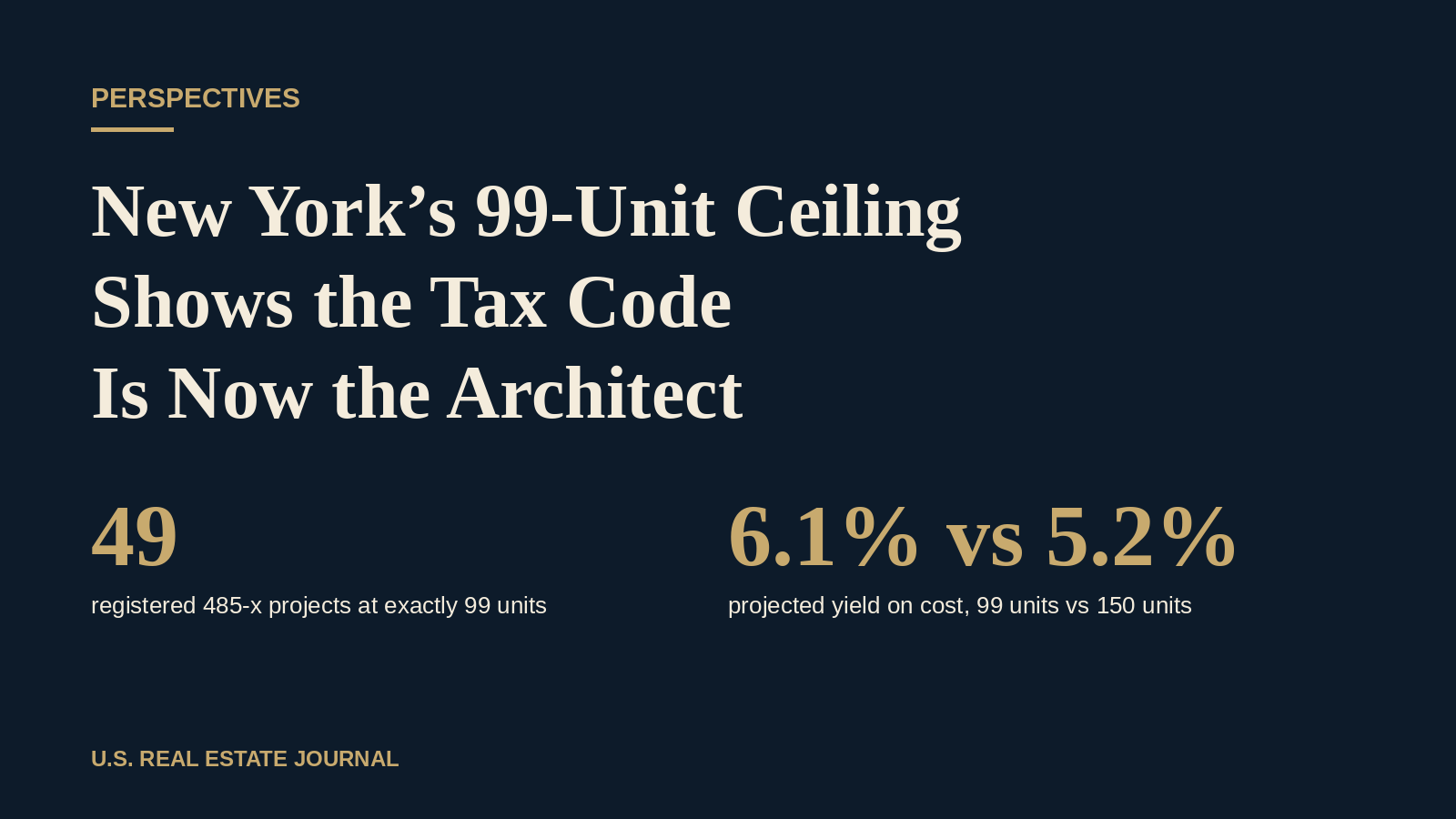

Every so often a single data release tells you more about a housing program than a year of hearings. CRE Daily reported on October 19 that New York City’s latest batch of 485-x registrations, analyzed by Nate Bliss of Latent Urban Ventures and first reported by The Real Deal, added 152 projects. Twenty of them have exactly 99 units. Only one is larger. Across the April and October releases, 49 registered projects sit at exactly 99 units, while just four exceed that size.
That is not a design fad. It is a price signal. When the rules change at 100 units, developers build 99, and the city gets the building its incentive structure paid for rather than the building its land could hold.
Why 99 Is the Rational Number
485-x is New York’s property tax exemption for new rental housing, offered in exchange for income restricted apartments. HousingWire notes the Legislature enacted it in the April 2024 state budget, almost two years after 421-a expired. The exemption is valuable, and the strings tighten as projects grow. According to HousingWire, construction workers on larger projects must be paid at least $40 an hour, rising 2.5% a year in certain zones, and the required affordable share rises from 20% to 25% at 100 units. CRE Daily adds that obligations step up again at 150 units.
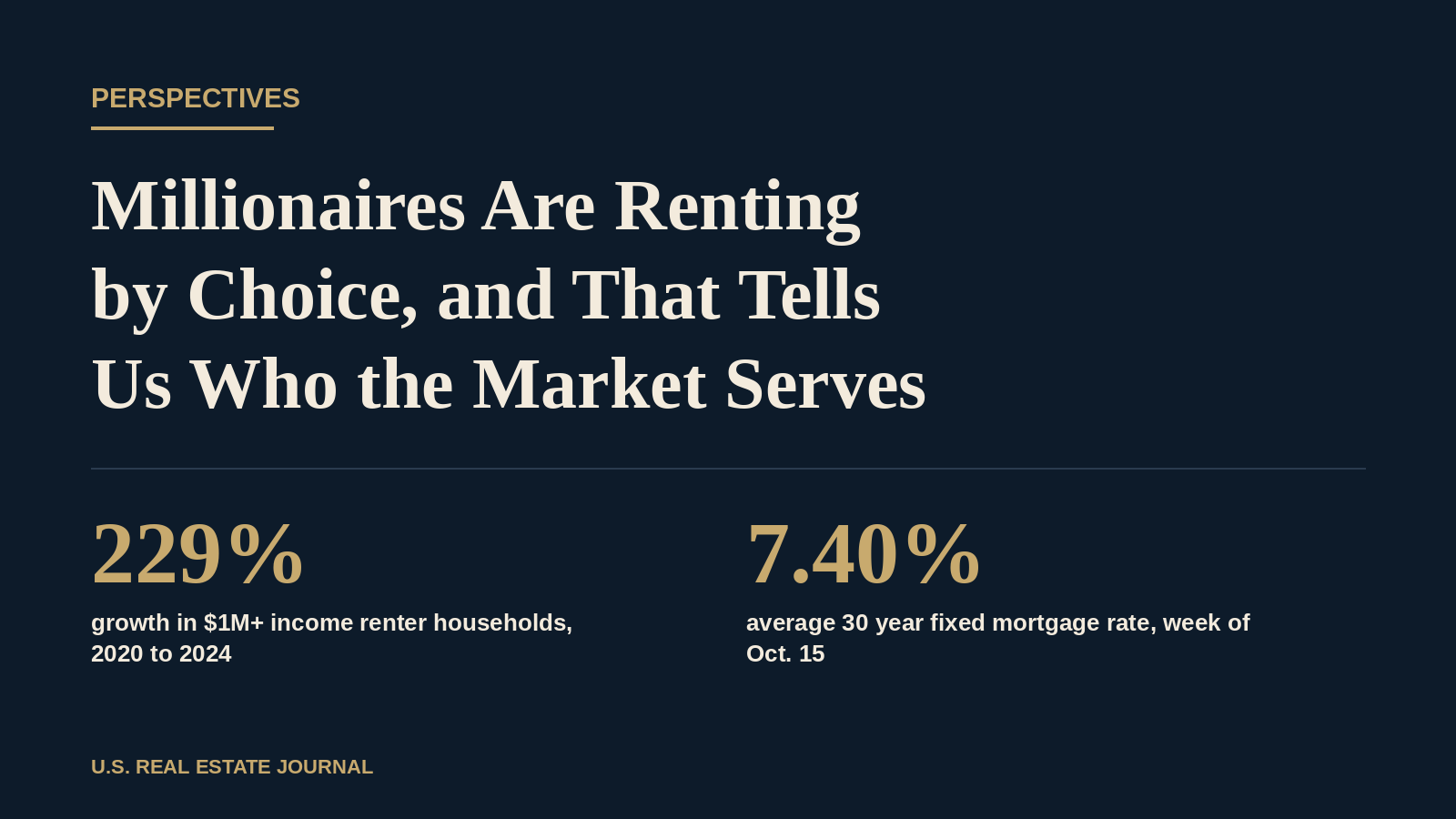
The underwriting gap is not subtle. CRE Daily cites a slide from Helen Hwang of Meridian Investment Sales projecting a 6.1% yield on cost for a 99-unit deal versus 5.2% at 150 units. CRE Daily’s market snapshot had the 10-year Treasury closing at about 5.09% on October 16, and Realtor.com reported that Freddie Mac’s average 30-year mortgage rate held at 7.4%, a three-year high. A 5.2% yield on cost barely clears a risk free bond. A 6.1% yield on cost is at least a project you can take to a lender.
Then there is the tail risk. CRE Daily reports that developers fear a failed audit above 99 units could cost them the entire abatement.
What the Headline Count Misses
The obvious read is that developers are gaming the program. I think that misses the lesson: the program is working exactly as written, and it was not written to produce large buildings.
The costs show up in places a unit count does not capture. CRE Daily reports that roughly a dozen developers are grouping 99-unit buildings on a single site, including one filing that lists 10 neighboring towers each just under 100 units. A Gothamist analysis cited by HousingWire found 48 such clusters with 538 fewer affordable apartments than larger buildings would have required, a 21% shortfall. YuhTyng Patka of Adler & Stachenfeld put it bluntly in CRE Daily’s account: “485x rewards inefficiency.” Every extra building means another lobby, another elevator core, another set of stairs, all eating floor area that could have been homes.
Scale matters here. CRE Daily notes that under 421-a, buildings with 100 or more units delivered 56% of new homes from 2010 to 2020. A city that loses its large building pipeline is not just losing a few towers. It is losing the format that produced most of its supply.
When the rules change at 100 units, developers build 99, and the city gets the building its incentives paid for.
Data over emotion cuts both ways, though. Latent itself cautions, per HousingWire, that its numbers cannot separate the program’s effect from interest rates, construction costs and rents. HousingWire also reports a pipeline of larger unregistered projects, including six that began construction this summer with registration deadlines running as late as February 19, 2027. The final count may look less lopsided than the headline. I would still bet the pattern holds.
Where I See Opportunity
The first opportunity is in land pricing. If the binding constraint on a New York rental site is a 99-unit program ceiling, then the land is worth what 99 units can earn, not what the maximum zoning envelope implies. Sellers anchored to as of right maximum density are pricing a building almost nobody will build under current rules. Buyers who underwrite to the program rather than the zoning map have an edge in negotiation, and they are less likely to overpay for density they cannot use.
The second is geographic. Of the 152 new registrations, CRE Daily counts 67 in the Bronx, 51 in Brooklyn, 28 in Queens and just 6 in Manhattan. Mid size sites in the outer boroughs that naturally fit 70 to 99 units are where this program pencils. That is where design teams, contractors and lenders who can execute a repeatable mid size rental building efficiently will find steady work.
The third is a lesson for every other city writing inclusionary or wage thresholds. A cliff produces bunching. A graduated phase in, where obligations rise gradually with unit count, would let the land decide the size of the building. New York is now the clearest case study in the country for why that matters.
What Could Break
Policy is the biggest risk. CRE Daily reports that this was the last data release before Albany lawmakers return in January, when they could amend 485-x or create a separate program for large projects. The Building and Construction Trades Council has urged lawmakers to close the clustering loophole, though The Real Deal reports, per CRE Daily, that such a change looks unlikely. HousingWire reports the city administration has said publicly it is not advocating changes. Anyone carrying a clustered site plan should still model the case where the rules tighten before registration.
Rates are the second risk. Realtor.com reported that the NAHB/Wells Fargo Housing Market Index fell to 29 in October, the lowest reading since June 2012, with builders citing mortgage rates well above 7% and higher construction loan costs. A 6.1% yield on cost looks thin if exit cap rates keep drifting up with Treasury yields. The 99-unit structure solves a program problem. It does not solve a capital markets problem.
What We Are Watching Next
We are watching three things: whether City Hall backs changes before the January session, whether the larger projects in the pipeline actually register by their deadlines, and whether outer borough land comps start converging on 99-unit economics rather than maximum density. If land prices adjust, the program’s ceiling becomes permanent in the market long before anyone in Albany votes on it.
If you track how entitlement rules and incentives shape land value across metros, the free watchlist and research at Land Briefing are built around that question.
Sources
- 485x Data Shows Developers Still Cap Projects at 99 Units, CRE Daily, October 19, 2026
- City data dump shows 99-unit project trend is unrelenting, The Real Deal, October 15, 2026
- New York 485-x filings cluster at 99 units to avoid wage rule, HousingWire, October 15, 2026
- One in Four Maturing Multifamily Loans Now Fall Short at Refinancing, CRE Daily, October 19, 2026
- Homebuilder Confidence Plunges to 14-Year Low as Mortgage Rates Soar, Realtor.com, October 19, 2026