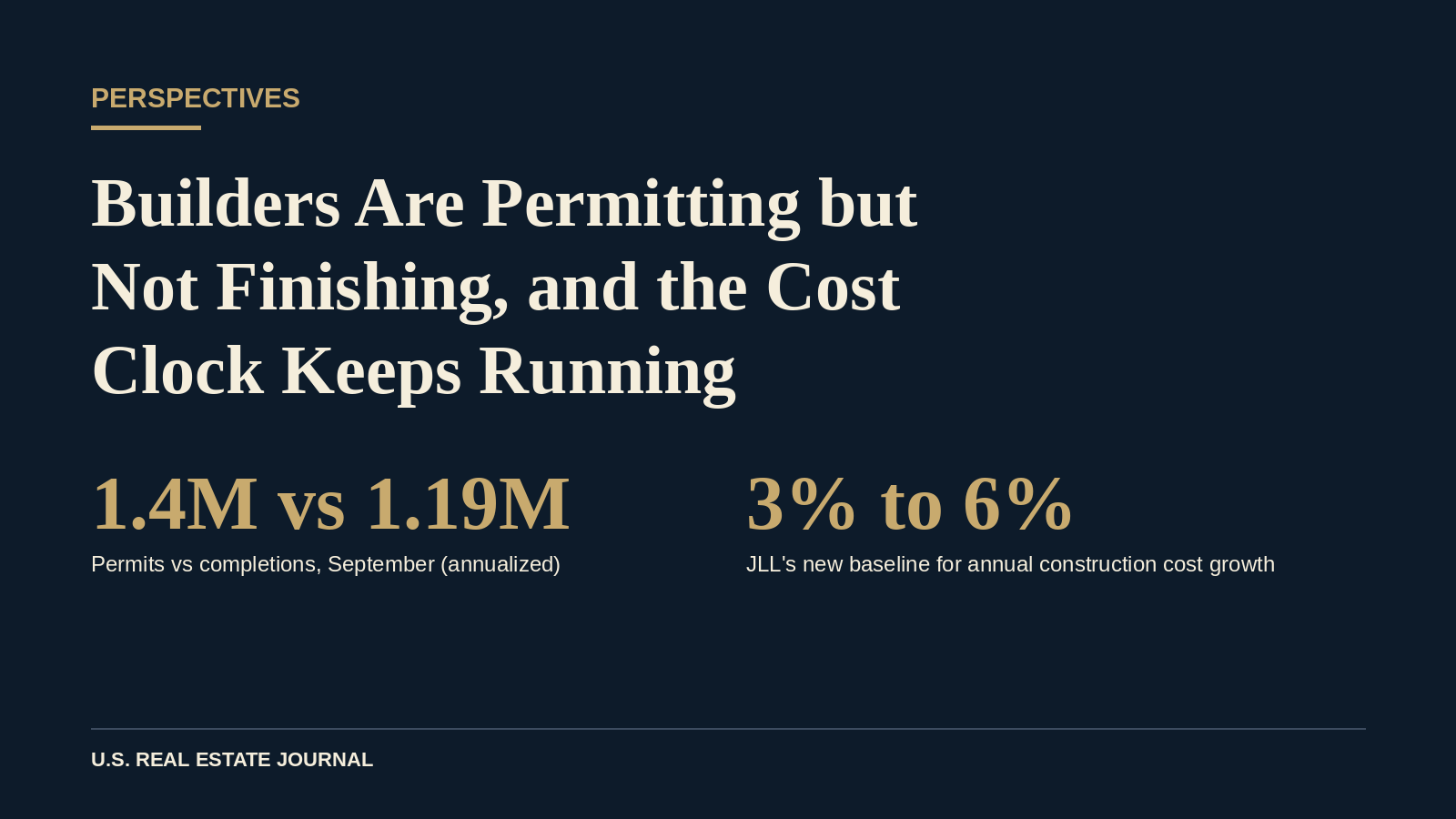

The Census Bureau’s September construction report, as covered by Realtor.com on October 20, reads like a market holding its breath. Builders kept the permit pipeline nearly flat at an annualized 1.4 million units, but total housing starts fell 5.2% from August to 1.22 million, and completions dropped 14% from a year earlier. Realtor.com spells out the gap: 1.4 million permits against 1.19 million completions. Projects are approved, and in many cases started, but they are not being finished at the pace the paperwork implies.
The usual read is that builders are waiting out 7% mortgage rates. Freddie Mac had the 30-year fixed at 7.4% last week, and the NAHB/Wells Fargo builder sentiment index just fell to a 14-year low, both cited in the same Realtor.com piece. Realtor.com economist Joel Berner said the market “is not conducive to building right now,” while noting that steady permitting suggests builders see these conditions as temporary. I think that second point deserves more scrutiny than it is getting, because the cost side of the equation is not temporary at all.
The Cost Baseline Has Moved, and It Is Not Moving Back
The same day, CRE Daily reported on JLL’s 2026 Global Construction Costs Index, and its central finding should change how every developer thinks about delay. JLL now treats annual construction cost growth of 3% to 6% as the baseline, compared with 2% to 3% before 2020. Its North America forecast for 2027 is 3.2% to 4.2%, driven by materials, trade policy and labor. Costs are already 25% to 30% higher worldwide than five years ago, and as much as 40% higher in some markets.
Labor is the piece I watch most closely. According to the JLL figures reported by CRE Daily, construction pay is up 8% to 35% since 2020, and 64% of markets report shortages of skilled workers. Electricians and carpenters are short in 64% of markets, plumbers and HVAC technicians in 58%. Those are the same trades data centers and advanced manufacturing plants are bidding for, and a 300-unit garden apartment deal does not win that bidding war.
Put the two reports together and the strategy of waiting has a price. A builder sitting on permitted lots for a year in hopes of better rates is likely to face hard costs several points higher when the shovels finally move, plus another year of land carry and interest. If rates fall meaningfully, that may cover it. If the 10-year Treasury stays near the 5.1% CRE Daily’s market snapshot showed at Tuesday’s close, the wait simply makes the deal worse.
Waiting for rates is a bet, and rising hard costs are the premium you pay to place it.
Where the Pipeline Is Still Moving
The national number hides a regional split. Realtor.com reports that starts in the South rose 6.1% from August and 11% from a year earlier, while softness elsewhere dragged the total down. This is the Southern Squeeze in real time. The region with the most land, the fastest approvals and the strongest job growth keeps building, which keeps rents and new home prices in check there, while other regions fall further behind on supply they will need later.
The product mix is shifting too. Permits for buildings with five or more units rose 5.9% month over month, even as multifamily starts fell 25.9% from a year ago. Berner tied that to margins, noting that larger projects pencil better when materials and labor are expensive. I read it a little differently. A multifamily permit is an option on future supply. Owners file while land and approvals are available, then decide later whether to break ground. With national asking rents down for 38 straight months, per Realtor.com, many of those options will expire unexercised unless rents firm.
Who Is Positioned, and Who Is Exposed
The winners in this environment are not the developers with the most permits. They are the ones with locked costs and patient capital. JLL’s advice, as CRE Daily summarized it, is to fix pricing on structure and MEP work, retest any pro forma written before 2024 against current benchmarks, and pull priority projects forward before the 2027 increases arrive. That is sound. A builder who locks framing and mechanical contracts now, on land already owned, is buying certainty that will look cheap a year from now.
Production builders with in-house mortgage arms also have an edge. Realtor.com notes that new home buyers can pay as much as a full percentage point less on their mortgage thanks to builder rate offers, and that the median new home sells for less than the median existing home. That is a real advantage over resale inventory, but it is paid for out of margin, and the margin shrinks every quarter costs climb.
The exposed group is anyone holding entitled land with a land or construction loan maturing into this cost curve: merchant builders with thin equity, smaller apartment sponsors whose budgets assumed the old 2% to 3% escalation, and workforce housing deals where rents are capped but costs are not. The workforce segment concerns me most. When rents are tied to area median income and hard costs rise 4% a year, the gap has to be filled by subsidy, a land contribution or an employer partner, and if none shows up the project quietly stays a permit.
What the Headline Misses
A 14% annual drop in completions will not show up in rent or price data for another year or two. Today’s soft asking rents reflect deliveries from deals started when money was cheap. The next supply gap is already baked in, and when it arrives, the markets that kept building, mostly in the South, will absorb demand that slower regions failed to house. The bottleneck is not only rates. It is land, entitlement and a skilled labor pool shared with every data center on the map.
What We Are Watching Next
We are watching three things: whether the gap between permits and completions keeps widening in the October and November data, whether builders start locking structure and MEP pricing further out as JLL suggests, and whether the South’s share of starts keeps growing as other regions pull back. If permits hold while completions keep falling, the 2028 supply picture is tighter than most models assume.
If you are weighing whether to build now, hold, or reposition an entitled site, our development and construction advisory work at Kaufman Real Estate and Consulting starts with exactly that math.
Sources
- Home Construction Drops as Builders Confront Higher Mortgage Rates, Realtor.com, October 20, 2026
- JLL Says Construction Costs Will Keep Climbing 3% to 6% a Year Through 2027, CRE Daily, October 20, 2026
- Blackstone’s $1.3B Apartment CMBS Loan Hits Special Servicing, CRE Daily, October 21, 2026