
Two announcements landed on Realtor.com News this week that, read side by side, sketch the industry's current theory of how to fix the housing shortage. I think both are useful, and I think both will disappoint anyone expecting them to move entry level prices on their own, because neither touches the input that kills most of the deals we look at: land that can actually be built on at a price the finished home can carry.
What Happened
Realtor.com reported that Bloomberg Philanthropies and the nonprofit Accelerator for America will put $450,000 to $750,000 into each of 30 cities to speed up housing permitting and approvals. Each city gets help in one of three lanes: technology to move approvals faster, preapproved "permit ready" plans developed with architects, or a strike force to unstick stalled projects. The first 15 winners include Charleston, Chattanooga, Columbia, Durham, Louisville, Miami, Nashville, Omaha, Pittsburgh, and San Jose, and the backers expect results within two years.
The same day, Realtor.com reported that D.R. Horton, which built about 85,000 homes last year, signed a multiyear deal with Promise Robotics to produce more than 1,250 homes using an AI driven "factory as a service" platform. Horton gets factory output without paying for a factory. Promise's robots produce components such as stairs, doors, and window frames before assembly on site, with plumbing and HVAC pieces now added.
Why the Permit Money Matters More Than the Check Size
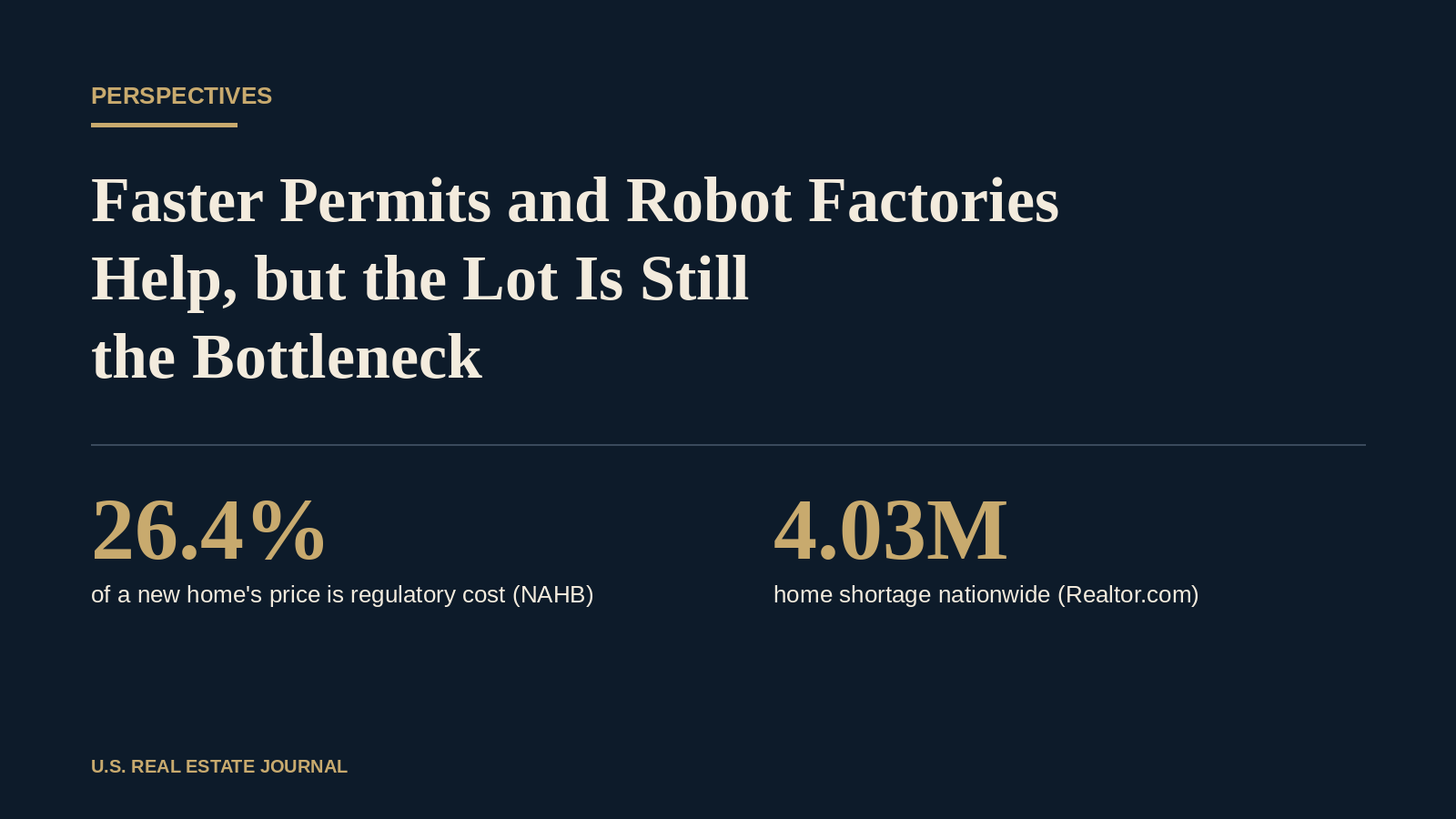
A few hundred thousand dollars per city is small money against the problem. Realtor.com's own supply gap work puts the national shortage at 4.03 million homes this year. What matters is where the money is aimed. The same Realtor.com piece cited a National Association of Home Builders study finding that regulatory costs have climbed almost 40% in five years and now make up 26.4% of the average new home's sales price. Much of that is fees and code, not delay, but time is the piece a city can fix without a council fight.
Time is also the piece that compounds at today's rates. Freddie Mac had the 30 year fixed mortgage at 7.40% this week, a three year high, according to Realtor.com, and construction and land carry run well above that. Every month a project sits in review is a month of interest on dirt that produces nothing. A preapproved plan set for a duplex or a small cottage court turns an infill lot from a custom entitlement exercise into something closer to a product. That is how small builders without an in-house land team get back into the game.
Why the Factory Deal Is Real but Narrow
I am more measured on the robotics headline, not because the technology is unserious but because of what it solves. Realtor.com noted that Horton's 2025 annual report blamed slow construction times, material shortages, supply chain disruption, and tight labor for squeezing margins. Factory produced components go straight at cycle time and labor.
But 1,250 homes is roughly 1.5% of one year of Horton's output. This is a pilot, and the reporting is candid that questions remain about how it scales and at what cost. Promise says its process will keep home prices at current market rates, which tells you the savings, if they show up, accrue to the builder's margin and schedule rather than to the buyer's price. That is not a criticism, since margin keeps builders starting homes in a market where Realtor.com found price cuts at a four year high in September.
A faster permit and a faster factory both shorten the clock. Neither one lowers what you paid for the dirt.
What Both Stories Miss
Here is where the narrative breaks down. Neither initiative changes what is allowed on a parcel or what the parcel costs. A city can process applications twice as fast and still allow only one house per half acre lot. A builder can cut weeks off vertical construction and still be buying finished lots that were priced for a cheaper money world. Land and entitlement remain the real bottleneck, and the permit counter is only the last step of entitlement, not the whole of it.
It is worth noticing which cities made the first list. Charleston, Columbia, Nashville, Chattanooga, Durham, and Miami sit squarely in what we call the Southern Squeeze, Sun Belt metros where incomes have not kept pace with what housing now costs to build and finance. Faster approvals help there, but the price pressure in those markets is mostly about land values that ran ahead of wages. Process reform without by right density just moves the queue faster toward the same expensive outcome.
There is also a K shaped problem underneath. Realtor.com's weekly data showed the median asking price at $415,000, down 2.3% from a year ago, while new listings fell 5.1%. Prices are softening, but the first time buyer is still priced out by the monthly payment, not the sticker. The bottom of the ladder needs smaller lots, smaller homes, and employer anchored land deals, and those are land problems before they are construction problems.
Where We See Opportunity, and Who Is Exposed
The likely winners are specific. Small and midsize builders in grant cities that adopt permit ready plans should be first in line, because a preapproved plan set cuts their soft costs and risk far more than it does for a national builder with its own entitlement staff. Owners of infill parcels already zoned for two to four units in those cities could see those lots become meaningfully more liquid. Component suppliers gain if cities pair faster review with standardized designs, because standard plans are what make factory production pencil.
The exposed side is anyone underwriting a land deal on the assumption that faster approvals will rescue a basis that was too high to begin with. Speed helps a good basis. It does not fix a bad one.
What We Are Watching
Three things. First, whether the remaining 15 cities skew toward places with real by right capacity or toward places that want process help without zoning change. Second, whether any grant city publishes before and after approval times, because data over emotion is the only way to judge this. Third, whether Horton expands the Promise program beyond the initial commitment, which would be the clearest sign the unit economics hold at scale.
If you are working through an entitlement, a feasibility question, or a site that looks right on paper but will not pencil, Kaufman Real Estate & Consulting offers strategy sessions and land and site reviews built for exactly that conversation.
Sources
- Bloomberg Philanthropies Will Fund Homebuilding Reforms in 30 Cities, Realtor.com News, October 15, 2026
- Homebuilder D.R. Horton Signs Robotics Deal for Factory Production, Realtor.com News, October 15, 2026
- Mortgage Rates Hold Steady at 3-Year High as Bond Market Stabilizes, Realtor.com News, October 15, 2026