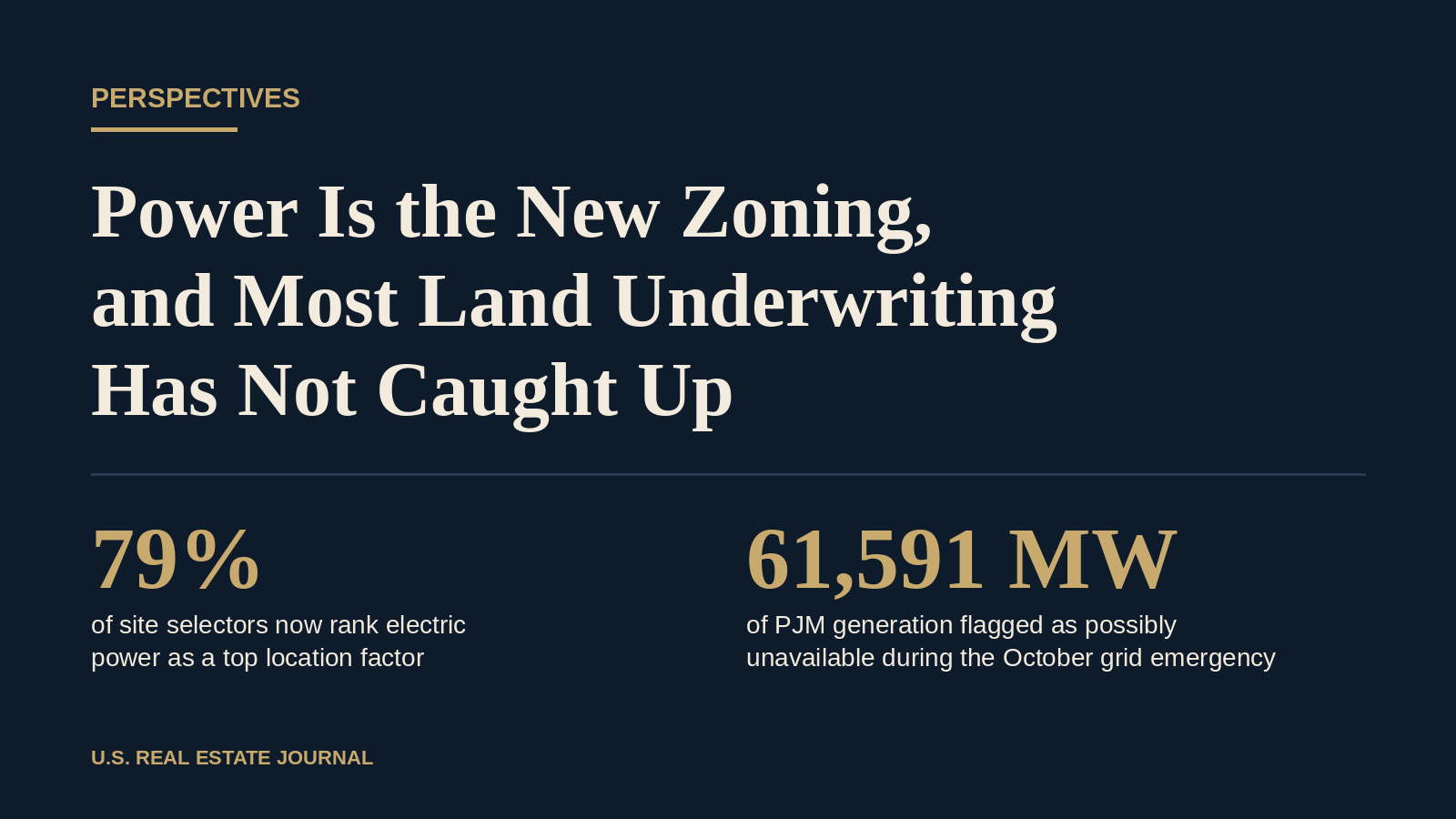

Two stories from this week, read together, say something most land underwriting still misses. CRE Daily reported that a 2026 Site Selectors Guild survey found 79% of members now cite electric power as a top location factor, well ahead of labor availability and geopolitics at 50% each. The same day, Realtor.com reported that the Department of Energy had put PJM Interconnection, the grid operator serving more than 67 million people across 13 states and Washington, DC, into emergency operations during an October heat spell. Both point at the same constraint, and it is not zoning, labor, or incentives. It is the megawatt.
The Ranking Flipped in Three Years
The order of priorities is the story. According to the CRE Daily brief, workforce availability led the site selector list in 2024 at 76%, and tariff policy topped it in 2025 at 87%. This year power sits on top, and more than half of the consultants said inadequate supply is a leading reason to eliminate a location outright. Labor still matters, but you can recruit workers to a region over a few years. You cannot recruit a substation.
The case study in the piece is the one I keep thinking about. A rare earth manufacturer approached Cherokee County, South Carolina, about a $1 billion plant with roughly 500 jobs. It needed 70 megawatts within two years. The site had capacity for 1. The county only got a two year delivery commitment from Duke Energy after a state senator helped speed up the transmission study. That project nearly died on interconnection, not on entitlement in the traditional sense.
Why a Grid Emergency in October Matters for Land
Realtor.com's reporting on PJM is worth reading closely, because the emergency did not come from record demand. PJM expected Wednesday load near 114,000 megawatts, well below the roughly 153,000 it served during the early September heat wave. The problem was what was available to meet it. PJM told the Energy Department that plants capable of producing as much as 61,591 megawatts could be offline, much of it in the fall maintenance window, leaving the system forecast within about 900 megawatts of its reserve margin.
Two figures in that piece tell me this is structural rather than seasonal. PJM's independent market monitor found that 37% of installed generating capacity at the end of 2025 came from units more than 40 years old, and a FERC analysis tied 53% of new line related transmission projects in PJM to aging infrastructure. Now layer demand on top. A Realtor.com analysis of Aterio facility data puts Virginia at roughly 13,300 megawatts of large data center capacity, about a fifth of the projected national total. Goldman Sachs Research, cited by CRE Daily, projects the demand it tracks, led by data centers, rising from 31 gigawatts in 2025 to 66 gigawatts by 2027.
For this cycle, the megawatt is part of the entitlement. A parcel without a credible path to power is a parcel with an asterisk.
What This Means on the Ground
We have argued for a while that land and entitlement are the real bottleneck in American real estate. This week's data says power now belongs inside that definition. A site with zoning in hand and no capacity plan is not shovel ready. It is shovel adjacent. When we look at a parcel today, the serving utility, distance to transmission, available substation headroom, and the realistic timeline for an upgrade belong on the first page of the analysis, not in an appendix.
That creates real winners. Owners of land near substations with spare capacity, and industrial sites that already carry heavy service, hold something that has quietly repriced. CRE Daily's national newsletter this week noted a $1 billion equity facility formed to convert industrial sites into AI data centers, and a technology campus in Austin approved for a gigawatt of capacity. Counties and utilities that can promise power on a defined schedule will capture the manufacturing projects the reshoring wave is producing. And this is one variable where the underpriced turnaround markets we keep writing about can beat bigger names: a secondary metro with cheaper land and grid headroom can outcompete a hot metro with a five year interconnection queue.
There is a housing angle that most coverage skips. A plant with 500 jobs needs homes for 500 households, and residential subdivisions draw on the same distribution upgrades the plant does. Employer anchored workforce housing has to be planned with the utility at the table from the first meeting, or the jobs arrive before the homes can be energized.
Where the Thesis Breaks Down
I would be careful in three places. First, speculation. Some buyers are already paying data center prices for parcels with only a theoretical path to power. Utility commitments slip, interconnection studies get restudied, and a land price that assumes the best case leaves no margin when the timeline moves.
Second, community opposition is real and growing. CRE Daily reported that 22% of site selectors said it can knock a location off a short list, and Data Center Watch counted at least 45 projects worth nearly $68 billion blocked or delayed from April to June alone. Power can be solved with money and time. Local politics sometimes cannot.
Third, households. When large loads grow faster than new generation, I expect more of the cost of upgrades and reliability to show up in utility bills. In a K shaped housing economy, the bottom leg feels that first, stacked on top of rent or a 7% mortgage, and multifamily owners feel it in operating expenses. Backup plans are also less reliable than the paperwork suggests. Realtor.com noted that during six PJM dispatches in summer 2025, demand response resources delivered about 67% of the reductions they had committed to. Data over emotion applies to the grid too.
What I Am Watching
Over the next few quarters I am watching whether more states move to fast track transmission studies the way South Carolina did for that plant, how many counties adopt data center and warehouse moratoria or buffer rules, whether PJM's reserve margins keep tightening outside of peak season, and whether power holds the top spot in next year's site selector survey. If it does, the land market will have to price capacity the way it prices zoning, parcel by parcel.
If you are weighing land in a growing metro and want a sense of how we score markets on growth, infrastructure, and entitlement risk, the free National Land Opportunity Watchlist and scoring methodology at Land Briefing is a good place to start.
Sources
- Power Access Is Now the Top Factor in U.S. Site Selection, CRE Daily, October 14, 2026
- 67 Million Americans Are Under a Power Grid Emergency: What This Means for Homeowners, Realtor.com, October 14, 2026
- Sun Belt Apartment Recovery Turns Sharply Uneven, CRE Daily National Newsletter, October 14, 2026