
Two numbers landed on my desk this week that should not be able to coexist. Realtor.com reported that one in five working-age renters was late or short on rent at some point in 2025, the first statistically meaningful jump since the Urban Institute began tracking it in 2017. And CRE Daily, citing RealPage, reported that the apartment supply wave that spent three years pushing rents down is now draining faster than demand.
Put those together and you get the story I think most of the market is underpricing. The rent squeeze is moving up the income ladder at the exact moment the cushion that was protecting renters is going away.
Falling Rents Did Not Fix the Math
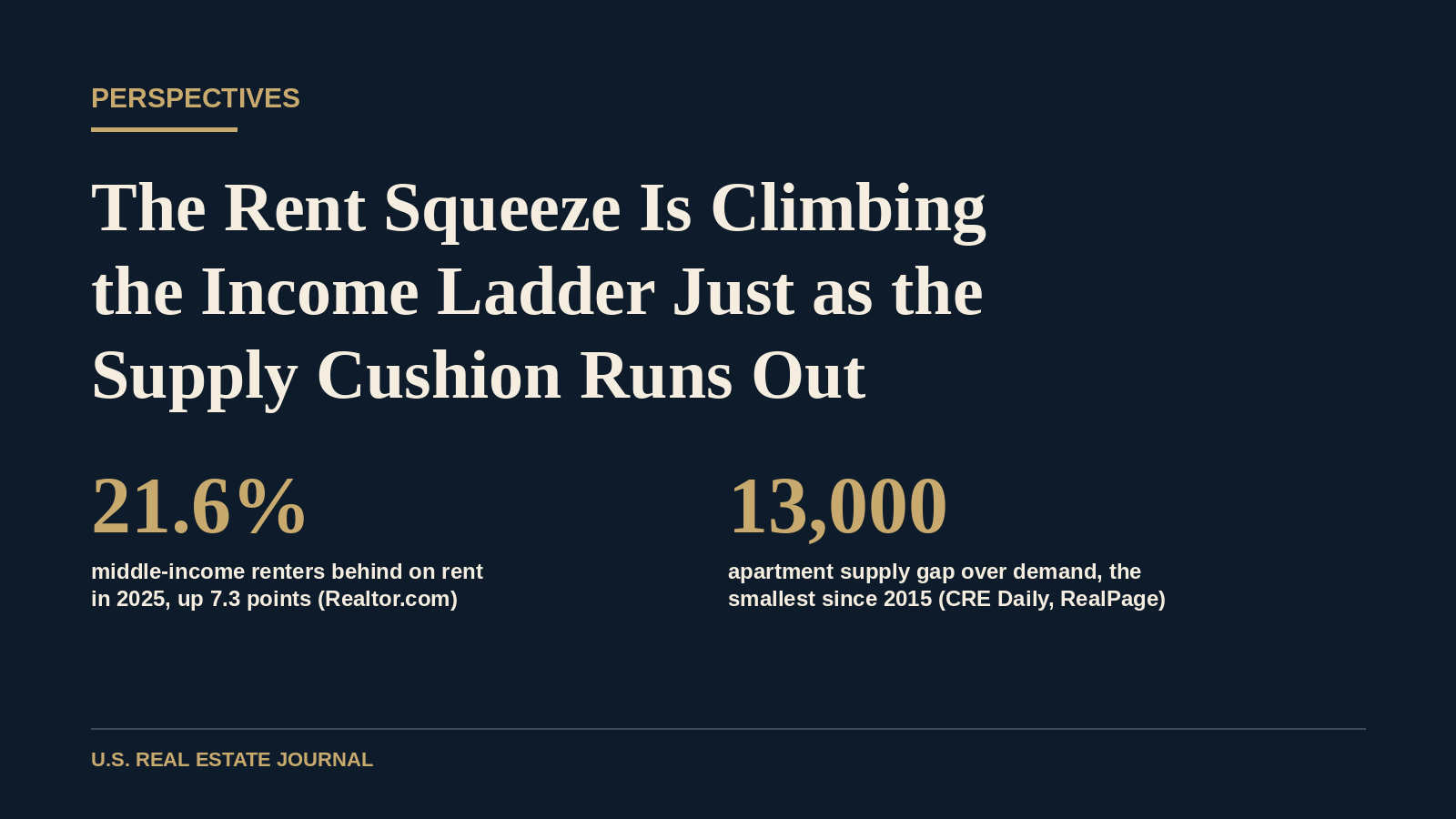
According to Realtor.com’s analysis of the Urban Institute survey, the share of working-age renters with payment problems rose from 16.5% in 2024 to 20% in 2025. The sharpest deterioration was not at the bottom. Middle-income renters saw payment problems jump 7.3 percentage points to 21.6%, closing much of the gap with lower-income households.
That happened while asking rents were falling. Realtor.com’s own Rent Report shows asking rents across the 50 largest metros declined year over year for 37 straight months through the end of 2025. Yet the median asking rent in August was still more than 15% above its pre-pandemic level, only about 4% off its 2022 peak. The piece also cites Harvard’s Joint Center for Housing Studies: from 2001 to 2024, inflation-adjusted rents rose 30% while renter incomes rose 9%.
A modest pullback was never going to repair two decades of divergence. What broke the middle in 2025 was the labor market. Realtor.com points to job gains averaging 49,000 a month in 2025, down from 168,000 in 2024, and Philadelphia Fed research showing that 59.5% of renters earning $60,000 to $120,000 had cut spending, up 13.1 points in a single year. These are households that earn too much for assistance and too little to absorb a shock.
The Supply Cushion Is Running Out
Now look at the other side of the ledger. CRE Daily’s national newsletter, drawing on RealPage, reported that renters absorbed about 304,800 apartments in the year through the third quarter against roughly 318,000 deliveries. That 13,000 unit gap is the smallest since late 2015. Deliveries are down 46% from the late 2024 peak of 588,000 units. National occupancy held at 95.4%, and effective asking rents rose 0.9% year over year, the first annual gain since the second quarter of 2025.
The oversupply of 2023 to 2025 was, in effect, a private subsidy to renters. That subsidy is ending, and nothing at today’s cost of capital is lined up to replace it. CRE Daily’s market snapshot had the 10-year Treasury at about 5.28% on October 7. Nobody is starting the next wave of garden apartments on that number.
A rent increase the median renter cannot pay is not revenue. It is a receivable with a short shelf life.
A K Shaped Rental Market
The same day, CRE Daily summarized a Zillow analysis showing that a household earning $100,000 can reach 77% of rental listings nationally on a 30% budget, versus 31% for the typical renter earning about $58,000. That is the K shaped housing economy in one line. The middle is cutting groceries to stay current.
For operators, that split matters more than the national average. A building leased to six-figure households can push renewals as supply thins. A Class B or C asset leased to the $50,000 to $90,000 band may print rent growth on paper and give it back in bad debt, turnover, and concessions on the back end. I would rather underwrite flat rents and clean collections than a 4% bump on a tenant base already skipping other bills.
Where the Southern Squeeze Shows Up
RealPage’s regional numbers, as reported by CRE Daily, show the South is the only region where rents are still falling and occupancy sits below 95%. San Antonio was down 3.7%, with Denver, Charlotte, Tampa, and Houston down 2% to 3%. The Midwest led every region at 2% growth.
The easy read is that the Sun Belt still has slack, so renters there are fine. I think that is backwards. Sun Belt renters got the biggest dose of the supply subsidy, and they will lose it fastest once deliveries fall off, in metros where wages never kept pace with the 2021 to 2022 rent spike. That is the Southern Squeeze in rental form. Owners who bought at 2022 values are counting on that recovery to rescue their basis. Their residents may not be able to fund it.
The Workforce Pipeline Is Stuck
Can subsidized supply pick up the slack? CRE Daily’s report on Chicago, based on city records obtained by Bisnow, is not encouraging. Only 2 of 13 projects awarded tax credits in the city’s 2023 round had closed by mid-September, about 30 months after the awards. One new construction project saw costs climb from about $732,000 to nearly $796,000 per unit while it waited. The two that closed were both rehabilitation deals.
That last detail is the lesson. Approval layers, not capital alone, are what kill affordability, and every month of process adds cost that renters eventually carry. The opportunity I see is in preservation and repositioning of existing stock, in employer anchored workforce housing where a hospital, school district, or plant has a reason to help close the gap, and in Midwest and turnaround markets where basis still makes sense for the $60,000 to $120,000 household. The risk is assuming that middle tier will absorb whatever rent growth the supply cycle allows.
What I Am Watching
Four things. The spread between renewal and new lease rents, because renewals are where existing tenants feel the squeeze first. Bad debt and collections commentary in apartment REIT earnings this quarter. Whether Sun Belt occupancy crosses back above 95%, which would be the signal that concessions are about to disappear. And whether cities like Chicago actually shorten the path from award to closing, since that is the only way subsidized supply moves fast enough to matter. Data over emotion: the national rent number will look healthy for a while. The household balance sheet underneath it will not.
If you are weighing a workforce housing project, a value add repositioning, or an acquisition whose underwriting leans on rent recovery, a capital structure and feasibility review through Kaufman Real Estate & Consulting is a practical way to pressure test the rent and collections assumptions before you commit.
Sources
- Rents Are Falling. So Why Are More Middle-Income Renters Falling Behind?, Realtor.com News, October 9, 2026
- Apartment Demand Catches Up to a Fading Supply Wave, CRE Daily, October 8, 2026
- Zillow: $100K Income Unlocks 77% of Rentals, Up From 31%, CRE Daily, October 9, 2026
- Only 2 of 13 Chicago LIHTC Projects Have Closed Since 2024, CRE Daily, October 9, 2026