
When nobody can afford to build something, the people who already own it get a quiet raise. That is the simplest way I know to read the latest retail construction numbers, and I think the headline undersells how much the math has shifted.
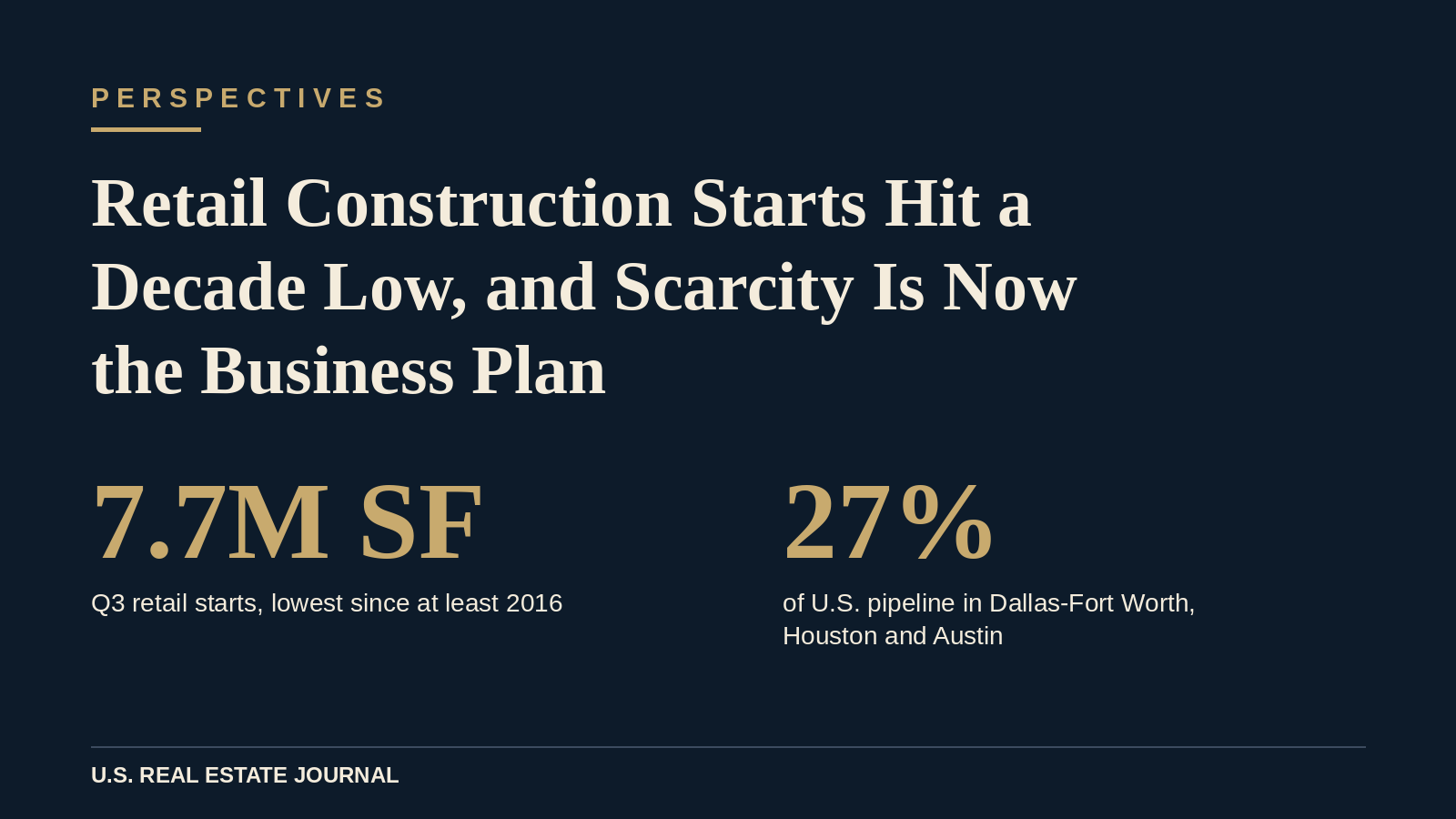
As CRE Daily reported on October 22, CoStar counted about 58.3 million square feet of retail under construction in the third quarter, down from 60.6 million in the second quarter and 63.3 million in the first. That is roughly 4% below the 10-year average of 60.7 million. The sharper number is starts. Only about 7.7 million square feet broke ground in the quarter, down from 10.7 million in the second quarter and the weakest quarterly total since at least 2016.
Why the Projects Do Not Pencil
CoStar’s Brandon Svec described the problem plainly in the CRE Daily brief: land, construction and debt now cost enough that a new project needs rents well above what many tenants will pay. Asking rents were flat in the quarter, so nothing closed that gap.
I frame it the way we frame any ground-up deal. Start with the rent a real tenant will sign, back out operating costs, capitalize what is left at a rate a lender and a buyer will accept, and compare that value to the all-in cost of dirt, entitlements, vertical construction and interest carry. When the answer is negative, the project dies on the spreadsheet long before it ever reaches a planning commission.
The cost of money is a big part of that. CRE Daily’s Texas newsletter noted on October 14 that the average 30-year mortgage rate rose to 7.03% in September as the 10-year Treasury climbed to 5.29%, in a month when the Fed raised rates. And on October 22, CRE Daily reported that CBRE, even with U.S. property sales revenue up 37% in the third quarter, is seeing rising rates reprice or kill deals that were already under contract. If stabilized assets are being repriced in escrow, construction loans for new retail are not getting easier to close.
A shrinking pipeline is good news for whoever already owns the corner, and bad news for every growing town still waiting on its grocery store.
Who Is Positioned to Win
The obvious winner is the owner of existing, well-located retail. CRE Daily tied the pipeline data to tenant demand, pointing to its earlier reporting that retailers such as Aldi, Burlington and TJ Maxx have planned large store expansions. Hines Research has made a related scarcity argument, noting that roughly 480 million square feet of U.S. retail has been demolished since 2000. When tenants want to grow and very little new space is coming, existing landlords gain leverage on renewals.
The tenant list matters too. Discount grocers and off-price apparel are among the concepts expanding, which fits what we describe as the K-shaped economy. Value-oriented shoppers are a large and durable customer base, and the retailers serving them want boxes near growing neighborhoods. Owners whose centers already house those tenants, or who can backfill a vacancy with one, sit in a strong spot.
The second group of winners is anyone holding entitled land in growth corridors. CoStar’s data show Dallas-Fort Worth, Houston and Austin together account for about 15.5 million square feet under construction, close to 27% of the national pipeline, and the 15 largest pipelines hold roughly 56% of the total. Retail follows rooftops, and Texas still has the rooftops. CRE Daily, citing the Texas Real Estate Research Center, reported that Texas payrolls grew 1.0% year over year in August, more than triple the national pace. That is the Southern Squeeze in practice: jobs and households keep arriving, and the bottleneck moves to land, entitlements and the cost of capital. Whoever controls an approved pad near new housing holds an option that gets more valuable every quarter that starts stay this low.
Where It Could Break
Scarcity is not the same as safety, and I see three ways this story goes wrong.
First, scarcity only pays if demand holds. The same Texas newsletter noted that national hiring is cooling, with September adding just 29,000 jobs and unemployment edging up to 4.2%. If consumers pull back, expansion plans get trimmed and landlord leverage fades quickly.
Second, scarcity hurts the places that need new retail most. The suburbs and smaller towns where new housing is going up still need grocery, pharmacy and daily services. If the only projects that pencil are in the largest Texas metros, households elsewhere drive farther and new communities wait longer for basic amenities. That cost lands hardest on workforce households, who have the least room to absorb extra time and fuel. In mountain resort and gateway towns, where land is scarce and expensive to begin with, I expect that gap to be wider still.
Third, there is concentration risk inside the pipeline itself. When more than a quarter of national retail construction sits in three metros, a local slowdown or a single overbuilt corridor hits those markets hard. Texas has been a reliable growth story, but Austin is a useful reminder. It was the one large Texas metro that did not add jobs in August, according to that same report, and its apartment rents only just turned positive in September for the first time since early 2023, after a long run of declines driven by new supply.
What We Are Watching Next
We are watching three things. The first is whether starts bounce off the 7.7 million square foot trough or keep sliding, as CoStar expects in the near term. The second is rent, because asking rents on existing centers have to move before new construction makes sense, and that is the number that would change developer math. The third is the cost of debt. If the 10-year Treasury stays near current levels, I would expect fewer starts and more repositioning of older centers, including partial demolitions and pad sales on surplus parking.
Data over emotion is the rule here. A decade low in starts is not a signal to rush into ground-up retail. It is a signal to underwrite existing centers on realistic renewal spreads, to price entitled land as the scarce input it has become, and to stay honest about which tenants are actually signing leases and which are only talking about growth.
For a closer look at how we approach development feasibility, construction and entitlement on complicated sites, our consulting work is at Kaufman Real Estate and Consulting.
Sources
- Retail Starts Hit a 10-Year Low as Pipeline Falls to 58.3M SF, CRE Daily, October 22, 2026
- CBRE Says Rising Rates Are Repricing and Delaying CRE Deals, CRE Daily, October 22, 2026
- Texas Job Growth Triples the Nation’s as Mortgage Rates Top 7%, CRE Daily, October 14, 2026