
San Francisco spent three years as the national shorthand for a broken downtown. This week CRE Daily, drawing on CoStar reporting, laid out how fast that story has turned. Anthropic went from a 160 person team in a 17,000 square foot Jackson Square building in 2023 to nearly 1 million square feet in the Financial District, with a 13 year lease at 300 Howard Street that it will move into in stages over 2027. Its staff grew from 940 at the end of 2024 to roughly 5,300 by late September, according to its SEC filings. Cushman & Wakefield data cited in the same report show more than a third of local leasing is now AI driven, and CoStar puts vacancy back under 20% after it peaked above 30%.
I take the rebound seriously. I also think it is the clearest example in the country of what a recovery looks like when it rests on a very small number of tenants, and that deserves as much attention as the leasing numbers.
Two Sets of Numbers, One City
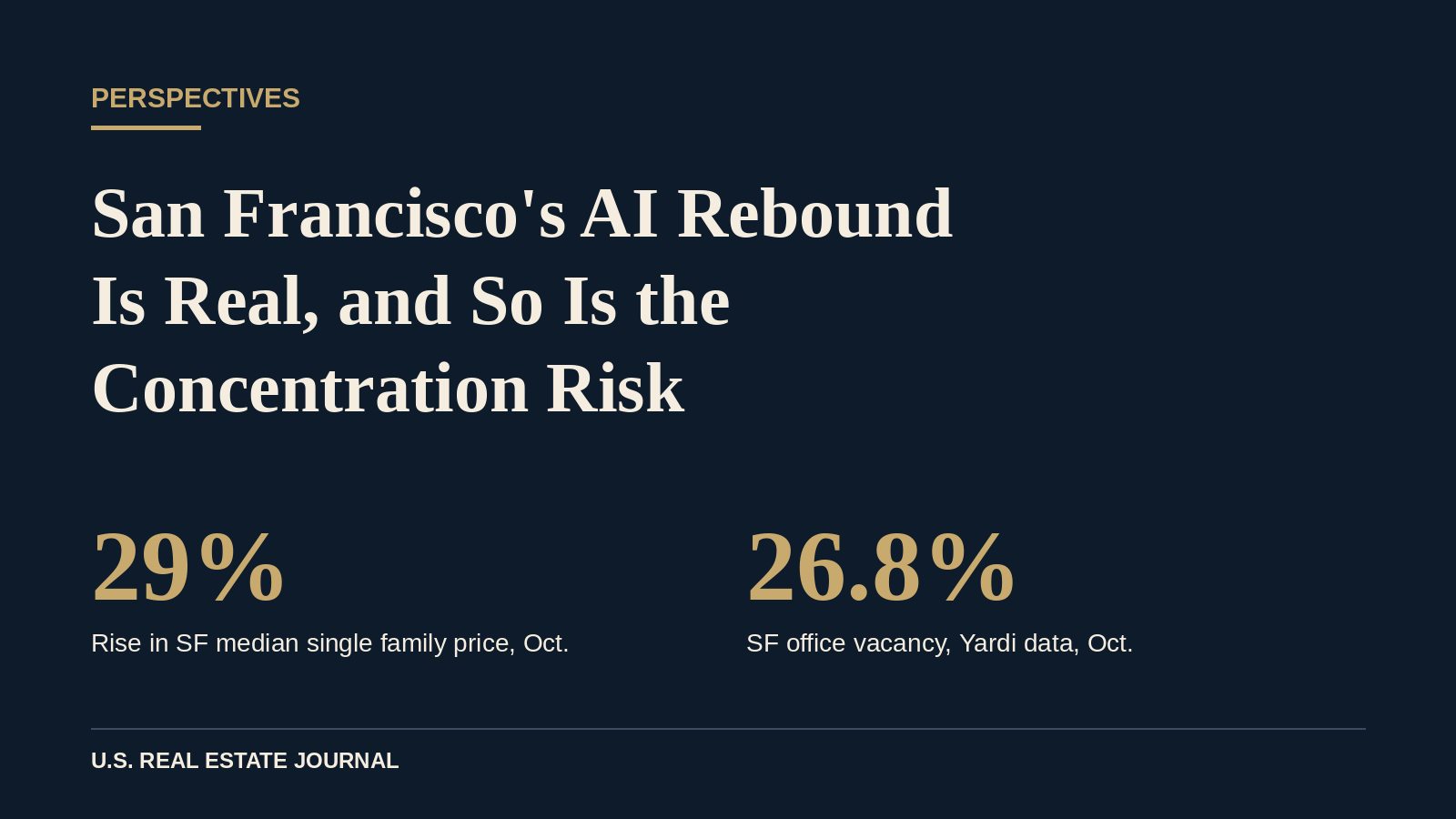
Start with the data, because the data does not agree with itself. The same day, CRE Daily covered CommercialCafe's November national office report, built on Yardi Research data for buildings of 25,000 square feet and up. It put national vacancy at 17.2%, down 140 basis points over the year, and San Francisco at 26.8%, the highest of the 25 largest markets and up 60 basis points. CoStar's figure under 20% and Yardi's 26.8% measure different inventories in different ways, and neither is wrong. But a gap of seven points or more is the difference between a market that has turned and one that is still digging out.
My read is that both are true at once. The AI tenants are concentrated in a handful of blocks and in the best buildings near Salesforce Tower, the stretch of Howard Street locals now call Anthropic Row. The rest of the inventory, older Class B floors in the wrong locations, is still sitting there. That matches the national pattern in the Yardi data, where Class A asking rents rose 2.5% over the year while Class B slipped 0.3%. A citywide vacancy rate averages two different markets together. The owner of a dated building on the wrong block is not living in the rebound.
The Wealth Lands on Housing First
The part of this story I care most about is not the office towers. It is what the money does to housing. Bloomberg, as cited by CRE Daily, reports that the city's median single family price rose 29% in a year to $2.39 million in October, per Compass, with 40 homes selling above $5 million, the most in monthly records going back three decades. Employees are borrowing against private shares to make cash offers. Mayor Daniel Lurie declared a rent emergency in September after rents jumped 14% between March and July, according to CoStar.
This is the K shaped housing economy in its purest form. One group of households received an enormous, sudden balance sheet event. Everyone else in the same labor market, the teachers, nurses, line cooks, transit workers and building engineers who keep those offices running, received a higher rent bill. Housing supply does not respond on the timeline of an IPO. Land, entitlement and construction take years in any market, and San Francisco has a long reputation as one of the hardest places in the country to build.
When a balance sheet event hits one part of a labor market, the rest of that market pays for it in rent.
We have seen the same mechanics in mountain resort and gateway towns, where outside wealth arrives faster than workforce housing can be built and the people who run the town get priced out of it. San Francisco is now running that pattern at the scale of a major city. The opportunity, for whoever can actually deliver it, is attainable and workforce housing tied to the employers and transit lines the new demand depends on. The hard part is that the bottleneck is not demand. It is buildable, entitled land.
What Could Break
The risk in this story is concentration, and it runs through every layer. CRE Daily notes that Anthropic and OpenAI together took in more than half of California's venture capital this year, per PitchBook. A broker told Bloomberg the obvious problem: if private company values fall, borrowers' net worth and their loan collateral shrink at the same time. That is a correlated exposure most mortgage underwriting is not built to see. A household that bought a $5 million house with share backed liquidity is a different credit than one with the same income and diversified savings.
The office side carries a similar exposure. A 13 year lease from a strong tenant is valuable. But a submarket whose recovery rests on one or two names inherits their fortunes. Earlier tech cycles in San Francisco left behind waves of sublease space when growth paused, and landlords who underwrote permanent demand from a single sector learned the cost. Nothing in the current numbers says that is coming. It does say the spread between the best and worst buildings is likely to widen, not narrow, if growth slows.
What We Are Watching
First, the phased move into 300 Howard Street through 2027 and what happens to the space Anthropic leaves behind. Backfill is the real test of depth. Second, OpenAI's expected IPO next year, which could add another wave of leasing and another wave of housing demand on top of the first. Third, whether the rent emergency produces real changes to how fast housing gets approved and built, or only to how rents are regulated. The first adds supply. The second does not. Fourth, the gap between the CoStar and Yardi vacancy figures. If it narrows because older stock starts leasing, the recovery is broadening. If it stays wide, the rebound is a submarket story wearing a citywide headline.
The lesson for every other metro courting an AI anchor tenant is simple. Plan the housing at the same time as the office deal, because the jobs arrive in months and the homes take years, and treat land and entitlement as the critical path rather than an afterthought.
If you are working through how employer driven demand, land and housing fit together in your own market, more of our thinking on long term strategy is at Kaufman & Company.
Sources
- Anthropic's Growth Drives San Francisco Office Rebound, CRE Daily, November 20, 2026
- National Office Vacancy Falls to 17.2% as Class A Pulls Ahead, CRE Daily, November 20, 2026