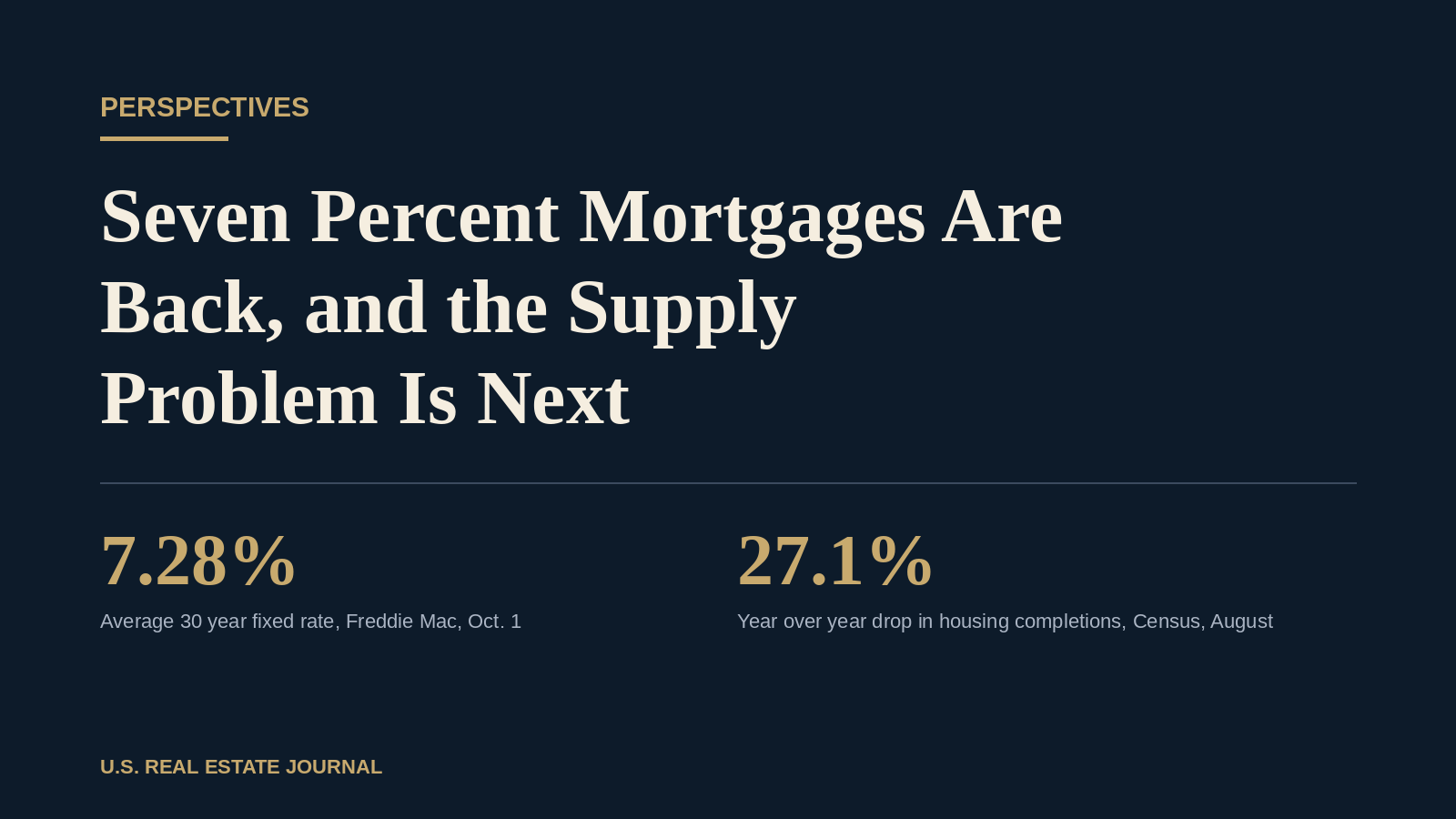

The weekly mortgage rate survey is usually a non-event. This week it was not. Freddie Mac reported Thursday that the average 30-year fixed rate rose to 7.28%, up from 7.03% a week earlier and from 6.34% a year ago. That is the highest reading since November 2023. The 15-year moved to 6.60%. A quarter point in seven days is the kind of move that shows up in every buyer’s preapproval letter by Monday.
The headlines will focus on buyers, and they should. But from where I sit, the more important story is what higher long rates do to the homes that have not been built yet. Demand recovers when rates come down. Supply that never got financed does not come back on the same schedule.
What Actually Moved
Mortgage rates follow the 10-year Treasury, not the federal funds rate, and the 10-year has pushed through 5%. Fox Business put it at roughly 5.23% as the Freddie Mac numbers came out. That repricing has a clear source. On September 16 the Federal Reserve raised its target range by a quarter point to 3.75% to 4.00%, its first increase since 2023, on a unanimous vote. Chair Kevin Warsh was blunt that inflation has run too hot for too long. August CPI rose 0.4% for the month and 3.4% from a year earlier, with energy costs tied to the Iran conflict pushing oil past $100 a barrel. Officials signaled that more tightening is likely before year end.
For anyone who spent the last two years waiting for the rate cycle to turn in housing’s favor, that is a hard reset. The market is no longer debating when relief arrives. It is pricing the possibility that relief does not arrive in 2027 either.
The Demand Side Is Already Thin
Buyers were not exactly rushing back before this week. The National Association of Realtors reported that pending home sales rose 0.3% in August but were down 4.7% from a year earlier, with the West off 6.7%. NAR’s chief economist, Lawrence Yun, pointed to higher mortgage rates offsetting the buying power that job and income gains had been building. Fox Business estimated that the latest jump adds more than $200 a month in principal and interest on a median priced home.
That matters, but it is a cyclical problem. A buyer priced out at 7.28% is still a buyer at 6.25%. The demand does not disappear. It waits, and it accumulates.
Demand that gets priced out waits for the next rate dip. Supply that never gets financed is simply gone, and the shortfall shows up two years later as rent.
The Supply Side Is Where the Damage Compounds
The Census Bureau’s August construction report deserves more attention than it got. Total starts ran at a 1.275 million annual rate, down 2.6% from July. Single family starts actually rose 7.6% to 918,000, but starts in buildings with five or more units fell to 344,000. Permits slipped 2.7% to 1.394 million. The number that stopped me was completions: 1.128 million, down 11.9% in a month and 27.1% from a year earlier.
Completions are the tail end of decisions made in 2023 and 2024, when the last wave of multifamily construction was financed. That wave is now finishing, and the pipeline behind it is thinner. Every project being underwritten today has to clear a construction loan priced off a higher base rate and an exit valued off a higher Treasury. Both sides of the spread move against you at once.
Principal Asset Management made a point in August that holds even more firmly now: with the 10-year near 5%, average forecast NOI growth of roughly 3.4% across property types is not enough by itself to defend values against a higher discount rate. In plain terms, a deal that penciled with the 10-year at 4.25% often does not pencil at 5.25% unless rents rise faster than anyone is willing to underwrite. When a deal does not pencil, it does not get a groundbreaking. It goes back in the drawer.
What I Am Watching
Three things will tell us how deep this goes.
First, multifamily permits. Permits for buildings with five or more units ran at 467,000 in August, well ahead of starts. If that gap stays wide, it means projects are entitled and permitted but stalled at the financing stage. Those are the deals most at risk of slipping a year or dying outright.
Second, the long end of the curve. The FOMC meets again October 27 to 28, and another hike is widely expected by year end, but the 10-year is doing the real work here. If it holds above 5% into the new year, construction lenders will keep sizing loans conservatively regardless of what the Fed does at the short end.
Third, single family builders. The rise in single family starts suggests the large builders still see a path, largely because they can buy down rates for their customers in a way the resale market cannot. That advantage gets more expensive with every basis point, and I expect incentive budgets to show up in margin commentary this earnings season.
The Lesson for Operators
The instinct in a rising rate market is to pause everything and wait for clarity. I understand it, but I think it misreads where the opportunity sits. The shortage of new supply being created right now will be visible in 2028, when completions are low, household formation keeps going, and the projects that did get built face less competition at lease up.
The operators who come through this well will be the ones who keep their entitlement and predevelopment work moving, protect their liquidity, and refuse to force a construction start into a capital stack that only works if rates fall on schedule. The rate is not the plan. The plan has to survive the rate.
Seven percent mortgages are a buyer problem this fall. If long rates stay here, they become a supply problem for the rest of the decade, and that is the part of the story worth watching most closely.