
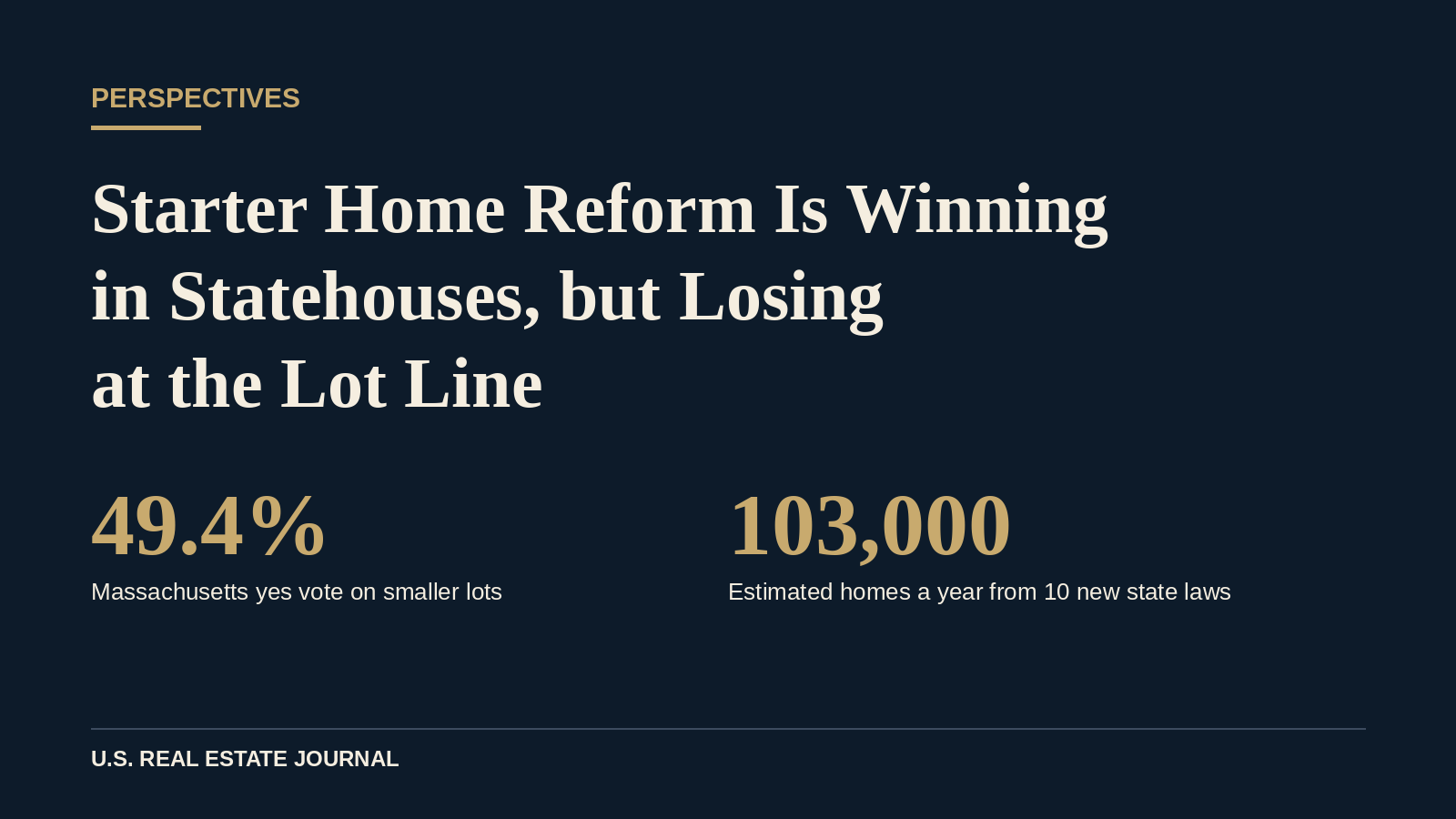

Massachusetts voters had a chance on November 3 to shrink the lot it takes to build a single family home, and they said no by the thinnest of margins. Question 7 would have set a statewide minimum of 5,000 square feet for single family lots that have public water and sewer and at least 50 feet of frontage. According to Realtor.com, it failed 50.6% to 49.4%, even with more than 1.2 million voters in favor. The same week, the American Enterprise Institute told a housing conference in Washington that 10 state laws passed this year could add an estimated 103,000 homes a year nationally, as Realtor.com also reported.
Read together, those stories say something every developer should sit with. Housing reform is now popular in the abstract and moving through statehouses. It is still losing at the lot line, which is where the cost of a starter home is actually set.
The Lot Is the Price
The math behind Question 7 was simple. Realtor.com cites a National Zoning Atlas finding that more than half of Massachusetts municipalities require roughly 40,000 square feet, about an acre, to build one home. At greater Boston land prices, the only product that pencils on an acre is a big, expensive house. The state's median listing price, per Realtor.com, is $699,990, about $250,000 above the national median of $415,000. The Homebuilders and Remodelers Association of Massachusetts puts the state's shortage at 220,000 homes.
A homebuilder representative quoted by Realtor.com laid out the choice plainly: on the same parcel, either one home that has to sell for $1.8 million to $2.5 million, or two or three smaller homes that still make the return. That is a land allocation problem, and the minimum lot size is the rule that decides it before an architect ever opens a file.
Nationally, the trend runs the same direction. Freddie Mac data cited by Realtor.com shows the country built about 418,000 starter homes a year in the 1970s, roughly a third of all starts, and only about 65,000 by 2020, under 10%. Buyers did not stop wanting small homes. Land rules made them impossible to deliver at a price that covered the dirt.
What the 103,000 Number Does and Does Not Mean
I take the AEI estimate seriously, and I also read the fine print. Roughly half of the projected units are accessory dwelling units. California's AB 956, which loosens ADU rules, accounts for an estimated 48,000 a year. Washington's SB 6026, which allows homes in commercially zoned areas, accounts for about 37,000. Idaho's SB 1352 on smaller lots adds an estimated 5,000, and several other states passed reforms. AEI's own housing center co-director cautioned that not every one of those homes will materialize.
ADUs matter, but they are a backyard product, built one at a time by homeowners with very different capital and patience than a production builder. They also bring friction. CRE Daily reported that Los Angeles tenants are suing landlords who are converting apartment parking into ADUs under SB 1211, after a judge froze a Hollywood project that turned 20 parking stalls into nine units. Every reform creates a new place to litigate.
The Washington law is the one I find most interesting for operators. Allowing housing on commercial land opens up underused retail pads, strip centers and office parks that already have utilities, roads and frontage.
Reform is winning in the statehouse and losing at the lot line, and the lot line is where the price of a starter home is set.
Where the Opportunity Is
The opportunity goes to whoever controls land in the places where the rules actually change and has the entitlement and engineering capacity to move first. When a state cuts minimum lots or allows housing on commercial parcels, the value shift happens to the land before a single home is built. Those who wait for the first wave of projects to prove the market will pay for that proof in the land price.
The polling helps. AEI's surveys of about 5,000 people found roughly 83% support for a state law allowing more affordable starter homes on smaller lots in new neighborhoods, and 61% would rather see a torn down home replaced by two smaller homes than by one larger one. The gap between that support and a 49.4% yes vote in Massachusetts tells me the opposition is not really about starter homes. It is about who decides. The Massachusetts Municipal Association opposed it as an override of local planning.
That points to the other model. New Rochelle, New York, adopted a form based code and streamlined approvals, with some projects cleared in as few as 90 days, and has approved 4,500 homes since 2020, according to Realtor.com. For attainable and workforce housing, which is what we focus on through Haven, a predictable 90 day approval is worth more than almost any subsidy.
Risks the Headlines Miss
First, a law on the books is not a permit in hand. Towns that lose on lot size can still slow projects through utility capacity, impact fees, design review and stormwater rules. Question 7 itself required public sewer and water, which much of outer Massachusetts does not have. Second, the cost of capital is moving the wrong way. Realtor.com reported that mortgage rates are above 7% and that futures markets price a roughly 77% chance of a December Fed hike after October payrolls came in at 165,000. Smaller lots cut the land basis, but they do not cut the carry on a project that takes two years to entitle. Third, reform that leans on ADUs and infill will produce homes slowly and unevenly.
What We Are Watching
I am watching three things. Whether the Massachusetts organizers use the town level results to push lot size reform locally, where it may pass in places that voted yes. How quickly Washington cities issue the first permits on commercial land under SB 6026, because that will set the template for other states. And whether this year's federal reform package translates into local code changes or stays a headline. At Kaufman & Company we buy land, entitle it, build and hold for the long term, so we read lot size rules the way an appraiser reads a rent roll: they tell you what a parcel can actually become.
If you are weighing what a specific parcel can support as these rules change, the Site and Feasibility Review at Kaufman Real Estate and Consulting works through exactly those entitlement and development questions.
Sources
- Massachusetts Plan for More Starter Homes Fails as ‘NIMBY’ Voters Insist on Local Zoning Control, Realtor.com, November 6, 2026
- New Laws Could Add an Estimated 103,000 Homes a Year, Study Finds, Realtor.com, November 6, 2026
- Massive Job Gains of 165,000 in October Bolster Case for More Fed Rate Hikes, Realtor.com, November 6, 2026
- CoStar Raises 2027 Apartment Rent Growth Forecast to 2.6%, CRE Daily, November 6, 2026