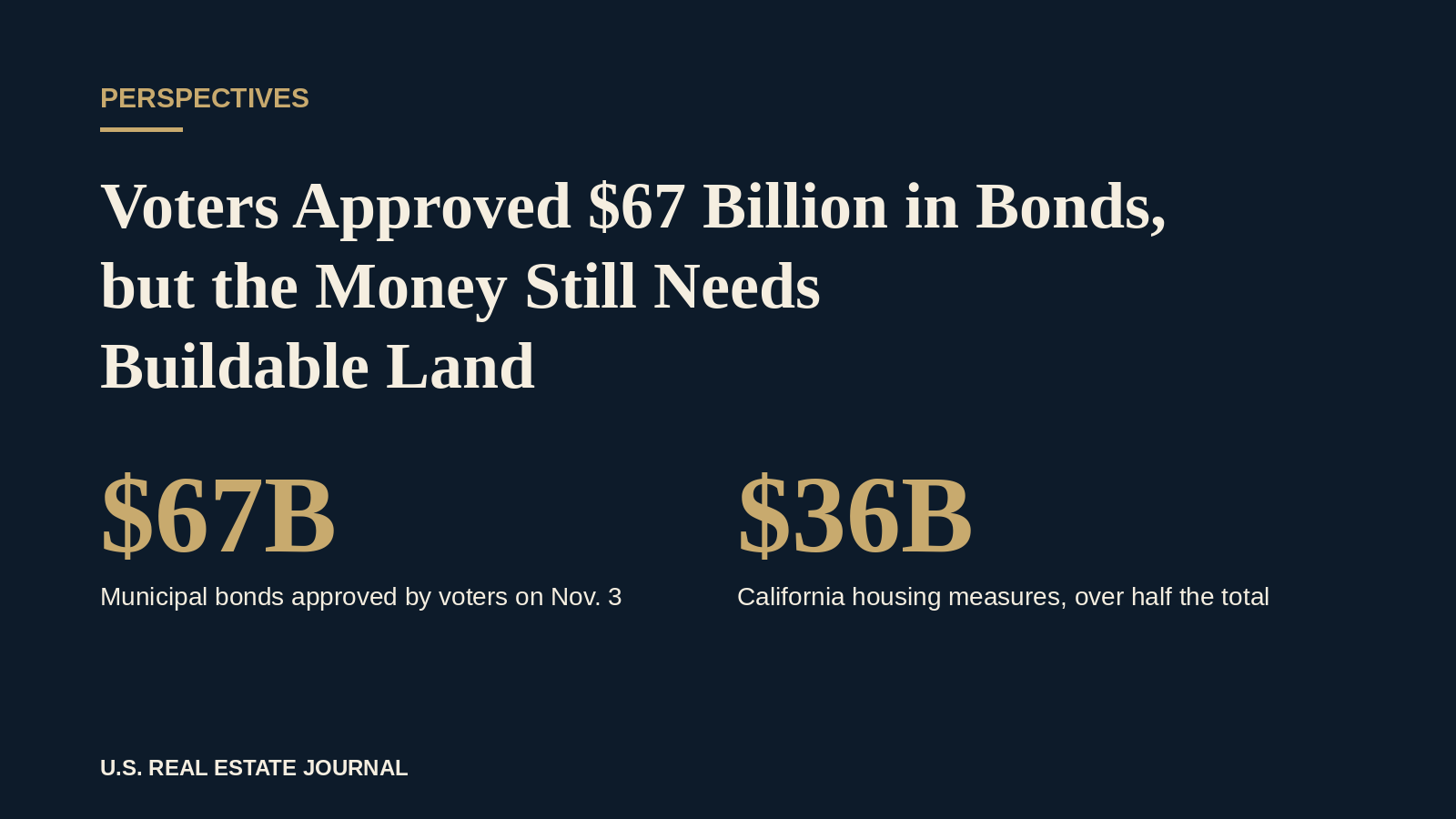

On November 3, voters approved at least $67 billion of the roughly $84 billion in municipal bond measures on the ballot, according to a CRE Daily brief built on Bloomberg's review of preliminary S&P Global Market Intelligence tallies. It was the largest slate ever put to voters in a midterm, and it compares with about $16 billion last year. California carried the headline. Proposition 37 creates a $25 billion revenue bond program to help households buy homes, and Proposition 1 is an $11.25 billion general obligation bond for below market housing. Together they account for more than half of everything approved nationally.
The same week, Realtor.com reported that leaders of the incoming Democratic majorities in Congress plan to put affordability at the top of their 2027 agenda, after an election in which voters repeatedly named housing costs as a deciding issue. Put those two stories together and the message from the ballot box is plain. People want housing they can afford, and they are willing to borrow to get it. My question as a developer is the one that comes after the vote: where does that money actually turn into homes, and what stands in the way?
What the Bond Wave Actually Buys
Start with cost. In the Bloomberg reporting summarized by CRE Daily, Aberdeen Investments' Miguel Laranjeiro noted that inflation has pushed up construction and materials costs, so the same projects now need more borrowing. Issuers have sold more than $500 billion of long term municipal debt this year, about 6% ahead of the 2025 pace, with roughly $600 billion expected by December. A good share of the record volume is not more building. It is the same building at a higher price.
Then look at what the California money is designed to do. Affordable housing developers such as EAH Housing argued before the vote, as CRE Daily relayed, that Proposition 1 targets the gap between what it costs to build and what restricted rents can carry, and that predictable public money helps unlock tax credits and private capital. That is a fair description of how the affordable stack works. Gap money is valuable because it is the last piece. But it only works when the first pieces are in place: a site, an entitlement, utility capacity and a contractor price that holds long enough to close.
The homebuyer program is a different animal. Help with a purchase raises what a household can bid. In a market where the stock of homes is fixed in the short run, more bidding power without more supply tends to show up in price. Realtor.com economists put the affordability problem in stark terms: a $2,000 monthly mortgage payment in October 2026 supported a home price about $33,600 lower than a year earlier, as rates climbed from 6.05% in February to 7.33% in October. Buyer assistance can soften that blow for the households who receive it. It does not add a single lot.
Public money can close a financing gap, but it cannot create a buildable site, and the site is where most projects die.
Land and Entitlement Are Still the Bottleneck
This is the part the headline numbers miss. Bond dollars are spent by agencies and nonprofits that compete for the same land, the same entitled pads and the same subcontractors as everyone else. When billions arrive at once in a state where entitlement takes years, the first effect is often on land prices near transit, near jobs and near existing infrastructure, because that is where everyone wants to build at the same time. Sellers read the news too.
Ken Wingert, chief advocacy officer at the National Association of Home Builders, told Realtor.com the national housing shortfall is roughly 1.2 million households, and the NAHB and Wells Fargo builder confidence index fell to a 14 year low last month. Builders are not short of demand. They are short of sites that pencil, approvals that arrive on schedule and financing that survives the wait. Congress passed the 21st Century Road to Housing Act this summer, and more federal ideas are coming. Lawmakers themselves have said cities and localities must step up to implement them, and that is where the real test sits: how fast land moves from raw ground to a permit.
Texas Shows the Other Side of the Squeeze
The rejections may be the more important signal. CRE Daily reported that Texas voters turned down a $1.6 billion school package in Cypress-Fairbanks and a $952 million package in Irving. Franklin Templeton's Jennifer Johnston tied the defeats to fear of tax increases, even in places where classrooms are filling up.
This is what we call the Southern Squeeze. The fastest growing metros in the South attracted people with lower costs, and now the cost of serving that growth is arriving as schools, roads, water and sewer. When voters decline to fund it through bonds, the bill does not disappear. It shifts toward impact fees, utility districts and developer exactions, which land on the price of every new home. For anyone underwriting suburban land in Texas, school capacity and a district's ability to borrow are now part of the entitlement risk, not a footnote.
Who Is Positioned, and Who Is Exposed
The groups best positioned for this cycle of public borrowing are those that already control entitled or entitleable land where bond money will flow, contractors who can hold pricing, and nonprofits with a record of closing. Owners who can deliver attainable and workforce units without waiting on a subsidy round also benefit, because they are not standing in the queue.
The exposed groups are land buyers who assume bond money will rescue thin deals, households counting on purchase assistance in markets where prices will absorb it, and growth suburbs whose voters said no to the infrastructure their next subdivisions require. There is also a timing risk. The tallies are preliminary, much of the money will take years to deploy, and CRE Daily noted that because costs keep rising, many agencies will need to go back to voters for more.
What We Are Watching Next
Three things. First, how quickly California agencies write the rules for Proposition 1 and Proposition 37, and whether the housing money is paired with faster approvals. Second, land pricing near the projects that bond money is likely to fund. Third, how Texas school districts and growth suburbs respond to rejected bonds, especially whether costs migrate into fees on new homes. At Kaufman & Company we build and hold for the long term, so we read these votes less as a funding event and more as a map of where public infrastructure will and will not arrive.
For a running view of land, entitlement and metro growth, the free watchlist at Land Briefing tracks the markets where these decisions are being made.
Sources
- Voters Approve $67B of Municipal Bonds for Schools, Housing, CRE Daily, November 5, 2026
- Democrats Will Focus on Affordability in 2027, Party Leaders Say, Realtor.com, November 5, 2026