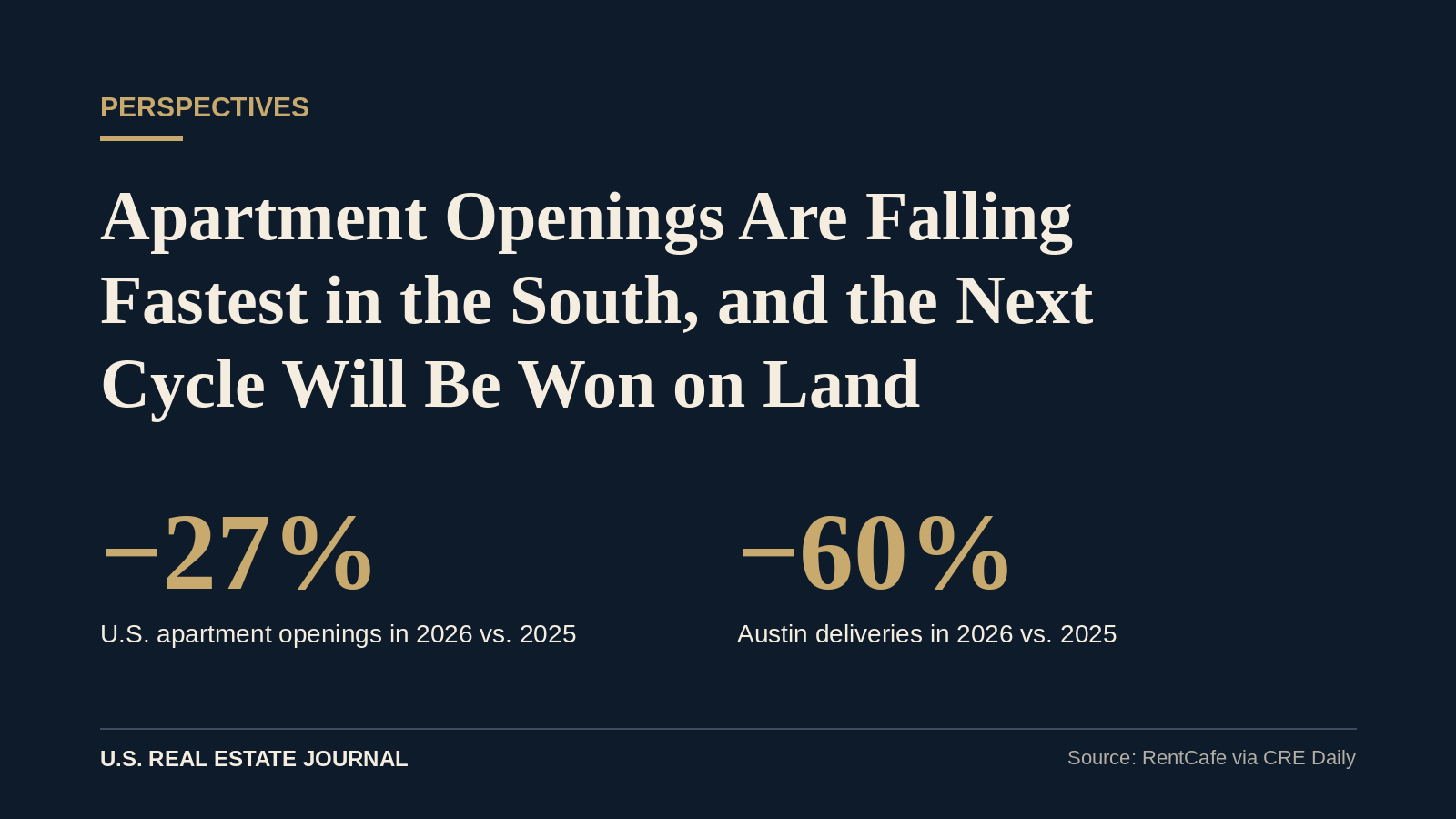

The apartment supply wave that defined the last three years is ending, and it is ending fastest in the places that built the most. According to RentCafe data reported by CRE Daily, 442,395 new apartments will open nationally in 2026, down 27% from 605,768 last year and short of the ten year norm of roughly 466,000 units. That makes this the first below average year in four.
The national number is the headline. The regional split is the story. The South still accounts for 47% of openings, or 208,085 units, led by Texas at 56,394 and Florida at 50,392. But Dallas deliveries are down 45.1% to 20,392, and Austin is down 60.4% to 12,334. Meanwhile the Northeast, a region known for slow permitting and restrictive zoning, is up 20% to 79,426 units, with the New York metro leading the country at 38,825 and Brooklyn alone adding 13,011 apartments.
When I read those numbers together, I see two markets running on two different clocks. Operators who treat them as one trade will misprice both.
The Southern Squeeze Starts to Turn
For two years the Sun Belt has been absorbing a historic delivery wave. Concessions became standard, lease ups stretched, and owners who underwrote 2021 style rent growth learned what a glut feels like. CRE Daily's read is that owners in the hardest hit Southern markets may regain pricing power first, and I agree with the direction. When Austin's deliveries fall by more than half in a single year, the backlog of new units gets absorbed faster than most models assume, because the household and job growth that drove the building did not leave.
RentCafe frames the drop as the end of the post-pandemic building cycle rather than a sign of weaker demand. That distinction matters more than the percentage. A supply decline caused by falling demand is a warning. A supply decline caused by cost and capital while demand holds is a setup.
I would still be careful about calling a bottom in Dallas or Austin rents today. The units opening this year still need to lease, and renters can still find incentives in recent deliveries. If the tightening comes, it shows up in 2027 leasing, not this winter.
Why the Next Cycle Is Further Away Than It Looks
The more important number may be the one behind the openings. Marcus & Millichap's October outlook, also reported by CRE Daily, puts apartment construction 50% below its 2023 high and still sliding, with industrial 60% under its 2022 peak. The causes are familiar: high interest rates, expensive materials and tight labor. Tariffs, immigration policy and competition from data center projects for crews and power add friction, and the outlook suggests the next building cycle could be pushed back by several years.
The cost and capital math backs that up. UBS puts the tariff toll alone at about $8,200 per home, according to CRE Daily. The 10 year Treasury closed Monday near 4.91%, and multifamily loans refinancing now are resetting to about 5.69% from 4.04%, a 41% jump in interest cost. Yardi's Doug Ressler, quoted in CRE Daily, expects fewer completions in both 2026 and 2027 than in 2024 and 2025, with most growth over pre-pandemic levels coming from mixed-income and affordable projects.
Put simply, the projects that would open in 2028 and 2029 are not starting, and nothing in the current cost structure suggests they will start soon.
Who Is Positioned to Win
The obvious winners are owners of stabilized, newer product in Southern metros where deliveries are collapsing, provided they have the balance sheet to hold through the remaining lease up. Pricing power returns to whoever is still standing when the pipeline empties.
The less obvious winners are the people who control entitled land. If starts stay this low for another year or two, the scarce input in 2028 will not be capital. It will be sites that are zoned, served by water, sewer and power, and ready to go vertical. Marcus & Millichap points to limited land, restrictive policies and infrastructure constraints as forces that could slow development further. That is exactly why entitlement work done now carries value that a construction loan cannot buy later.
The developers who deliver into the 2028 shortage will be the ones who secured entitled land in 2026, not the ones waiting for rates to fall.
I also think workforce and employer anchored housing has a structural edge. Ressler's point that new growth is coming mostly from mixed-income and affordable projects tells me where tax credits, public partners and employers are filling the gap that market rate capital left. Developers who know how to stack those sources will keep building while others wait.
Downfalls and Risks
The first risk is timing. Owners who bought or refinanced near peak values are not rescued by a supply cliff. A 41% jump in interest cost at refinance can erase the benefit of a few points of rent growth, and lenders will not wait for 2027 rents to show up in trailing numbers.
The second risk is demand. The thesis depends on job and household growth continuing in Texas and Florida. If the economy softens, falling supply only offsets falling demand, and nobody regains leverage.
The third risk is the Northeast itself. New York is delivering against the national trend because buildings started during the earlier demand surge are finishing now. That is a one time wave. Jersey City openings jumped 807.4% to 4,637 units, and concentrated deliveries like that can pressure lease ups in specific submarkets before they relieve anything.
Finally, a shrinking pipeline is good for landlords and hard on renters. In a K shaped housing economy, the households already stretched by rent will feel the 2027 tightening first, and the policy response, whether rent regulation or new incentives, is a variable every underwriter should carry.
What We Are Watching Next
At Kaufman & Company we are watching three things. First, quarterly absorption in Dallas and Austin, because the speed of absorption tells us when concessions burn off. Second, starts and permits rather than completions, since completions describe the past and starts describe 2028. Third, the price of entitled land relative to the cost of building. When construction is this expensive, sites with approvals and infrastructure in hand become the real bottleneck, and I do not think the market has fully priced that yet. We let the data set the timeline, not the headlines.
If you follow land, entitlement and metro growth the way we do, the free watchlist at landbriefing.com tracks the markets where the next building cycle will be decided.
Sources
- Apartment Openings Fall 27% in 2026 as New York Metro Bucks the Slowdown, CRE Daily, November 3, 2026
- Soaring Costs Push the Next Construction Cycle Years Down the Road, CRE Daily, October 30, 2026