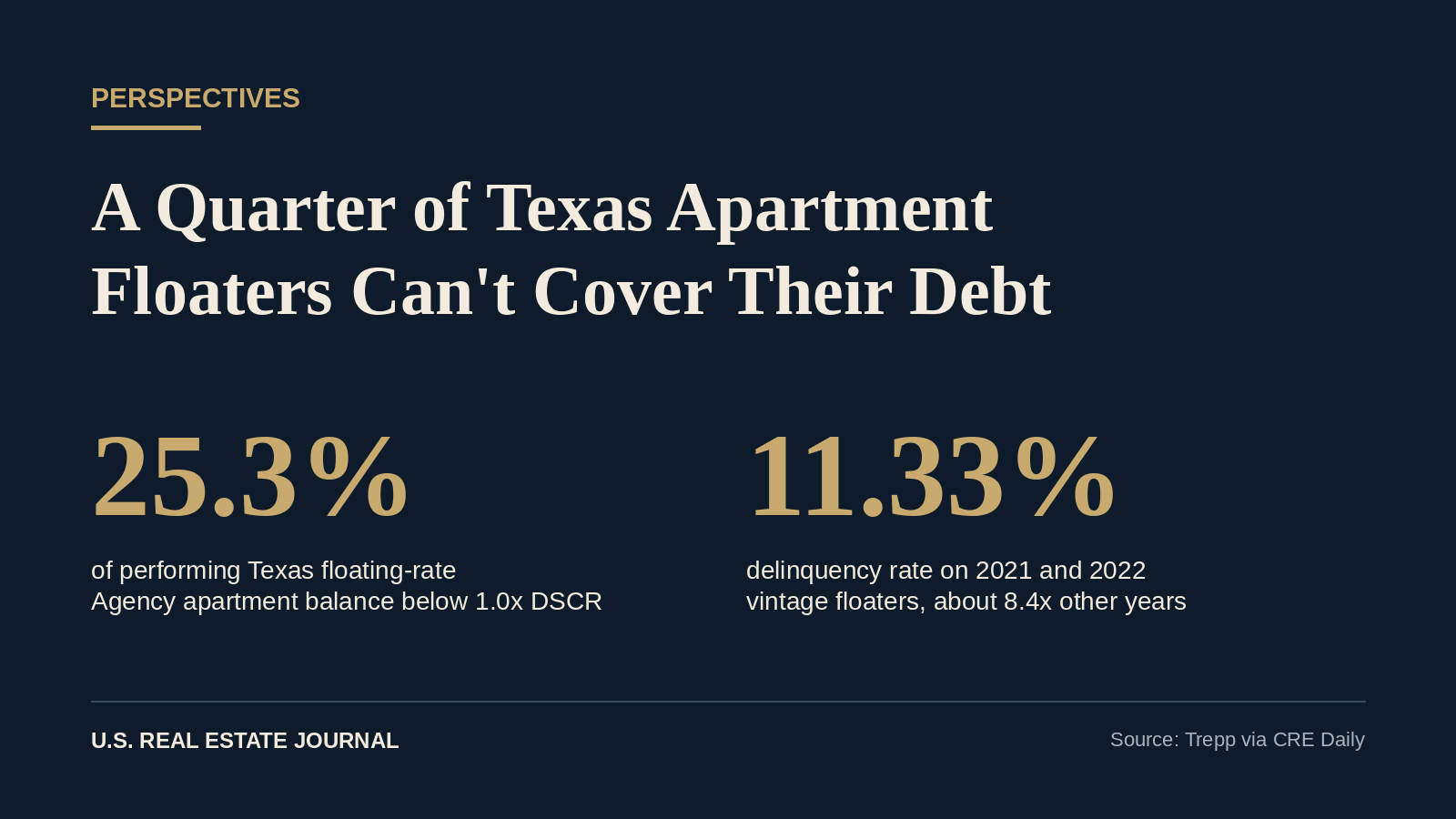

The most telling number in Texas multifamily right now is not a delinquency rate. It is a coverage ratio on loans that are still paying. According to Trepp data reported by CRE Daily, $3.04 billion across 130 performing floating-rate Agency apartment loans in Texas carries a debt service coverage ratio below 1.0x. That is 25.3% of the performing floating-rate balance, at a weighted average of 0.77x. In plain terms, a quarter of these properties do not produce enough income to pay their lenders, and the owners are covering the shortfall some other way.
Those loans are current, and that is exactly why they deserve attention. A loan paying on time at 0.77x coverage is being carried by reserves, sponsor cash or capital calls, and every one of those sources runs out eventually.
What the Trepp Numbers Actually Say
CRE Daily's Texas newsletter laid out the shape of the problem clearly. Texas holds $150.10 billion of securitized apartment debt, second only to California. Floating-rate loans make up just 21.3% of the state's Agency apartment balance, yet they account for 55.8% of the $1.35 billion that is delinquent. Floaters carry an average coupon of 5.74%, compared with 4.66% on fixed-rate debt, and the delinquent floaters are paying 5.99%.
The vintage story is sharper still. Loans packaged in 2021 and 2022 hold 87.5% of the delinquent floating-rate dollars, with an 11.33% delinquency rate, roughly 8.4 times the 1.35% rate for loans from other years. Of the 28 delinquent floaters, the 15 that report coverage all sit below 1.0x, at a 0.72x weighted average.
None of this should surprise anyone who watched Texas apartments trade in those two years. Deals were priced on compressed cap rates, aggressive rent growth and floating debt, on the assumption that rates would stay low or come back down quickly. Instead, rates moved up and a wave of new supply arrived across the Sun Belt, flattening the rent growth those models needed.
Why Rate Relief Is Not Coming to the Rescue
The hope built into many of these business plans was that the Fed would cut and floating coupons would fall back. The current read on policy points the other way. Realtor.com reported on October 29 that Federal Reserve policymakers voted 10 to 2 to hold the benchmark rate at 3.75% to 4%, and that the odds of a hike in December had climbed to nearly 80%, according to CME FedWatch. Floating-rate apartment debt prices off short-term rates, so the borrowers most exposed to a hike are the same ones already below 1.0x.
Long rates offer little comfort either. The same Realtor.com report put the 30-year fixed mortgage at 7.24%, citing Freddie Mac, with the 10-year Treasury yield averaging roughly 5.02% earlier that week. When an owner tries to refinance a 2021 floater into fixed-rate permanent debt, the lender sizes that loan against long-term yields at these levels and against today's net operating income, not the pro forma from four years ago. A property that cannot cover its current debt will not size to a takeout loan large enough to retire it.
A loan can be current and still be broken. Paying on time at 0.77x coverage means someone is writing a check every month to keep the story alive.
Where the Risk Sits and Who Gets Hurt
The exposure is concentrated in a specific group: sponsors who bought or built in 2021 and 2022 with floating debt, interest rate protection purchased for the initial term, and little fresh equity behind them. As those loans reach maturity, CRE Daily notes, more Texas owners could face refinancing gaps that force sales or restructurings. Someone has to fill that gap, whether it is the sponsor with new equity, a preferred equity or rescue capital provider at a steep cost, or the lender through a modification or a loss.
Limited partners in those syndications are the most exposed and often the least informed. Many see a property labeled performing on a quarterly report while the reserves that keep it performing quietly drain. Residents feel it too. When an owner is short on cash, deferred maintenance and thin staffing show up long before a default does.
What the headline misses is that this is a capital structure problem, not a Texas demand problem. The same CRE Daily issue cited the Dallas Fed's September Texas Manufacturing Outlook Survey, whose headline index rose to 29.5, well above its series average of 9.7. Many of these buildings are sound assets in growing job markets. The debt stacked on them is the problem.
Who Is Positioned to Win
This is where the Southern Squeeze turns into an opening for the right buyer. As the 2021 and 2022 vintage works through maturities, recapitalizations and note sales should bring well located, relatively new Texas apartments to market at a basis below what it would cost to build them today. Buyers with patient, lower leverage capital and the ability to close without a financing contingency will set the clearing price.
The discipline is in the underwriting. We underwrite these situations on in place income, current insurance and property tax bills, and a realistic lease-up path, not on a rent recovery or a drop in rates. If a deal only works with a Fed cut, it does not work. I would rather pay a bit more for a property that can carry fixed-rate debt at today's yields than chase the deepest discount on an asset that needs a capital program nobody has priced. For workforce housing in Texas employment centers, a reset basis may be what finally lets rents stay attainable for the people filling those jobs.
What We Are Watching Next
Three things. First, December: whether the Fed actually raises rates, and what that does to coupons on loans already below 1.0x. Second, extension activity on the 2021 and 2022 vintage, since extensions often come with conditions such as paydowns or new rate protection that stressed sponsors struggle to fund. Third, how Agency servicers handle these loans, whether through modifications that buy time or through sales that set real comparables for everyone else.
Data over emotion matters most in moments like this one. The coverage ratios are already telling us which owners have time and which do not.
If you are working through a refinance, an extension or a recapitalization on floating-rate debt, I share how we think about financing and rate risk at danielkaufmanre.com/capital.
Sources
- A Quarter of Texas Floating-Rate Apartment Loans Can't Cover Their Debt, CRE Daily, October 26, 2026
- Mortgage Rates Drop to 1-Month Low, Offering Buyers Relief Ahead of Midterm Elections, Realtor.com, October 29, 2026