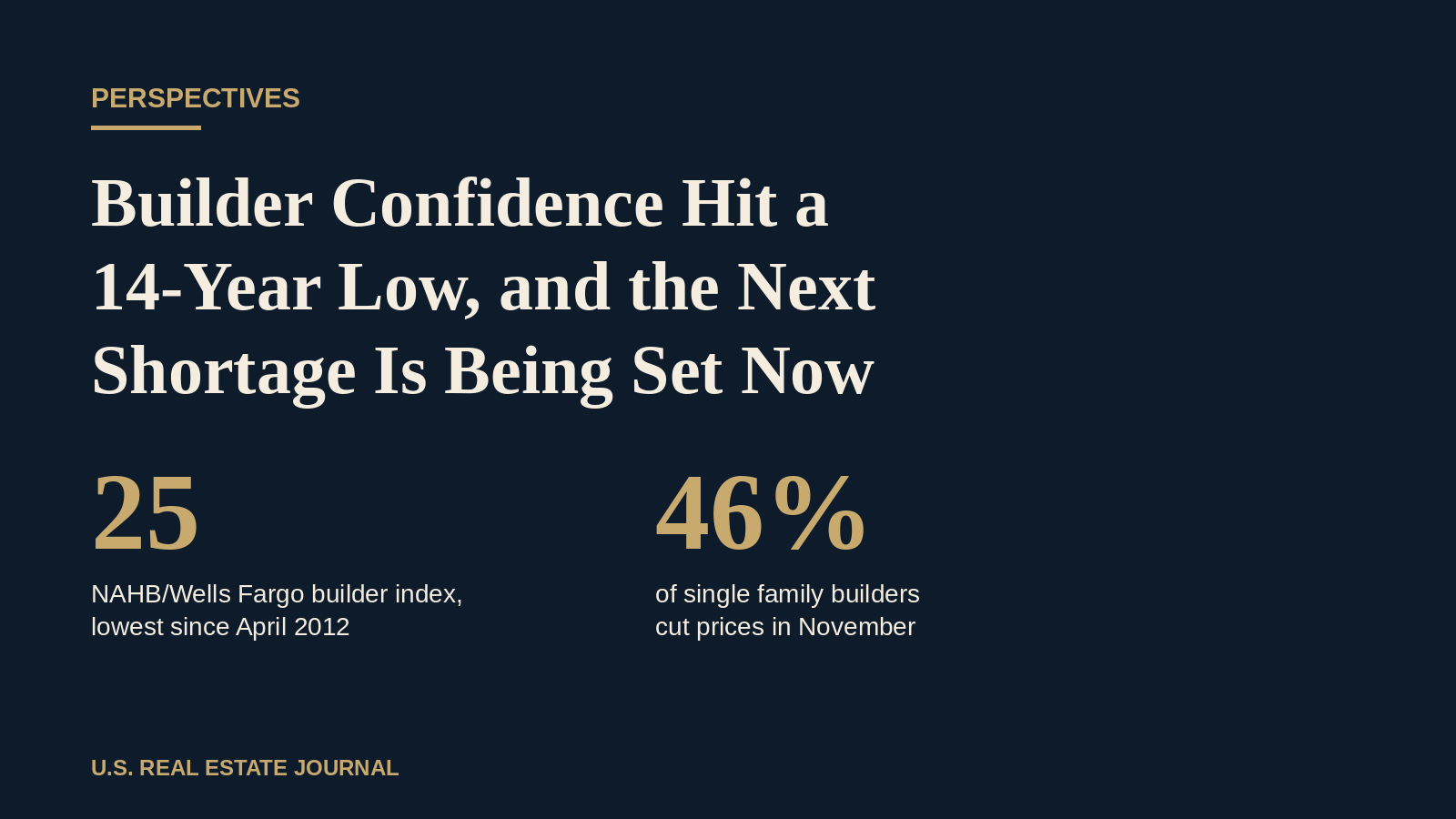

The National Association of Home Builders and Wells Fargo Housing Market Index fell three points in November to 25, according to Realtor.com’s report on the release. That is the lowest reading since April 2012, and the index has now stayed below 40 for 19 straight months. Any reading under 50 means more builders see conditions as poor than good.
The number I care about more than the headline is what builders are doing in response. In the same survey, 46% of single family builders cut prices in November, up from 43% in October and the highest share of the post-Covid period, Realtor.com reported. The average cut held at 6% for the eighth month in a row, and 68% of builders used incentives such as rate buydowns. The gauge of prospective buyer traffic fell to 16, its weakest level in 15 years outside the start of the pandemic.
What the Survey Is Actually Saying
NAHB leadership pointed to mortgage rates above 7%, tariff driven material costs, higher fuel prices that subcontractors are passing through, and labor shortages that NAHB Chairman Bill Owens tied to stepped up immigration enforcement keeping legal workers off job sites. Freddie Mac’s weekly survey put the 30 year fixed rate at 7.11% last week, slightly lower, but Realtor.com noted that a hotter than expected inflation print could make that relief short lived.
Put together, builders are being squeezed from both ends. Costs are not falling, and the buyer they need can only be reached by buying down the rate or cutting the price. A 6% cut stacked on a buydown can erase most of the margin on an entry level house. When that goes on long enough, the rational move is to start fewer homes, and Owens told Realtor.com that more builders are already scaling back construction.
This is the K shaped housing economy in one survey. Owners with low rate mortgages and built up equity are fine. Households trying to buy their first new home at 7% are not, and the builders who serve them are the ones pulling back.
The Apartment Pipeline Is Draining at the Same Time
CRE Daily’s write up of a new Yardi Matrix analysis this week counts about 1.2 million apartments under construction for delivery through 2030, with roughly 85% of them due by the end of 2027. Yardi marks the 3.2 million units completed from 2020 through 2025 as the peak, and the earlier Yardi forecast CRE Daily cited has deliveries falling 22% in 2026 and bottoming near 451,000 units in 2027.
Two details in that analysis matter for anyone who builds. First, no developer holds more than 2% of the pipeline, and builders with fewer than 1,000 units account for 63% of supply through 2030. Second, Texas leads every state with more than 173,000 units underway. Small developers carry most of the pipeline, and they are the group most exposed to tighter construction lending and costs that stay high. NMHC’s Caitlin Sugrue Walter told Yardi that access to capital is what separates developers who keep growing from those who stall, and she warned that depressed starts could produce a renewed shortage late in the decade.
So both engines of new supply, for sale single family and rental multifamily, are slowing at once. The shortage of 2029 and 2030 is being built, or not built, right now.
A builder survey at a 14 year low is not a signal to stop. It is a calendar telling you when the next shortage arrives.
Where the Opportunity Sits
When builders stop starting homes, they also stop buying and entitling land. Lot pipelines thin out first, and in our experience they take the longest to rebuild, because zoning, utilities and road capacity move on a public calendar that does not care where the cycle is. Land and entitlement, not demand, is usually the real bottleneck.
That is where I see the opportunity. The owners who use this stretch to secure and entitle well located land, with water, sewer and access solved, will control the scarce input when demand returns. At Kaufman & Company that is simply how we work: we buy land with our own capital, entitle it, design and build, and hold for the long term. A weak builder survey does not change that plan. It improves the odds that land is priced for the cycle we are in rather than the one that ended in 2022.
Workforce housing is the clearest gap. Even after a 6% cut, most new homes are still priced above what teachers, nurses and tradespeople can carry at 7%. Employer anchored projects, where demand is tied to a hospital, a school district or a plant rather than to open market buyer traffic, are far less exposed to a traffic index sitting at 16. That is the thinking behind Haven, our attainable and workforce housing brand.
The Risks the Headline Misses
A low sentiment reading can create false comfort that new home prices must fall. The survey says 46% of builders are cutting, which means more than half are not. Prices can stay sticky because the costs underneath them, materials, labor, insurance and impact fees, are sticky too.
The South is the region to watch. NAHB’s three month average for the South fell to 27, and Texas carries the largest apartment pipeline in the country. That is the Southern Squeeze: the markets that absorbed the most new supply are now where sentiment is weak and where small, thinly capitalized developers are concentrated. If those deliveries land in softer demand, concessions will rise before any shortage shows up. The West posted the weakest regional reading at 23.
Rates are the other risk. If the 30 year stays above 7% through spring, incentive budgets become permanent, and some builders, especially private ones, will sell land and lots to raise cash. Much of that ground will have unresolved utilities or entitlement risk. Data over emotion: a discount only matters if the site works.
What We Are Watching Next
Three things. First, single family starts and permits in the next Census release, to see whether weak sentiment is turning into fewer shovels in the ground. Second, whether the share of builders cutting prices climbs past half, which would mean margin pressure is spreading from the entry level into move up product. Third, construction loan availability for small apartment developers, since Yardi’s numbers show they carry most of what is left in the pipeline.
If you track where lot supply and entitlements are tightening, the free watchlist at Land Briefing is where we follow land, entitlement and metro growth signals as this cycle turns.
Sources
- Homebuilder Confidence Hits New 14-Year Low as High Mortgage Rates and Inflation Take a Toll, Realtor.com, November 17, 2026
- Greystar Leads 1.2M-Unit Multifamily Pipeline, Yardi Finds, CRE Daily, November 17, 2026