
The New York City Council approved the Community Opportunity to Purchase Act on Thursday, and the reaction split along predictable lines. Tenant groups called it a way to stop displacement. Small owners called it a disaster. I think both camps are arguing about the wrong variable. COPA changes who gets to bid first on the city’s most troubled apartment buildings. It does not change what those buildings need, which is a large amount of patient capital and an operator who can actually run them.
What the Law Actually Does
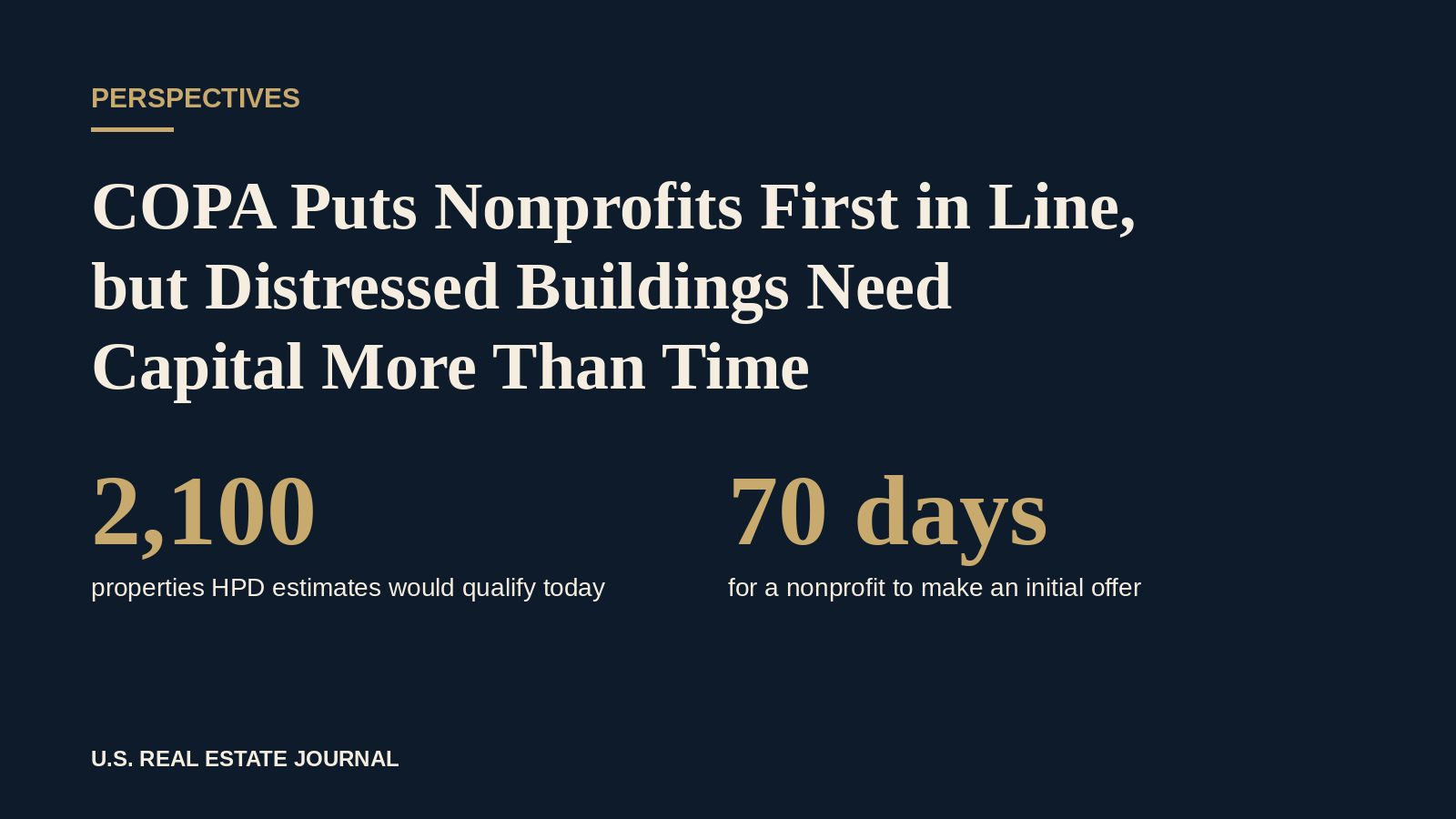
According to Realtor.com’s reporting, the final bill is much narrower than the version that stalled last year. It applies only to buildings with four or more units that meet specific measures of distress, foreclosure or repair actions, or that carry persistent hazardous violations. Owner occupied buildings with five or fewer units are exempt. When a covered building goes up for sale, the owner has to notify the Department of Housing Preservation and Development and qualified nonprofit buyers, who then get 20 days to express interest and 70 days to make an initial offer. The owner can say no, but if the building later sells to someone else, a qualified nonprofit can match that buyer’s price and terms.
The scale matters. HPD estimated in September that roughly 2,100 properties would qualify today, and that about 300 buildings sold last year would have met the criteria. That is a small slice of the city’s rental stock, but it is exactly the slice where distressed capital has been circling. CRE Daily reported last December that the earlier version, with a 45 day interest window, a 90 day offer window and a 30 day contract period, passed the Council 30 to 10. The shorter clocks in this version are a real concession to sellers, and they still add months to a sale.
Why the Timing Is Not an Accident
This law lands in the middle of a rent stabilized credit problem that has been building for years. CRE Daily’s coverage of A&E Real Estate’s $506 million CMBS loan is the clearest example I have seen. That loan is backed by 53 buildings and more than 3,500 units, 86% of them rent stabilized. KBRA now values the portfolio at $460 million, against an estimated $717 million when the loan was written in 2021, and projects bondholder losses above $80 million. Expenses are running about 22% above the original projections while revenue has grown only 6%. Layer on the rent freeze the Rent Guidelines Board approved in June, which landlords have challenged in court, and the math on a lot of older regulated buildings does not work at the old basis.
Nationally, distress is finally starting to trade. CRE Daily reported last week that distressed commercial property sales rose 26.4% through September and discounted apartment deals jumped 62.8%, even though distress is still only 2.4% of total volume. The forced selling everyone predicted is showing up, and New York has just decided to put a new bidder at the front of the line for its share of it.
Who Is Positioned to Win
The obvious winners are the larger, well capitalized nonprofits and community land trusts that already have acquisition lines, relationships with HPD and in house construction management. A 70 day offer window feels long to a seller, but it is short for an organization that has to assemble subsidy, a first mortgage and a rehab budget from scratch. The groups that can move inside that window will see deal flow they never had access to before.
The second set of winners, and the one I think gets missed, is private capital willing to partner with those nonprofits rather than compete with them. Realtor.com points to Washington, D.C., where a 2026 Urban Institute analysis found the city’s tenant purchase law helped create or preserve 16,224 affordable units from 2006 to 2020 and was associated with significant repairs to 12% of the city’s housing stock. The researchers stressed that purchase rights worked alongside financing and technical assistance, not in place of them. That is the opening. Lenders, bridge capital and construction managers who can turn a nonprofit bid into a closed deal are going to be in demand.
A right of first offer is only as valuable as the check that can follow it.
Where It Could Break
The risk owners raise is not imaginary. Ann Korchak of Small Property Owners of New York argued that the process will discourage conventional buyers who have the money to fix a failing building right away. I think she is right about the mechanism, even if I disagree about the scale. Any buyer underwriting a covered building now has to price in months of uncertainty and the chance that their negotiated terms become a free option for someone else. Some will bid lower. Some will not bid at all. For a building with open hazardous violations, every month of delay is a month of deferred repairs, and the tenants are the ones living with them.
There is also a financing gap hiding in plain sight. Washington and San Francisco show that purchase rights can work, but both leaned on public money to close deals. CRE Daily’s December coverage noted that city officials estimated $600 million in implementation costs for the earlier version. If the subsidy is not there when a nonprofit reaches the front of the line, COPA becomes a delay mechanism rather than a preservation tool, and the buildings it was meant to protect sit longer in distress.
Lenders and special servicers holding defaulted loans on covered buildings also face a slower and less certain exit. I expect that to show up in recovery assumptions and in how lenders time their resolutions.
What We Are Watching
Three things. First, the rules HPD writes on how nonprofits qualify and how the matching right works in practice, because that is where the law becomes either workable or litigated. Second, whether the city pairs COPA with acquisition and rehab capital at a scale that matches 2,100 eligible properties. Third, pricing on the first covered sales. If discounts widen enough, these buildings get cheaper for everyone, nonprofits included, and the law may end up working through price rather than through time.
At Kaufman & Company, we read this the way we read most turnaround situations: the building is rarely the whole problem, the capital stack usually is. If you are thinking through how distressed multifamily gets financed in this rate environment, our capital and lending page walks through how we approach it.
Sources
- NYC Council Passes COPA, Giving Nonprofits First Shot at Troubled Buildings, Realtor.com, October 22, 2026
- Blackstone’s $1.3B Apartment CMBS Loan Hits Special Servicing, CRE Daily, October 21, 2026
- NYC CMBS Loan Faces $80M Loss Risk as Rent Freeze Looms, CRE Daily, August 6, 2026
- COPA Legislation Moves Forward Amid NYC Housing Reform, CRE Daily, December 20, 2025