
Realtor.com ran a piece this week calling Fresno California’s unlikely new boomtown, and the headline undersells the more useful point. Fresno is not booming because it discovered something new. It is absorbing demand the coast keeps pushing out, because it still has the two things coastal metros have run out of: land people can afford and a city hall willing to let them build on it. That is a real advantage. It is also narrower and more fragile than the coverage suggests.
What the Numbers Actually Say
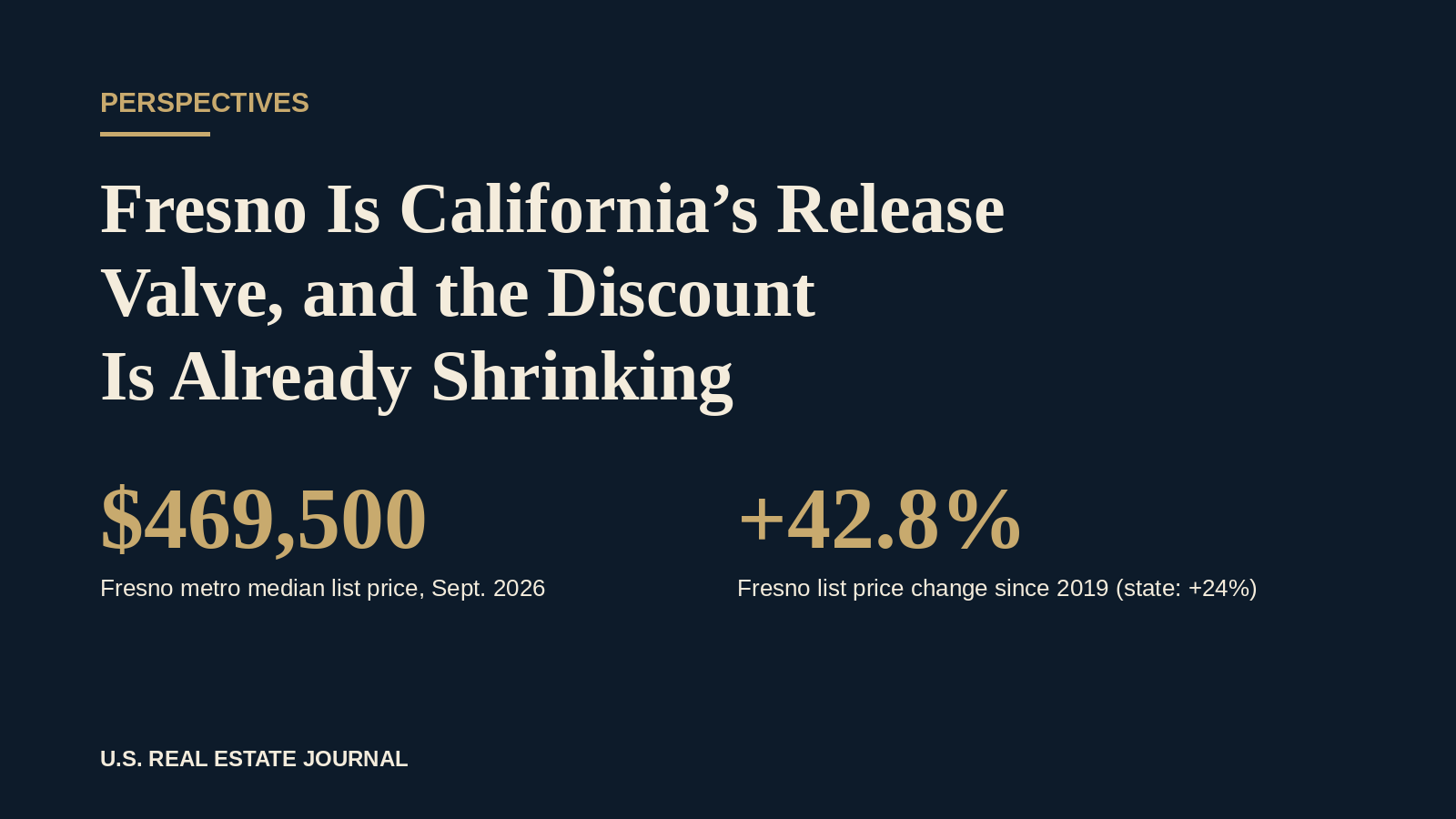
The story, which Realtor.com published from California Post reporting, lays out the case. Realtor.com data puts the Fresno metro median listing price at $469,500 in September, up 42.8% from $328,800 in September 2019. Statewide, the median listing price rose 24% over the same stretch, from $584,700 to $725,000. Fresno homes still list roughly 35% below the state average, and Fresno listings draw about 15% more online views than the California norm, with nearly half of those views coming from people in other California metros, led by San Jose, Los Angeles and Sacramento.
Supply is responding, at least by California standards. According to state figures cited in the piece, Fresno added more than 2,000 homes last year, a 1.1% increase in its housing stock and the seventh most of any city in the state, ahead of San Francisco at about 1,500. Census estimates show Fresno County has added roughly 22,500 residents since 2021 and now tops one million people, while state figures show Los Angeles lost some 33,000 residents last year.
The commercial side tells the same story. Cushman & Wakefield data in the article shows just 5% of the metro’s 84.6 million square feet of industrial space was available in the second quarter, and Scannell Properties broke ground last year on a $100 million industrial park expected to create up to 1,000 jobs. Employers are following land, and households are following employers.
Policy Is the Real Story
The detail I would underline is not the price chart. It is the 4 to 3 City Council vote last year that lets developers build homes in office districts and near bus stops without council approval or public hearings, along with the $9.9 million in developer fees the city has waived over the past decade. That is entitlement risk being taken off the table, and entitlement risk is what kills most housing deals before anyone moves dirt.
Contrast that with Los Angeles. Earlier this month Realtor.com covered a RAND Corporation study of Measure ULA, the city’s transfer tax on property sales above $5.4 million. RAND found that production of large multifamily buildings fell an average of 30% after the tax took effect, roughly 9,100 units that never got built, and that the tax had raised about $1.2 billion by early 2026, less than half of what its backers projected. When one city makes it more expensive to sell a finished building and another makes it faster to approve one, capital notices.
Cheap land only matters when a city lets you build on it, and Fresno decided to let people build.
This is the same pattern we look for in underpriced turnaround markets. The market that wins is rarely the one with the best story. It is the one where land is still cheap and the approval path is predictable.
Who Is Positioned to Win
Builders and land holders with entitled or by right ground inside Fresno city limits are in the best spot. Fee waivers and streamlined approvals compress the timeline, and a shorter timeline is worth more than almost any amenity package when rates are where they are. Industrial and logistics owners are a close second given that availability figure.
Employer anchored housing also fits here. When a single industrial park is promising up to 1,000 jobs, someone has to house those workers at rents they can carry, and Realtor.com notes that Los Angeles rents run about 65% higher than Fresno’s. Housing priced for the people who staff the warehouses, the farms and the clinics is the opportunity I would want to understand first, ahead of another round of move up product.
What the Headline Misses
Several things make me cautious. First, the discount is shrinking. Fresno list prices have risen almost twice as fast as the state’s since 2019. A market that sells itself on being about a third cheaper loses some of its pull every year that gap narrows, and much of the demand is coming from people priced out elsewhere rather than from local wage growth.
Second, the local job market is weaker than the migration story implies. The article notes Fresno County unemployment fell to 7.4% in September from 7.8% in August. That is progress, but it is still well above the 5.1% statewide rate. Underwriting rents and absorption on the assumption that local incomes will catch up to prices is a bet, not a base case.
Third, the K shaped housing economy is showing up here too. Realtor.com reports a 15% rise in million dollar listings in Fresno over the past year, while home sales have eased as higher mortgage rates squeeze budgets, with buyers at the lower end pulling back hardest. The buyers Fresno most needs to keep, first time buyers in their late 20s and 30s, are the ones most exposed to rates. If the market tilts toward luxury and move up product, it starts to look like the coastal markets people left.
Finally, the policy advantage is a political choice, and a 4 to 3 vote shows how thin it is. Fee waivers and hearing exemptions can be reversed by one council seat. Anyone underwriting Fresno land on the assumption that today’s approval path lasts through a full build cycle should price in the chance that it does not. Water, power and infrastructure capacity are also real constraints in the Central Valley, and cheap land does not solve them on its own.
What We Are Watching
We are watching four things: whether completions keep pace with the inflow or permits start stacking up unbuilt, whether Fresno County unemployment keeps closing on the state rate, whether the price gap with the rest of California holds near a third or keeps narrowing, and whether the council’s streamlining survives the next election cycle. In Los Angeles, the ULA reform debate and the mayoral race will tell us whether the coast decides to compete for this capital or keep exporting it.
If you follow where land and growth are moving metro by metro, the free watchlist at Land Briefing tracks these shifts, including the entitlement and infrastructure signals that tend to move before prices do.
Sources
- Inside California’s Unlikely New Boomtown Where Homes Sell for Under $500K, Realtor.com, October 26, 2026
- L.A.’s Mansion Tax Cost City 9,000 New Homes as Builders Pulled Back, Study Finds, Realtor.com, October 6, 2026