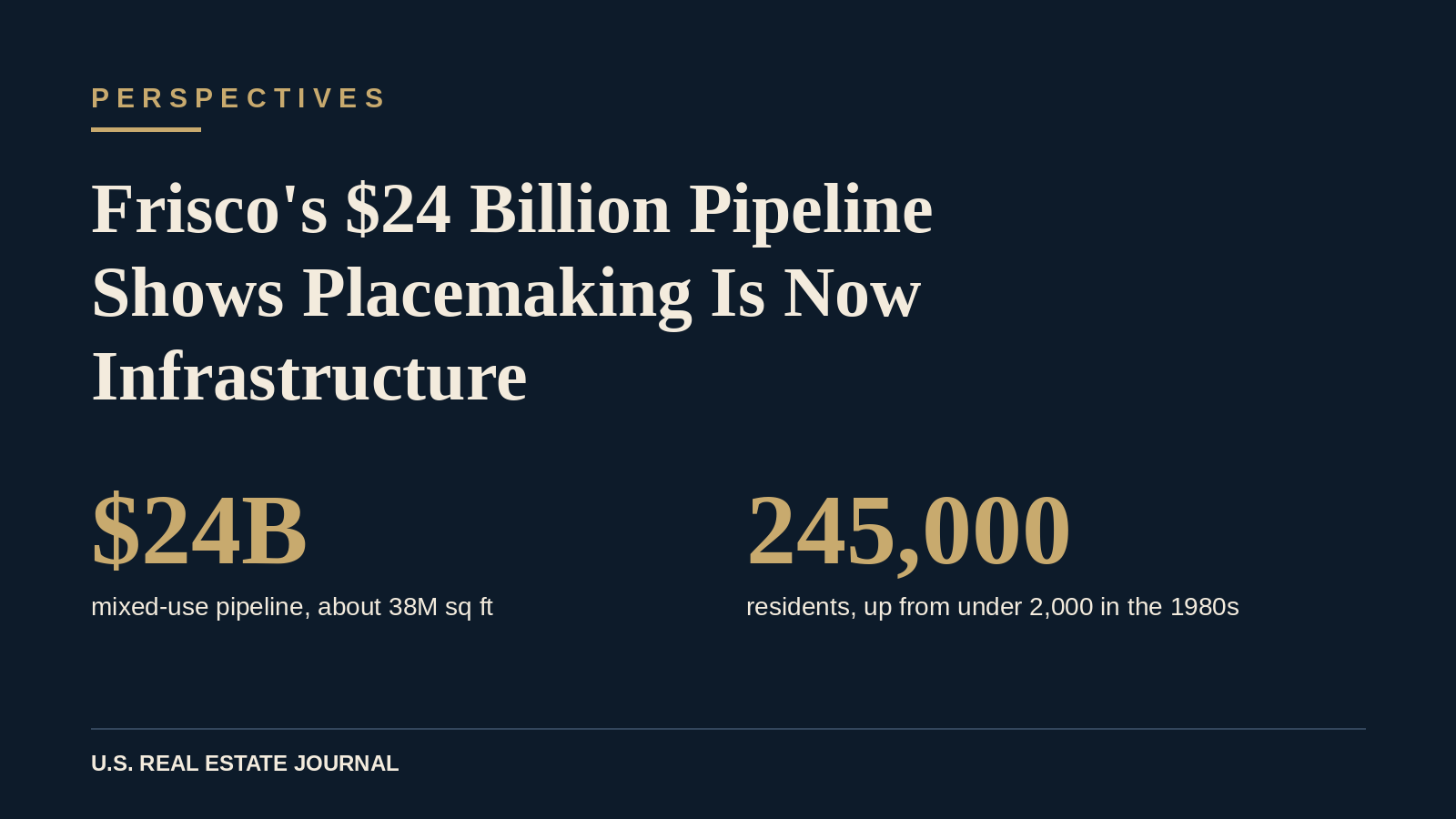

Frisco, Texas had fewer than 2,000 residents in the 1980s. It now has more than 245,000, and according to this week's CRE Daily Texas newsletter, which cites a Real Deal analysis, the city has at least $24 billion of mixed-use projects moving toward construction, roughly 38 million square feet of office, retail and multifamily. That is one of the largest suburban build outs in the country, and it is happening while most of the industry is still waiting on rates.
I read a story like this with two questions in mind. Why does the capital keep showing up here when it has gone quiet in so many other places? And which part of the plan is most likely to break?
What Frisco Built First
The headline number is the pipeline, but the more useful fact is the order in which things happened. Fields Frisco, the largest piece, is a $10 billion, 2,545 acre project from Karahan Companies and Hunt Realty. CRE Daily notes it already holds the PGA of America headquarters and the $500 million Omni PGA Frisco Resort, with a Universal Kids Resort on the way. The retail and residential layers are coming after the anchors, not before them.
That sequence matters. Retail and apartments follow demand. Headquarters, a resort and a destination create it. The $800 million Fields West and JVP Development's $3 billion, 112 acre The Mix, which targets a 2028 first phase, are being built into a place that already gives people reasons to show up. The same logic runs through the Toyota Stadium district, where the council approved up to $5 million to pair a $215 million stadium renovation with a 250 key hotel, a 15,000 square foot convention center and 30,000 square feet of retail.
This is what I mean when I say placemaking is infrastructure. It is not landscaping and a fountain. It is the decision about what goes in first, so that everything built after it has a market waiting.
Retail and apartments follow demand. Headquarters, a resort and a destination create it.
The Incentive Story Is Smaller Than It Looks
The easy read is that Frisco bought its growth. The numbers say otherwise. The city has pledged up to $113 million in performance-tied incentives to The Mix, which is real money. But the Frisco Chamber said that of 24 companies weighing a move or expansion in April, 60% to 70% arrived without incentives. Corporate relocation, not subsidy, is carrying most of the demand.
Performance-tied structures are also the right model when a city does spend. The public money pays out only if the private side delivers, which keeps the risk where it belongs. Cities that hand out incentives up front, before a single job or square foot exists, are buying hope. Frisco is mostly paying for results.
Where the Plan Can Break
I would not treat a $24 billion pipeline as $24 billion of buildings. Pipelines are announcements, and announcements are cheap compared with vertical construction at today's costs and today's debt terms. A few risks deserve more attention than the headline gives them.
First, office. The pipeline includes office space, and North Texas office debt is already showing strain. The same CRE Daily issue reports that office loans make up more than a fifth of DFW's delinquent CMBS value, compared with about an eighth nationally, with $434 million of office debt past due. A new suburban headquarters campus is a different product than an aging downtown tower, but lenders will still price the whole category with caution.
Second, absorption across overlapping projects. Fields West, The Mix and the stadium district will all be chasing retail tenants, hotel guests and renters in the same corridor. When several large projects deliver into one suburb within a few years of each other, the last one to open usually pays for the others' success in concessions and slower lease up.
Third, housing for the people who make the place run. A corporate magnet raises incomes at the top, but resorts, retail, hotels and stadiums run on hourly workers. If those workers cannot live within a reasonable commute, jobs get harder to fill and the district loses the energy that made it work. This is the K shaped housing economy at the scale of one city: luxury multifamily pencils, workforce housing does not, unless someone plans for it on purpose and early.
Fourth, power and land. The same newsletter notes that SpaceX plans a $24 billion data center and gas-fired power plant on a 444 acre tract at Starbase. Texas is now competing for electrical capacity and large sites across every use at once, and that competition will show up in the cost and timing of everything else, including mixed use.
Who Is Positioned to Win
The winners in a market like this are the owners who control land early, entitle it with a clear plan and can hold through a soft rate cycle without being forced to sell. Putting a national headquarters and a resort in the ground before the retail layer is a long hold strategy, not a quick trade. The weaker positions belong to merchant builders who bought late, at peak land prices, with short term debt and a business plan that assumes rents keep climbing.
For other metros, the lesson is not to copy Frisco's incentives. It is to copy its patience. The region spent decades lining up roads, schools and employers before the mixed use wave arrived. Most suburbs that want to be the next Frisco skip that part and then wonder why the new apartments sit half empty.
At Kaufman & Company we look at a project like this as a land and sequencing problem first and a building problem second. We buy, entitle, design, build and hold for the long term, so we care most about what will still be working in twenty years. That usually means the anchor, attainable housing for the people who staff it, and the infrastructure underneath both.
What We Are Watching Next
I am watching four things. Whether The Mix hits its 2028 first phase on schedule. Whether corporate relocations keep arriving without incentives while rates stay volatile. How DFW office delinquencies move through 2027, and whether they reach suburban campuses. And whether Frisco and the suburbs farther north plan seriously for workforce housing near these employment centers before rents push that labor out.
If you are weighing a mixed use, master planned or entitlement heavy project and want a disciplined look at the site and the sequence before you commit, our Site and Feasibility Review at Kaufman Real Estate and Consulting is built for exactly that question.
Sources
- Frisco's Mixed-Use Pipeline Tops $24B Across 38M SF as the Suburb Booms, CRE Daily, November 11, 2026