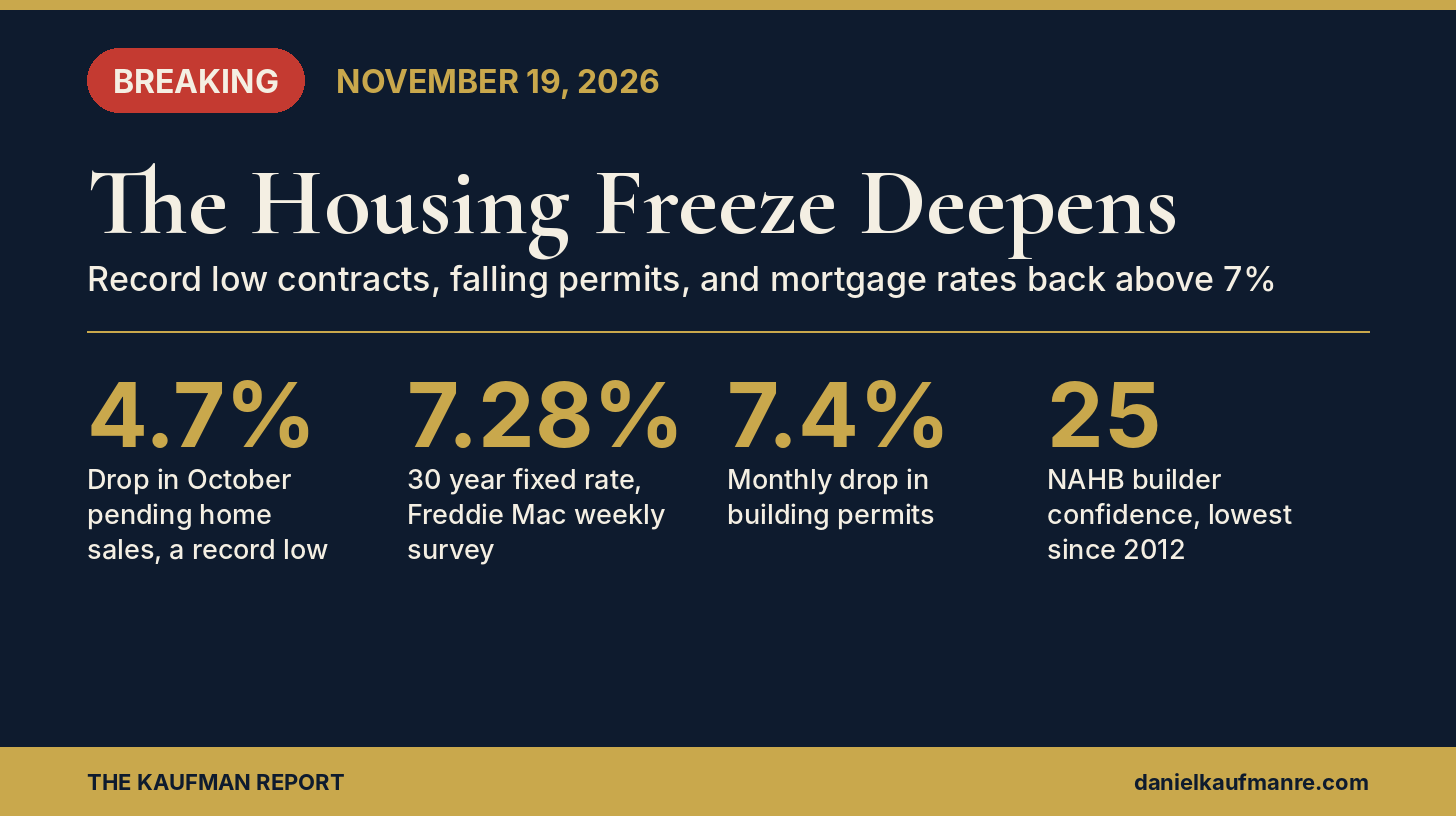

The housing data that landed this week was the bleakest set of numbers I have seen in this cycle, and it arrived on the same morning mortgage rates jumped again. On Wednesday the National Association of Realtors reported that pending home sales fell 4.7% in October and 16.7% from a year earlier, a second straight month at the lowest level in the index’s 25 year history, CNBC noted. The same day, the Census Bureau reported that building permits fell to a 1.295 million annual rate. Then on Thursday, Freddie Mac said the 30 year fixed averaged 7.28%, up from 7.11% a week earlier.
Put those three together and the message is simple. Buyers have stepped back, builders are pulling back at the top of the funnel, and the cost of a mortgage is moving the wrong way again.
The numbers that matter this week
- Pending home sales: down 4.7% in October and 16.7% year over year, with declines in all four regions, per NAR
- Regional pain: contracts fell 20.3% from a year ago in the West and 18.7% in the South
- Existing home sales: 3.75 million annual rate in October, down 8.8% from a year earlier and the lowest since 2010, per NAR via NPR
- Building permits: 1.295 million annual rate, 7.4% below September and 8.7% below October 2025, per Census
- Single family permits: 772,000, down 8.7% from September
- Housing starts: 1.309 million, up 9.9% from September, with single family starts up 4.0% to 864,000
- Builder confidence: the NAHB/Wells Fargo index fell four points to 25 in November, the lowest since April 2012
- 30 year fixed: 7.28% as of November 19 per Freddie Mac, versus 6.26% a year ago; the 15 year rose to 6.66%
Contracts are the leading indicator, and they are flashing red
Pending sales measure signed contracts, so they tell you what closings will look like over the next month or two. NAR Chief Economist Lawrence Yun said two straight months of record low contracts point to very sluggish fourth quarter closings, and that annual existing home sales could be the lowest since the mid 1990s. He also offered a hopeful read, that October “could mark the low point in contract signings for this housing cycle” because rates appeared to have topped out.
The rate market did not cooperate. One day after that release, Freddie Mac’s survey showed the 30 year up 17 basis points in a single week. With the Fed signaling another hike in December, I would not build a plan around rates having peaked.
When contracts fall to a record low and permits follow, the next supply shortage is already being written.
The trend behind the print
Starts rose in October, mostly on a rebound in larger multifamily buildings, but permits are the better signal of where construction is heading, and they fell. Builders are telling us the same thing directly. In the NAHB survey, 46% of builders cut prices in November, the highest share since Covid, and 68% offered sales incentives. The buyer traffic index fell to 16. Builders cited tariffs on materials, labor shortages, higher fuel costs, and mortgage rates above 7%.
Completions were 10.4% below a year ago in October, per Census. Fewer permits now means fewer completions later, in a country that already has not built enough housing.
What it means for investors
Rental demand gets stronger, not weaker. Every household that cannot buy at 7.28% stays in the rental pool. Well located workforce rentals near real employment should hold occupancy through this.
Transaction volume is the casualty. When sales run at 2010 levels, price discovery slows. Underwrite with real comparable trades, not list prices, and expect longer marketing periods on any disposition.
Motivated sellers are coming. Builders cutting prices and owners who planned to sell into lower rates are running out of runway. Patient buyers with their own capital will see real opportunities in land and stalled projects over the next few quarters.
What it means for developers
Do not chase the starts number. One strong month driven by multifamily does not change the direction set by permits and builder sentiment. Plan absorption for the market in front of you.
Product and price point decide who sells. Buyers who are still active are qualifying at 7% plus. Attainable, right sized homes near jobs are where demand is holding. That is why Haven, our attainable and workforce housing brand, sits at the center of how we plan new communities.
Use the slowdown to entitle. When others stop permitting, the projects that keep moving through entitlements and engineering will deliver into a thinner supply pipeline. As a long term owner, that is the window I care about.
Land basis is the margin. Land sellers who priced for a 6% mortgage market are starting to adjust. Buy at a basis that works at today’s rates, and let the cycle turn in your favor.
What I am watching next
- October new home sales and builder inventory of completed homes
- The December 8 to 9 FOMC meeting and the size of any hike
- The 10 year Treasury, which sets the floor for mortgage rates
- Freddie Mac’s weekly mortgage survey every Thursday
- November existing and pending home sales, to test whether October was the bottom
Bottom line
The housing market is in its deepest freeze in more than a decade, and this week rates moved higher again instead of offering relief. Record low contracts and falling permits mean weak sales now and less supply later. For anyone who can hold for the long term, buy land at the right basis, and keep projects moving through entitlements, this is the part of the cycle where the next set of communities gets positioned.
To track land and housing fundamentals market by market, use LandBriefing. If you want a second set of eyes on a site before you commit, the Site and Feasibility Review at Kaufman Real Estate and Consulting is where we work through those decisions.
Sources
- Pending Home Sales Decreased 4.7% in October, According to NAR Report, National Association of Realtors, November 18, 2026
- Two new housing reports point to bleak winter ahead, CNBC, November 18, 2026
- Monthly New Residential Construction, October 2026, U.S. Census Bureau, November 18, 2026
- Builder Sentiment Continues to Fall on Affordability Concerns, National Association of Home Builders, November 17, 2026
- Home sales fall to their lowest in 16 years, Stephan Bisaha, NPR, November 12, 2026
- Mortgage Rates Average 7.28%, Freddie Mac Primary Mortgage Market Survey, November 19, 2026