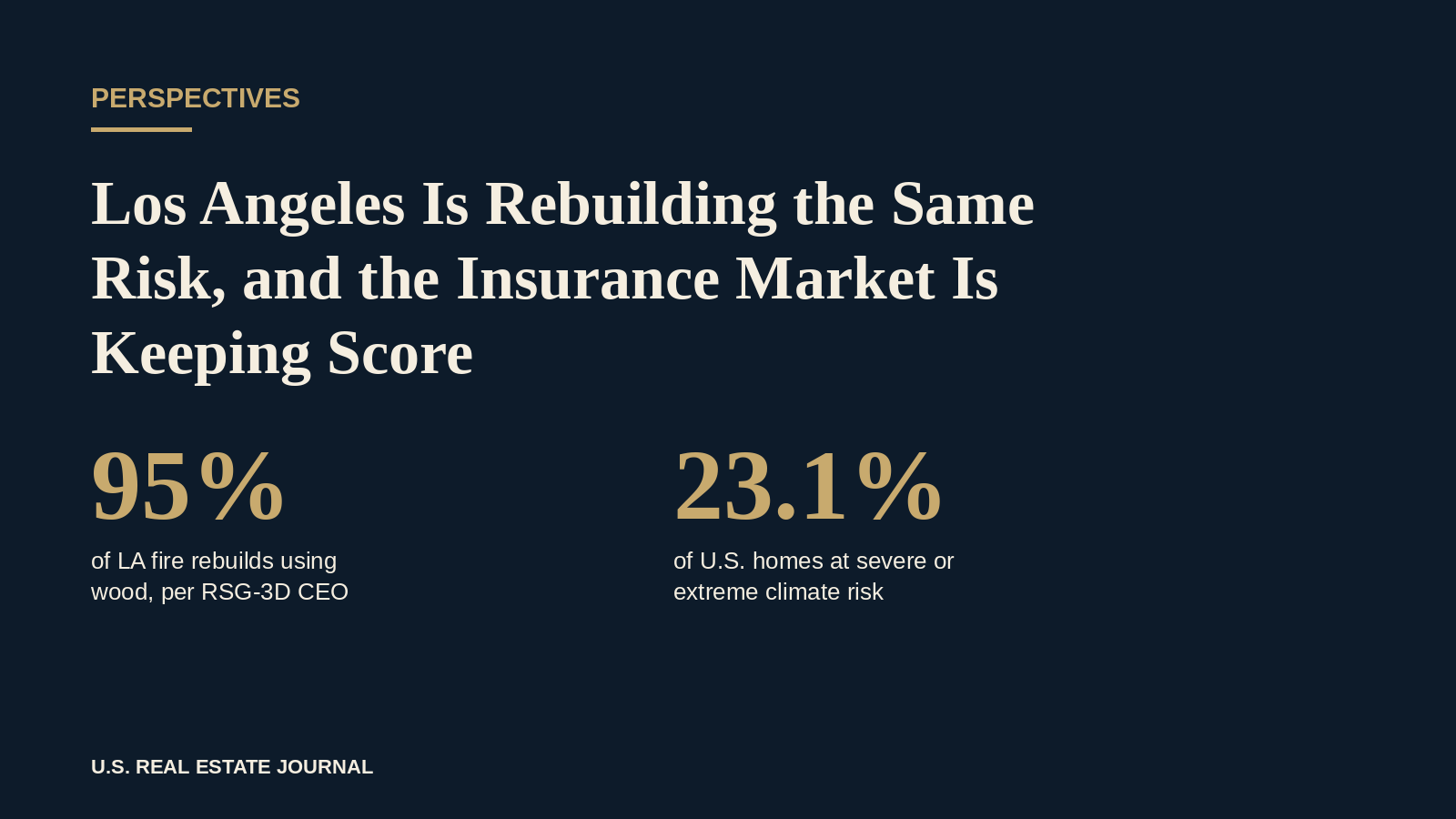

Nearly two years after the Palisades and Eaton fires, the rebuild in Los Angeles County is finally visible from the street. What is going up should concern anyone who owns property at the wildland edge. In a November 7 interview with Realtor.com, Ken Calligar, founder and CEO of the building technology company RSG-3D, estimated that 95% of the community is rebuilding with wood, and said many of the new homes are larger and sit closer together than the ones that burned. In his view, builders have "designed in the next disaster."
Calligar sells an alternative, framing panels of steel wire and foam wrapped in concrete, so his view comes with an obvious interest. I would not take his cost claims at face value without seeing bids. But his underlying point does not depend on his product. When a burned neighborhood comes back denser, bigger and built from the same fuel, the risk that destroyed it has been rebuilt along with the houses.
The market forgets faster than the fire returns
The most important number in the story comes from the 2026 Realtor.com Housing and Climate Risk Report, which the article cites. After the January 2025 fires, buyer interest in high risk homes fell about 10%, and it fully recovered within a month. Buyers pay for views, mountains and water. They do not price an event that wipes out a neighborhood once a decade, at least not for long.
The same report puts 23.1% of U.S. homes at severe or extreme risk from wind, flood or wildfire, with $11.2 trillion in exposure. NPR reported in August that more than 800 homes burned in Spokane, Washington this summer, in fires that ran through dense neighborhoods, and California regulators told NPR that more than 57,000 homes and buildings have been destroyed in the state over the last decade.
So the buyer is not the one keeping score. The insurer is, and the premium carries that score into every monthly payment, every sale and every refinance.
What the wood debate gets wrong, and what it gets right
The framing of wood versus concrete is a little too clean. As NPR noted, California has required fire resistant building materials in high risk areas for almost 20 years, and a wood framed house with a hardened exterior, ember resistant vents and a clean perimeter is a very different asset from the house it replaced. Research shows the first five feet around a structure matter a great deal, which is why the state Board of Forestry and Fire Protection voted in August to adopt Zone Zero rules limiting plants within that band.
But look at how those rules land. They apply to new construction right away. For the almost 2 million existing homes in high risk areas, NPR reported, the vegetation rules phase in no earlier than 2029, enforced by local inspectors who will start by educating rather than citing. Oregon and Washington defeated similar vegetation rules after public pushback. A hardened rebuild can sit next to an untouched older home, and embers do not respect lot lines. Fire risk is a block level problem that we keep regulating one parcel at a time.
That is where Calligar's point about spacing bites hardest. A bigger house on the same lot means less separation between structures. The choice that maximizes square footage for one owner raises the risk for every neighbor.
A neighborhood that rebuilds bigger, closer and with the same fuel has not recovered. It has reset the clock.
Who is positioned to win
The opportunity is real, but narrower than resilience marketing suggests. The winners are owners who treat hardening as part of the basis, not as an upgrade. According to NPR, California requires insurers to offer discounts to homeowners who make their homes more fire resistant. A building that can document its envelope, its perimeter and its access for firefighters has a case to make at renewal that a comparable building cannot. Over a long hold, that difference compounds through premiums, through insurability and eventually through value.
The second group is anyone building in mountain and gateway towns, where the workforce housing shortage and the wildfire map overlap almost perfectly. In those markets the cheapest land is often the land closest to the trees. We treat that as a land problem first: access roads, water pressure, defensible setbacks and how a parcel sits relative to its neighbors decide what can responsibly be built long before the framing material does. Sites that clear those tests are scarcer than they look on a listing.
Builders with noncombustible systems that actually pencil also stand to gain, but only if they can scale. Calligar told Realtor.com his firm has about a dozen Los Angeles projects underway and three times that number scheduled for next year, and he still calls it a small company. Capacity, trained crews and inspectors who know the system are the constraint, not demand.
The risks the headline misses
The downside is concentrated in a few places. First, owners rebuilding with claim checks that never covered true replacement cost will default to the cheapest compliant system, which in Los Angeles is wood. Resilience is a K shaped good right now: the households with the deepest pockets can build the concrete house, and everyone else rebuilds what the check allows. That splits streets into hardened and unhardened lots.
Second, appraisals and loan files still mostly value the house, not the block. A resilient home surrounded by fuel may never get full credit for its construction. Third, the regulatory calendar is slow. A 2029 start for existing homes is several fire seasons away, and each one is another chance for the market to relearn the lesson the hard way.
Then there is cost. Builders argue resilience makes homes unaffordable, and Calligar argues the opposite. I trust neither claim without line item numbers. The real answer depends on the site, the local labor market and what the insurer will actually credit.
What we are watching next
We are watching three things: whether California insurers turn Zone Zero compliance into meaningful premium differences, whether other Western states follow California or keep backing away after the Oregon and Washington defeats, and whether lenders and appraisers start asking about neighborhood level mitigation in wildland edge markets. If those three move, resilience stops being a design preference and becomes part of how every parcel in fire country gets priced.
If you follow resort, mountain and gateway markets where wildfire exposure and housing demand overlap, the free Mountain Watch from Land Briefing tracks those land and entitlement shifts as they happen.
Sources
- 'It's Insane': Building Tech CEO Slams L.A.'s Return to Wood Framing After Deadly Wildfires, Realtor.com, November 7, 2026
- California passes toughest wildfire rules in the U.S. for home landscaping, NPR via OPB, August 20, 2026