
Las Vegas just posted the most homes for sale it has ever recorded, and Nevada just posted the steepest drop in new home permitting of any state. Those facts sound contradictory. They are not. Read together, they describe a market that is pausing on demand while quietly undersupplying its own future, and I think that second half is the more important story for anyone who builds.
What the numbers actually say
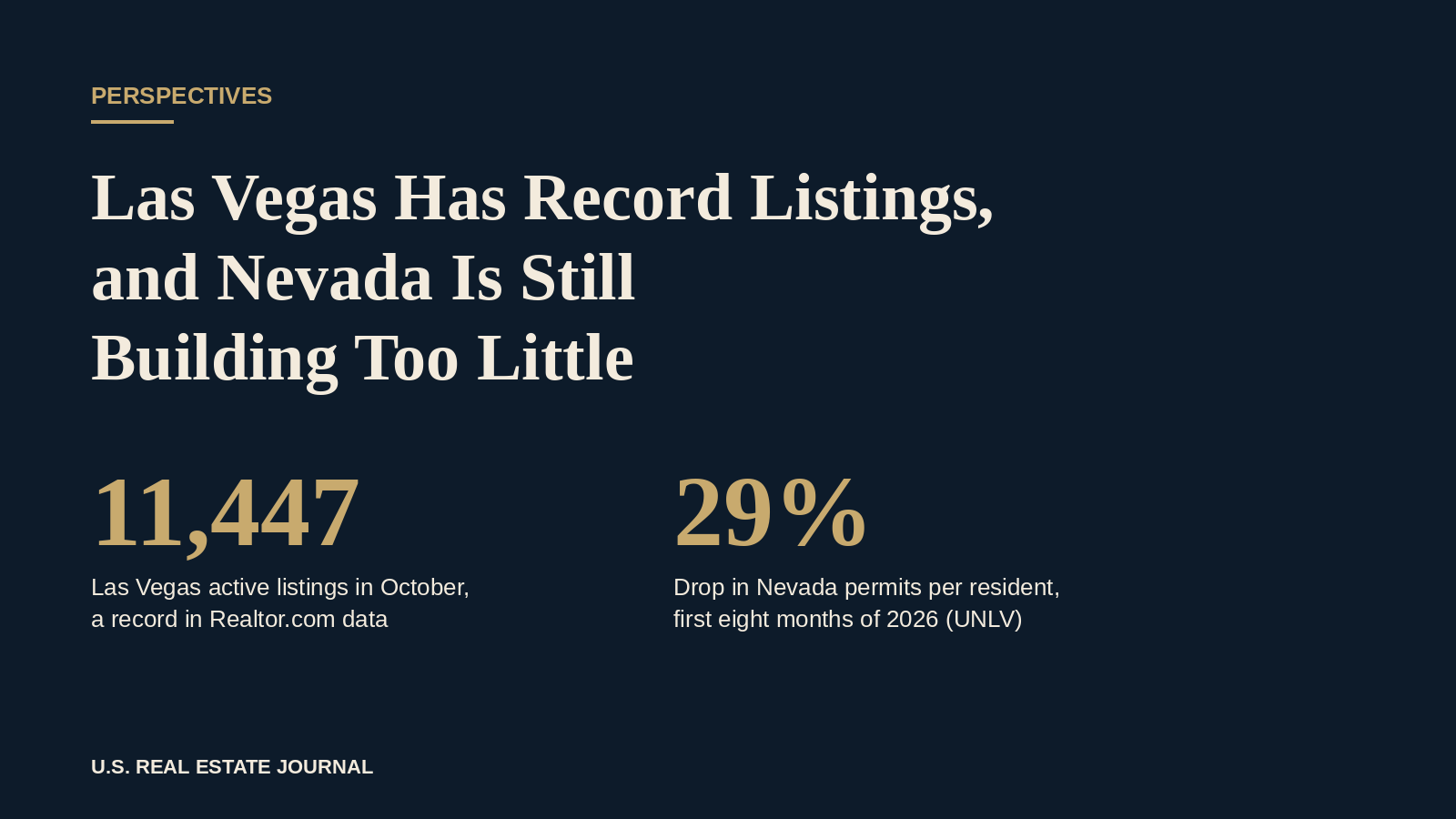
Realtor.com reported on November 10 that active listings in the Las Vegas metro rose nearly 10% from a year earlier in October to 11,447, the highest level in its data going back to July 2016. New listings fell 10.5%, and Realtor.com senior economist Jake Krimmel noted that fresh listings made up less than a quarter of inventory, down from 30.4% a year ago. The typical home sat 59 days. Contract signings fell more than 25%, worse than the roughly 17% national decline. The median asking price was $459,900, down 2.6%.
That is not a flood of new supply. That is the same homes sitting longer because buyers stepped back. Krimmel tied it to rising rates erasing the financing advantage buyers had enjoyed earlier this year. CRE Daily's November 9 national newsletter shows the same force on the commercial side: the 10-year Treasury climbed nearly 70 basis points from its August low into early October and closed November 6 near 4.86%, and buyers of income property are pressing sellers for 5% to 10% off agreed prices, according to Cushman & Wakefield data cited there.
Now the other side. A study from the Lied Center for Real Estate at UNLV, covered by Realtor.com on November 9, found that Nevada's permits per resident fell 29% in the first eight months of 2026 compared with the same stretch of 2025, the largest drop in the country. Realtor.com put Nevada at 12,662 permitted units in 2025 and 8,986 so far this year, and the study found Nevada is one of only two states, along with North Dakota, permitting fewer homes than its projected household growth.
Listings measure how long buyers hesitate. Permits measure what the market will have to sell two years from now.
Why I read the glut as temporary and the shortfall as structural
Inventory built from stale resale listings clears when the monthly payment changes. Permits that never get pulled do not come back on their own. Study coauthor Nicholas Irwin made the point that supply decisions made today set the prices people face 18 to 24 months out. If Nevada is permitting below household formation in a year of record listings, the likely sequence is a soft resale market now and a tight new home market later, arriving right when rates or incomes finally give buyers room to move.
The national picture sharpens the contrast. Realtor.com reported that September permits fell 5.2% from August and 7.4% from a year earlier to an annual pace of 1.22 million, yet senior economist Joel Berner called permits the "lone bright spot" in a difficult year, a sign builders want to be ready when conditions turn. Nevada is the state that is not getting ready.
The K shape is showing up inside one metro
The same Realtor.com report found the entry point for the top 10% of Las Vegas homes rose 2.2% to $1.2 million, and a local Sotheby's adviser counted 23 sales above $10 million so far this year against 18 in all of 2025. Wealthy buyers who are less sensitive to rates are still arriving. The broad middle, the households who need a mortgage payment that pencils, is the part that stalled.
This is the K shaped housing economy in a single market. The top end has capital and does not need the rate to fall. The workforce end, the hospitality, logistics, healthcare and construction employees who actually run the region, is waiting. And the product built for that buyer is the product builders cut first, because that is where margins are thinnest when land, labor and money all cost more.
Land is still the real constraint in the valley
Southern Nevada has a different land problem than most Sun Belt metros. Much of the ground surrounding the Las Vegas Valley is federally owned, so new supply depends on land being released and then served with water, sewer and roads. That process is slow and lumpy. When builders slow permitting, they also slow the infrastructure and entitlement work that has to happen years ahead of a foundation. A pause that looks like prudence in 2026 can become a lot shortage in 2028.
Compare the leaders. UNLV ranked South Carolina, Idaho and North Carolina at the top for permits per resident, with South Carolina at just over six per 1,000 residents against a national rate near 2.83. Those states pair job growth with land that can move through approvals. That is the Southern Squeeze in plain view: places that keep the land pipeline open take share from places that let it freeze.
Who is positioned, and who is exposed
The owners positioned to win are those who control entitled, serviced land and can carry it through a slow year without being forced to sell. They will be able to start while others are still restarting approvals. Long term owners who build for the middle of the market, rather than for a quick sale, can also take the other side of a moment when everyone else is cautious.
The exposure sits elsewhere. Sellers counting on a fast resale face 59 days on market and contract signings down by a quarter. Builders carrying land bought at peak pricing on short-term debt face the same rate pressure CRE Daily describes for commercial buyers. And working households face the worst version of the story: a soft market today that does not reach their price point, followed by a tight one that prices them out.
What we are watching next
We are watching three things. First, whether Nevada permits recover in the final months of the year or the 29% drop hardens into a trend. Second, the pace of federal land releases and the utility capacity attached to them, because that decides how fast supply can return. Third, the spread between luxury and median price movement in Las Vegas. If the top keeps rising while the middle slides, the gap in attainable housing grows even while the inventory headline looks generous. Data over emotion means reading the permit line, not the listing count.
If you follow land, entitlement and metro growth the way we do, the free watchlist at Land Briefing tracks these signals market by market.
Sources
- Las Vegas Inventory Hits Record High as Buyer Demand Sinks, Realtor.com, November 10, 2026
- These Sun Belt States Are Falling Behind on Home Permitting, Study Finds, Realtor.com, November 9, 2026
- Buyers Press for Deeper Discounts as Higher Financing Costs Bite, CRE Daily, November 9, 2026