
The most useful housing story I read this weekend was not about a big metro. In a November 8 profile, Realtor.com followed Ben Goehner, a developer who moved from Seattle to Mansfield, Ohio, to build attainable homes through his company, Western Dominion Land. Mansfield is a town of about 47,000 halfway between Columbus and Cleveland that lost its Westinghouse plant in 1990. Goehner told Realtor.com that his homes priced at $215,000 sold immediately, while homes at $260,000 sat for months, in a market where the median listing price is $229,000.
That spread is rural housing in one data point. The demand is there, it is extremely sensitive to price, and most of what gets built misses the price.
Shrinking on paper, short on the ground
The argument in the piece that stuck with me is about how demand gets misread. Goehner's point is that many rural counties look like they need no housing because population is falling, when population is falling partly because nothing has been built in 20 to 40 years. He gave Realtor.com a sharp example: Holiday City, Ohio, a village of 48 people near the Indiana and Michigan lines, is home to three large employers, including a Menards distribution center, that together draw roughly 1,500 commuters from out of state.
A census table would call that market dead. A payroll file would call it underserved. That gap is where data beats emotion. When a town's jobs outnumber its homes by that margin, the commute is the demand signal, and it does not show up in household growth until someone builds.
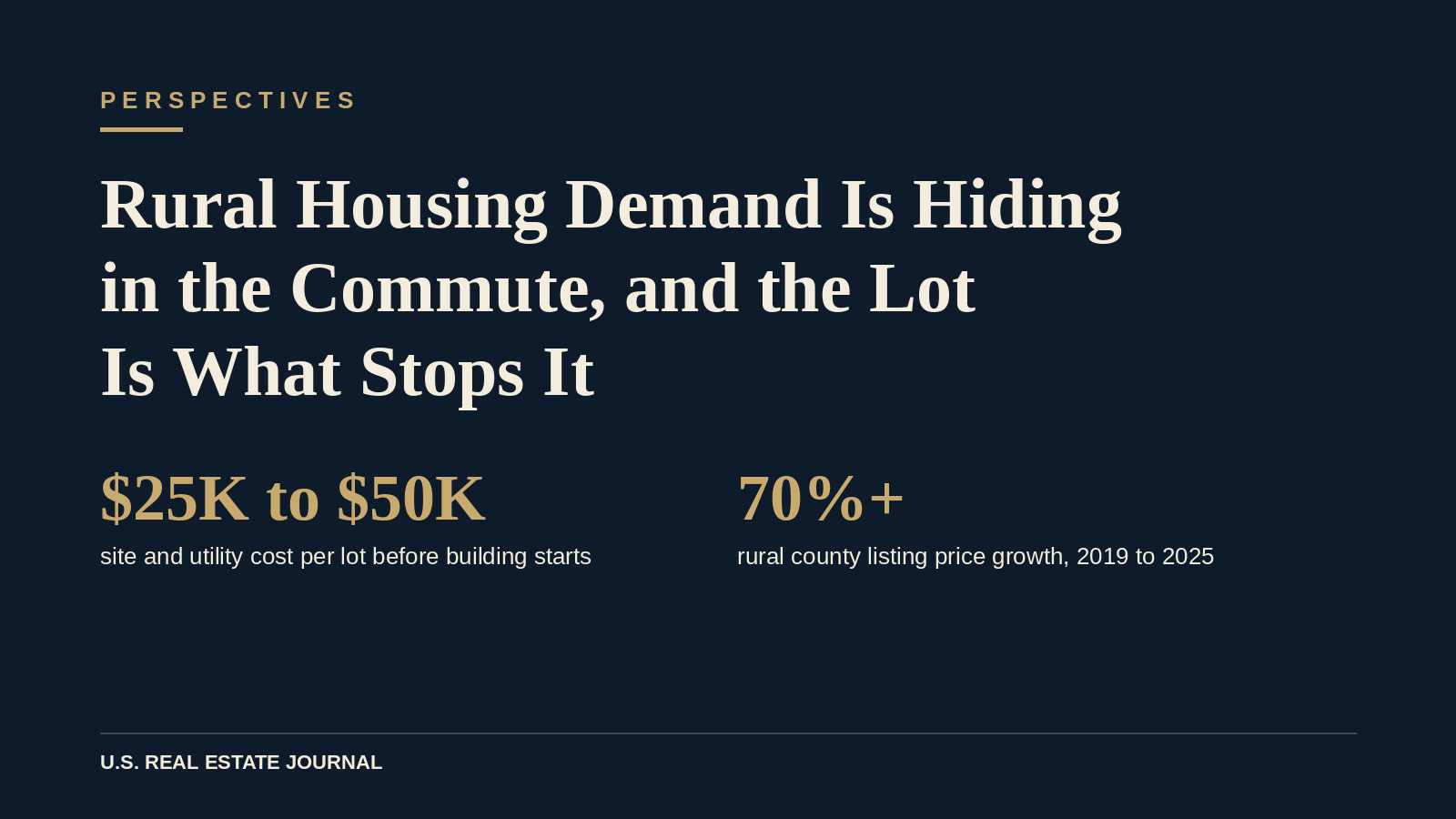
The price data backs this up. A Realtor.com analysis found that median listing prices in rural counties rose more than 70% between November 2019 and November 2025, against roughly 30% in metro counties. Prices do not run like that where nobody wants to live. They run like that where supply stopped.
A census table calls that town dead. A payroll file calls it underserved.
The lot is the bottleneck, not the house
Most of the attention in the profile goes to the factory. Western Dominion is building a structural panel plant in Mansfield, with first panels expected in early 2027, and Goehner says his process can deliver a move in ready home in 40 days, compared with the 8.8 months the National Association of Home Builders reports for a typical build. The more important number is about dirt: Goehner puts utility and site work at $25,000 to $50,000 per lot before a house can even start.
On a $215,000 home, that is roughly 12% to 23% of the sale price spent before vertical construction begins. You can make the box cheaper, and you should, but if water, sewer, power and roads have to be extended lot by lot, the box is not the constraint. Land and infrastructure are.
The second barrier is financing. Goehner described lenders asking for comparable sales in towns where nobody has built new homes in decades. That is a structural problem, not a credit problem: underwriting built on comps cannot see a market without them, so construction capital defaults to metros.
Who is positioned to win
The winners are operators who control the full chain and do not depend on a merchant builder's margin or a lender's comp set. Goehner's pitch is vertical integration, so no one takes a markup at every handoff. I agree with the logic, and it is the same reason Kaufman & Company is built the way it is. We buy land, fund with our own capital, entitle, engineer, design, build and manage, and we hold for the long term. When you are the long term owner, you underwrite a town's next 20 years, not its last six months of sales.
Employers should be winners too. Holiday City is a textbook case for employer anchored development. A distribution center losing workers to a long daily commute has a direct stake in homes near the dock door. That is the thinking behind Haven, our attainable and workforce housing brand: start from the jobs, then size the homes to what those paychecks can carry.
Policy may help at the margin. CRE Daily reported on November 6 that Treasury and the IRS designated 6,576 census tracts as new opportunity zones, effective January 1, 2027, with about 39% of them rural and a larger tax benefit for rural funds than for others. Ohio received 260 tracts. That will steer some capital toward small towns. It will not extend a sewer line.
The risks the headline misses
Rural demand is real, but it is thin. The same price sensitivity that sold $215,000 homes instantly is a warning. A builder who misjudges cost by 15% does not get a slower sale, he gets no sale.
Employer concentration cuts both ways. A village anchored by three businesses is exposed to the decisions of three businesses, and Mansfield itself is the cautionary tale: it lost its anchor plant and spent decades recovering. Anyone building workforce housing next to a single employer needs to underwrite the scenario where that employer leaves.
Execution risk is high as well. A new panel factory has to reach volume before its cost advantage shows up, and first production is not expected until 2027. And incentives like opportunity zones can pull in money that chases the tax break rather than the fundamentals, which bids up land without solving the lot cost problem.
What we are watching next
I am watching three things. First, whether states start funding infrastructure to the lot line in exchange for price commitments, which Goehner argues is cheaper over time than subsidizing rents. Second, whether lenders build underwriting for markets without recent comps, using employer payroll and commuter data instead. Third, where the new rural opportunity zones overlap with real employment centers, because a designation in a place with no jobs is just a map.
The broader point is that the K shaped housing economy has a rural branch almost nobody models well. The top end keeps building, while the middle of the market in small towns has been starved of new supply for a generation. The opportunity is not in finding cheap land. It is in finding towns where the jobs already arrived and the homes never did.
If you are working through land, utility and entitlement questions in a market like this, Kaufman Real Estate and Consulting is where we share how we think about development, construction and feasibility from the ground up.
Sources
- Meet the 27-Year-Old Who's Trying To Bring Housing Back to Rural Ohio, Realtor.com, November 8, 2026
- New Opportunity Zones Cover 6,576 Tracts, a 25% Cut, CRE Daily, November 6, 2026