
New Yorkers approved all five city charter amendments on the November ballot, and two of them go straight at the part of development that never shows up in a rendering: the waiting. One consolidates building approvals into a single Department of Buildings system. The other lets the city sell small, awkward parcels without the full land use review. I think both are real progress. I also think the market should be careful about pricing in speed that has not arrived yet.
What voters actually changed
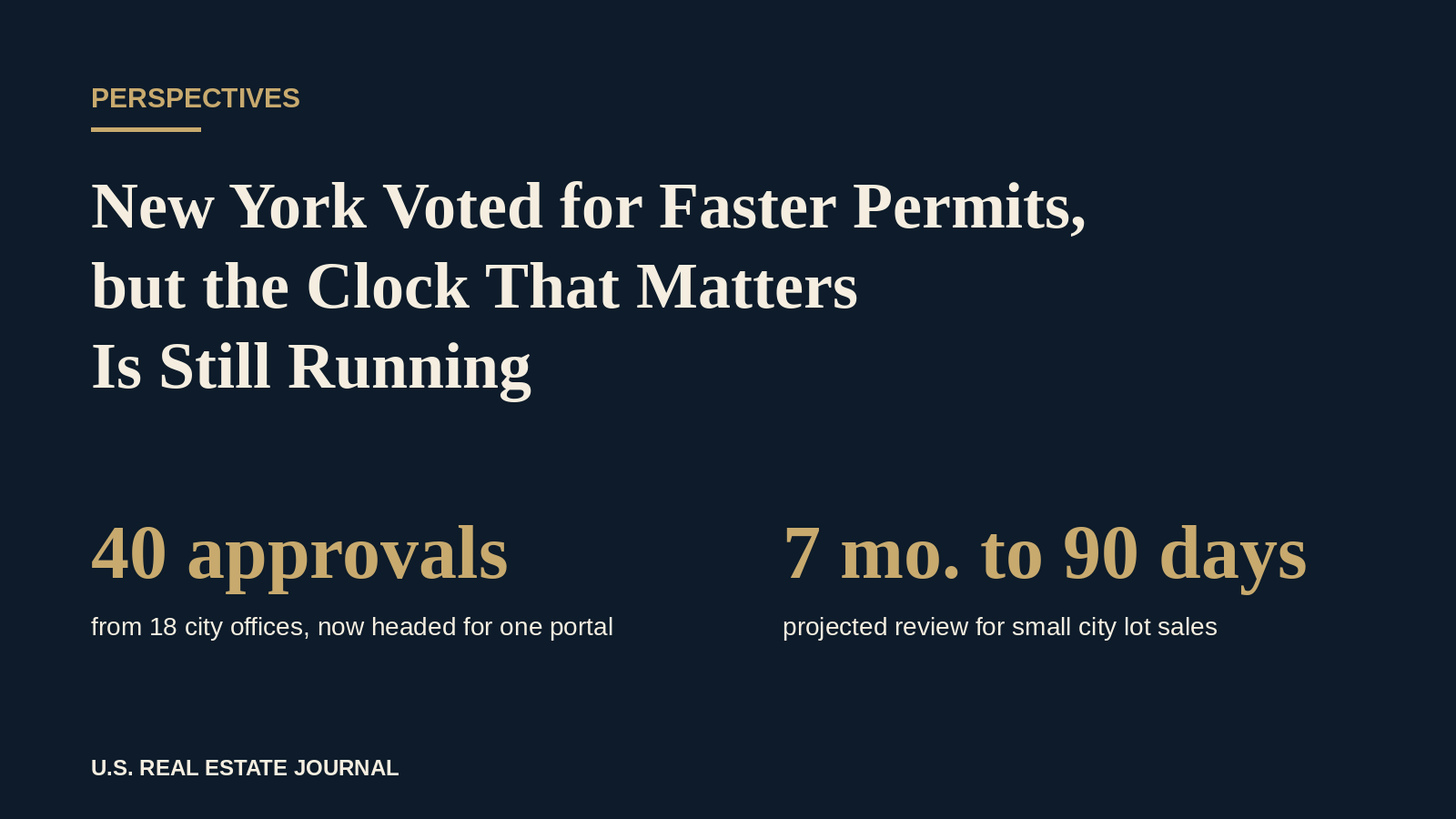
CRE Daily, summarizing reporting from Bisnow, laid out the scale of the problem: builders in New York collect roughly 40 approvals from 18 separate city offices. Proposal 4 puts those approvals behind one Department of Buildings portal and moves permits for certain waterfront structures from Small Business Services to Buildings. According to 6sqft, which cited unofficial Board of Elections results, it passed with about 67.7% of the vote.
Proposal 3, which drew about 65.7%, creates a faster review track for the sale or lease of city properties of 10,000 square feet or less and for transfers of unused development rights from city-owned landmarks. The community board and borough president review at the same time, and the City Planning Commission makes the final call with no last round at the City Council. NYC Votes, the city's official voter guide, notes the shortcut applies only when no environmental impact statement is required, and sales of undevelopable slivers to adjacent owners without an auction become permanent. Bisnow reported the city's efficiency commission expects that process to fall from about seven months to roughly 90 days, and 6sqft reported the administration sees more than $200 million in potential revenue from small surplus lots and unused air rights.
The procurement change is smaller than it sounds. CRE Daily reported that public works contracts take a median of 387 days to award, and the reform trims about 30 of them.
Why time is the real cost
We underwrite schedule the way most people underwrite rent. On any ground-up project, the months between controlling a site and pulling a full permit are months of carrying cost with no revenue, and that cost has gotten heavier. In a separate CRE Daily brief the same day, a self storage developer described financing on deals moving from about 6% to 8% or 9% while terms were still being negotiated. CRE Daily's national newsletter noted the 10-year Treasury climbed nearly 70 basis points from its August low into early October. At those numbers, a permit that arrives three months earlier is not an administrative nicety. It can be the difference between a project that pencils and one that waits for another cycle.
That is why a single portal matters more than any one approval. Forty sign-offs across 18 offices is not 40 separate delays. It is a chain where each link waits on the last and nobody owns the whole schedule. One system with one queue gives a builder something close to a critical path they can actually see and manage.
Speed written into a charter is a promise. Speed you can underwrite is a track record.
Who is positioned to win
The small lot provision is the piece I would watch most closely, because it touches the scale of infill that New York has struggled to unlock. A 10,000 square foot cap means corner remnants, side yards and odd parcels next to existing buildings. The obvious winners are adjacent owners who can fold a sliver into a better site plan, and smaller builders who can move on a 90 day disposition where a seven month review would have killed the deal. For workforce housing, those parcels are often exactly where a few dozen units near transit can go without a rezoning fight. With the city's stated goal, cited by CRE Daily, of about 700,000 new homes over a decade, every buildable lot that comes out of the inventory of unused public land counts.
Owners of landmark properties with unused air rights also gain a cleaner path, since those transfers can now follow the faster track. In a city where land is the scarcest input, unlocking development rights that already exist is about the cheapest new supply there is.
What could break
The first risk is the calendar. 6sqft, citing amNY, reported a target launch for the permit portal of December 1, 2029, contingent on funding, with room for the deadline to slip. A builder buying land today will likely pull permits under the old system. Anyone paying for speed in a land price this year is paying for something that may arrive after the project is finished.
The second is that consolidation is not elimination. A single portal still routes plans to fire, environmental and transportation reviewers. If those agencies stay understaffed, one front door just means one longer line. The substantive requirements did not change. Only the plumbing did.
The third is political. The Municipal Art Society warned, as quoted by 6sqft, that the land change could make public land and development rights easier to sell "without sufficient safeguards." Faster dispositions with less Council review invite scrutiny of the first deals that go through. If an early sale looks like a giveaway, the backlash could slow the program more than any statute.
The fourth is the one the headline misses. None of this touches zoning or construction cost. A lot you can buy in 90 days still has to support a building that pencils at today's financing rates. Entitlement got shorter at the margin. Land and the right to use it remain the bottleneck.
What we are watching next
We are watching three things. First, whether the city funds the Buildings portal in the next budget, because a charter mandate without money is a deadline that moves. Second, the first batch of small lot dispositions under the new track: how many parcels, how fast, and at what prices relative to the $200 million estimate. Third, whether other large cities copy the single portal model, which would tell us cities are starting to treat time as a housing cost rather than celebrating a one-time ballot win. Data over emotion means waiting for a year of actual approval times before treating New York as a faster place to build.
If you are weighing an infill site, a small public disposition or an entitlement path in a market like this, Kaufman Real Estate and Consulting offers a Site and Feasibility Review built for exactly that question.
Sources
- NYC Permitting Reform Passes Alongside Faster Land Sales, CRE Daily, November 9, 2026
- NYC Self Storage Developers Face Cost and Zoning Barriers, CRE Daily, November 9, 2026
- Buyers Press for Deeper Discounts as Higher Financing Costs Bite, CRE Daily, November 9, 2026
- New Yorkers Approve Ballot Measures To Speed Up Permitting, Contracting, Bisnow, November 4, 2026
- NYC voters approve all five Mamdani ballot proposals. Here's what changes, 6sqft, November 4, 2026
- 2026 Ballot Proposals, NYC Votes, accessed November 11, 2026