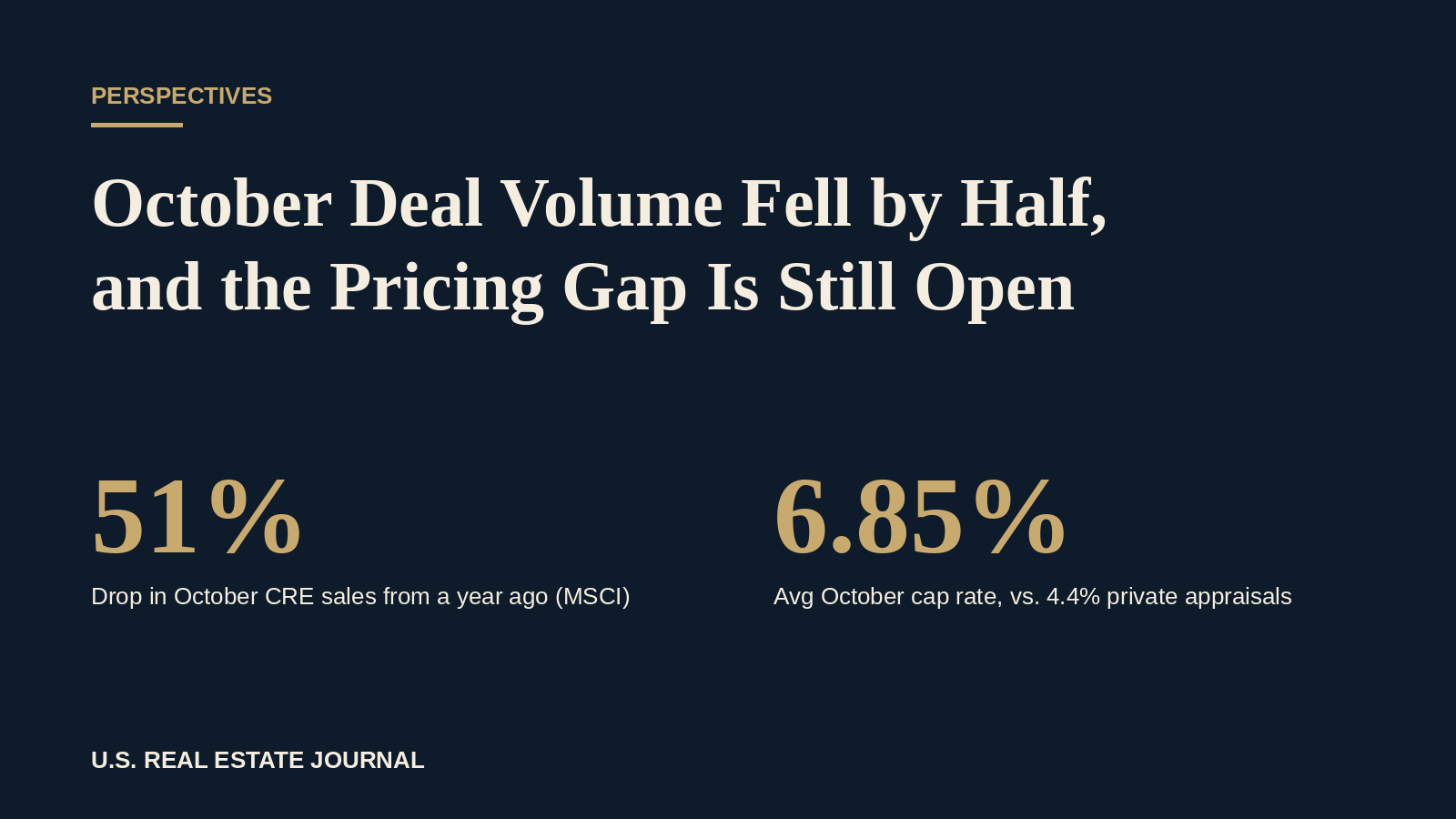

Commercial real estate had a good third quarter and a bad October, and I think October is the more honest of the two. CRE Daily reported that, according to MSCI, October transaction volume fell to $35.4 billion, down 51% from a year earlier. That came right after a third quarter that MSCI put at $160.6 billion in sales, up 16% annually. Altus Group's count of the same quarter was even stronger, with volume up 20.3% and industrial and office leading the gains.
A swing that sharp is not about property fundamentals changing in 30 days. It is about the cost of money. CRE Daily notes that the 10-year Treasury topped 5% in September and that the Fed followed with its first rate hike since 2023. At the November 19 close, the newsletter had the 10-year at 5.044%. Buyers repriced, many sellers did not, and the deals stopped.
The Gap Between the Marks and the Market
The number I keep coming back to is not the 51%. It is the distance between two cap rates reported in the same CRE Daily issue. MSCI's average cap rate on October trades rose 15 basis points to 6.85%, with retail up 16 basis points to 7.20%. Meanwhile, private appraisal cap rates slipped to 4.4% in the third quarter, which puts them below the 10-year Treasury for the first time since 2022.
Those two figures do not measure exactly the same pool of buildings, so I would not treat the spread as precise. But roughly 245 basis points separate them, and the direction is unmistakable. The buildings that traded were priced at one level, and the buildings sitting in private portfolios are being carried at a very different one. On a stabilized asset, that is not a rounding error. It is the difference between a valuation that holds and one that does not survive a refinance.
The deals that stopped in October did not disappear. They are waiting for someone to admit what the building is worth.
When marks lag the market, transactions freeze because nobody wants to be the first to print a loss. That is what October looks like to me. It is not a collapse in demand for real estate. It is a standoff over price.
Where the Standoff Breaks
Standoffs end at maturities. CRE Daily reports that fresh appraisals on 295 distressed apartment loans cut values 33% to $6.5 billion, and that 57% of those loans now owe more than the property is worth. Servicers have reworked $98.3 billion of CMBS loans since 2022, and a little over 21% of the remaining balance is delinquent again, compared with 4.7% for loans that were never modified.
The most useful data this week came from Trepp, as covered by CRE Daily. Of 966 CMBS modifications since January 2022, only 210 included a paydown of at least 1% of the balance. Twelve months later, 21% of the paydown loans were in special servicing, delinquent or liquidated, against 40% of the loans where the borrower put in no new cash. By month 24 it was 17% versus 39%, and 51% of the payers had paid off entirely versus 18% of the rest.
That tells you what separates survivors from casualties in this cycle. It is not property type or market alone. It is whether the owner has real equity to put in when the math changes. Trepp also found that higher reserves did not track with better outcomes, partly because some of that cash was swept from the property rather than contributed fresh. Extensions without new money buy time; they do not fix anything. And the patience is wearing thin: Trepp's data shows foreclosure at 23% of special servicing exits, while modifications fell to 37% from 54% in 2024.
Who Is Positioned, and Who Is Exposed
At Kaufman & Company we fund our work with our own capital and we hold for the long term. We do not sell, so a frozen exit market does not hit us the way it hits an owner facing a maturity date. That changes how I read October. When volume falls by half, the owners who must transact set the price, and the owners who do not have to transact get to choose.
The exposure sits in a few clear places. Owners who bought or refinanced at peak values with floating rate or short term debt are the obvious group. Assets carried at appraisal cap rates near 4.4% are another, because when those marks catch up to the trading market, values will move down in steps, not all at once. Retail, where cap rates rose the most in October, deserves a closer look than its recent rebound suggests.
There is also a risk on the buy side that the headline misses. A 51% drop invites people to call a bottom. I would not. Moody's, as cited by CRE Daily, expects U.S. growth to cool to 2% in 2027 and 2028, which keeps pressure on borrowing costs. Buying a distressed asset at a 33% discount to its last appraisal is not a bargain if the rent roll, the insurance bill and the capital needs have not been underwritten from scratch. Data over emotion matters most when the discount looks largest.
The fundamentals underneath are mixed rather than broken. CRE Daily reports apartment occupancy reached 95.7% in the third quarter as the construction pipeline shrank 6% to about 504,000 units. That is a healthy operating backdrop for well located housing, including the attainable and workforce product we build through Haven. The trouble is in the capital structure of specific assets, not in demand for places to live and work.
What We Are Watching Next
First, December. CRE Daily notes that December typically accounts for roughly 15% of annual deal activity, so a real year end rebound would tell us sellers have started to meet the market. A weak December tells us the standoff carries into 2027. Second, the 10-year. Every week it holds above 5% makes appraisal marks near 4.4% harder to defend. Third, servicer behavior. If servicers start demanding paydowns as the price of an extension, which is what the Trepp data argues for, owners without fresh equity will be pushed to sell or hand back the keys, and that is when the trading market finally clears.
The quiet months are when the next cycle's basis gets set. I would rather be early in understanding where real prices are than early in paying them.
For more on how we approach development, entitlement and distressed assets as a long term owner, visit Kaufman Real Estate and Consulting.
Sources
- CRE Sales Plunge 51% in October After Strong Q3 Rally, CRE Daily, November 20, 2026
- CMBS Loan Modifications With Paydowns Fare Twice as Well, CRE Daily, November 20, 2026