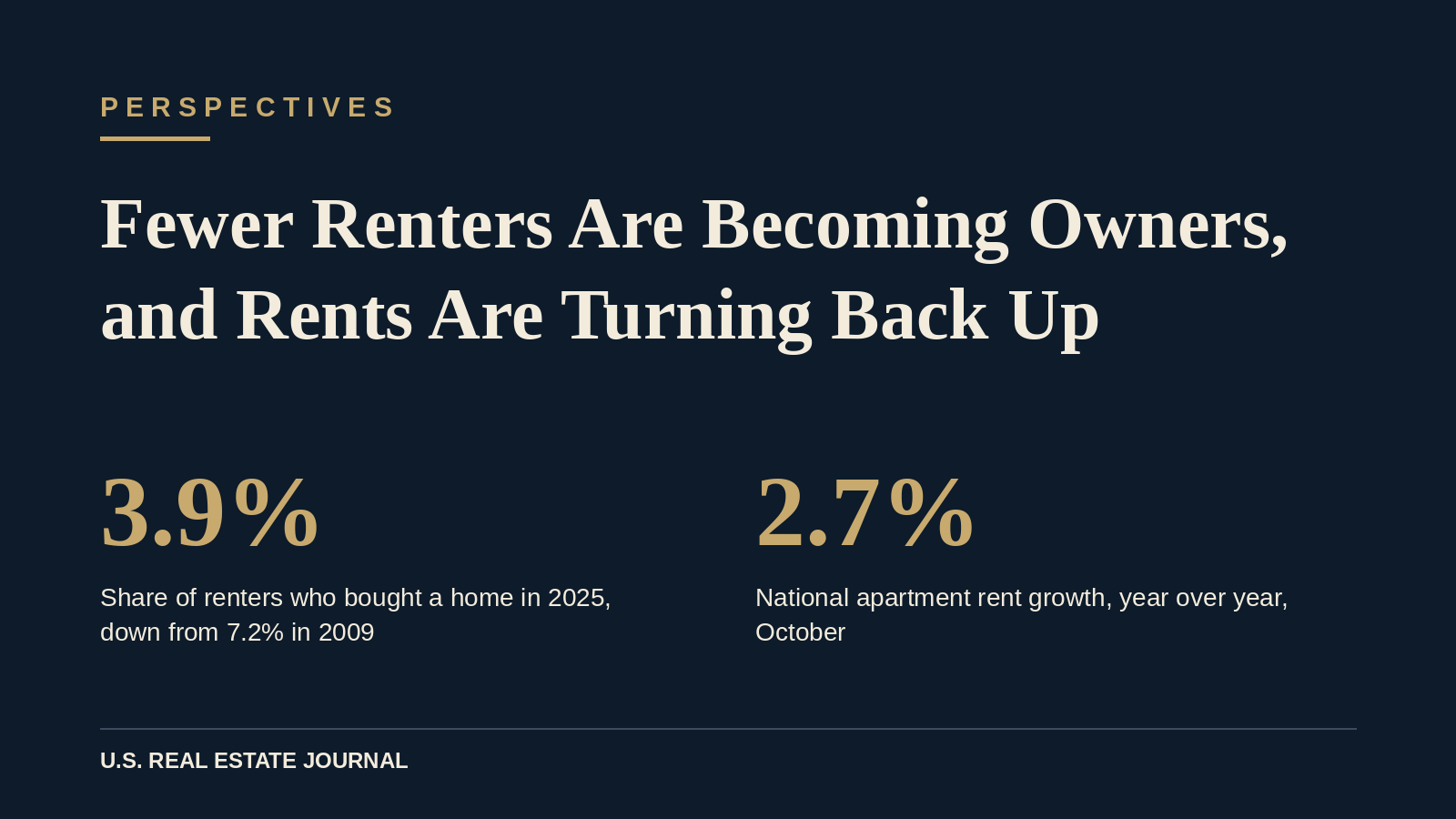

The share of renters who make the jump to homeownership fell to 3.9% in 2025, down from 7.2% in 2009, according to a TransUnion insurance outlook reported by Realtor.com. That is a 46% drop in the rate at which tenants become owners. TransUnion paired it with a National Association of Realtors finding that the median age of first time buyers rose from 33 to 40 in five years.
A day later, Realtor.com reported that the median asking rent rose year over year in October for the first time since June 2023. The gain was a single dollar, to $1,692. CRE Daily, citing Chandan Economics, put national apartment rents 2.7% above a year ago in October, up from 2.4% in September and from roughly 1% at the March trough.
I read these two stories as one story. The rent recovery is not mainly about a hot economy. It is about a household that used to leave the rental pool every year and now stays.
The Exit Door Is Narrowing
For decades, apartment demand had a natural release valve. Renters saved, married, had kids and bought a starter home, and their unit turned over to the next household. When that conversion rate nearly halves, the renter base swells without anyone building a single new job. That is the quiet engine behind occupancy holding up through the biggest delivery wave in a generation.
The numbers explain why the door is narrowing. Realtor.com noted that mortgage rates are above 7%, and Cotality chief economist Selma Hepp pointed to construction costs, insurance premiums and property taxes on top of the payment itself. An agent quoted in the TransUnion story put it plainly: renters did not stop wanting to own, the monthly number just stopped working. I agree with that framing. This is a math problem, not a preference shift, and math problems tend to persist until a price, a rate or a product changes.
This is the K shaped housing economy in one chart. Households with equity and low locked rates are fine. Households without equity are being held in the rental market longer, and they are getting older while they wait.
Supply Is Leaving Just as Renters Stay
The second half of the story is the pipeline. Realtor.com reported that roughly 1.5 million units in buildings with five or more units were completed from 2023 to 2025, which held rents flat. That wave is ending. Third quarter multifamily completions fell 26% from a year earlier to an annualized 330,000, starts averaged 403,000, and units under construction slipped to 674,000. Realtor.com senior economist Jiayi Xu said she does not expect deliveries to rebound over the next 12 months.
On the for sale side, Census data reported by Realtor.com showed October building permits at an annualized 1,295,000, down 8.7% from a year earlier and the lowest since May 2020, with single family permits down 12.9%. Fewer new homes for sale means even fewer renters converting. The two pipelines are shrinking at the same time, and both feed the same pressure on rent.
The rent recovery is not a boom in demand. It is a household that used to move out and now cannot.
Where the Opportunity Sits
The winners are owners of well located rental housing at price points the stuck renter can actually pay. That is not luxury product. It is workforce housing, attainable rentals and build to rent communities near real employers, where a nurse, a teacher or a plant technician can live within a reasonable commute. When the exit to ownership closes, those tenants stay longer, renew more often and value stability over amenities.
I also think this argues for patience on land. Starts are falling now, which means the deliveries of 2028 are being decided this winter. Developers who control entitled sites and can build without relying on a hot exit market will deliver into a thinner pipeline. That is the case for being a long term holder rather than building to sell into a cycle.
There is a product opportunity too. If renters are 40 by the time they buy, the rental market needs more family sized units. Realtor.com found two bedrooms leading the October rebound while studio rents fell 1.2%. That is renters telling us what they need.
The Risks the Headline Misses
First, momentum is fading even as the annual number climbs. CRE Daily reported that October's monthly gain annualizes to 3.85%, the first reading under 4% since June, and that only 69.3% of metros posted a monthly increase. Chandan also cautioned that advertised rents can take time to reach property income when owners hold asking rates but give concessions. Underwriting a quick return to strong rent growth is how deals get hurt.
Second, vacancy is still high. Realtor.com cited a Census rental vacancy rate of 7.6% in the third quarter, the highest since early 2014. Absorption has to keep working off that inventory before landlords regain real pricing power.
Third, the geography is uneven, and the Southern Squeeze is real. TransUnion found Florida, Texas, the Carolinas and Tennessee gained the most new residents, but it also flagged that those states carry heavier hurricane and storm exposure. Insurance and taxes rise with in migration, so a renter who moved south for a cheaper payment may find the gap closing. CRE Daily noted San Antonio rents are still down 1.0% from a year ago, while San Francisco leads at 13.3% on AI hiring. A national rent number hides a lot of local pain.
Fourth, the social cost is a policy risk. A generation that cannot buy will vote, and rent control, investor restrictions and tenant mandates tend to follow affordability stress. Owners who price fairly and invest in their properties will be in a better position when that conversation reaches their city council.
What We Are Watching Next
We are watching three things. The first is the monthly rent pace through winter, because a soft season will tell us whether the rebound has depth. The second is concessions, since a rising asking rent with rising free months is not a recovery. The third is starter home supply, especially state reforms that legalize smaller lots and cheaper product, because the only durable fix for the conversion problem is a home the renter can afford to buy.
Until then, I expect more households to rent longer, and I expect the markets that pair jobs with attainable housing to keep pulling ahead. If you want to see how we think about building and holding for that renter over the long run, our approach is laid out at Kaufman & Company.
Sources
- Study Finds a Nearly 50% Drop in Renters Becoming Homeowners Since 2009, Realtor.com, November 17, 2026
- Rents Rise Annually for First Time in 3 Years as Multifamily Building Boom Stalls, Realtor.com, November 19, 2026
- Multifamily Rent Growth Climbs to 2.7%, but Monthly Gains Keep Cooling, CRE Daily, November 19, 2026
- Single-Family Construction Rebounds in November, but Permits Nosedive, Realtor.com, November 19, 2026