
The Senate voted 62 to 33 last week to pass the Bipartisan American Affordability and Jobs Act, the permitting bill known as BAAJA. As Realtor.com reported, it narrows the scope of federal reviews under the National Environmental Policy Act and the Clean Water Act, and most of its target is big energy infrastructure: pipelines, transmission, power plants and mines. Housing groups from the National Association of Home Builders to YIMBY Action backed it anyway, and the National Association of Realtors said it supports cutting the regulatory burdens that delay construction.
I read a bill like this the way I read a site. The question is not whether it sounds good for housing. The question is which constraint it actually removes, and whether that constraint is the one holding up the projects that matter. My answer is that BAAJA could matter a great deal for real estate, but almost none of that value shows up where the headlines say it will.
What the bill actually touches
Federal environmental review is rarely the gate on an apartment building or a subdivision. Most housing never triggers a major federal action. The gates are local: zoning, subdivision approval, utility capacity letters, impact fees and the mood of a planning commission on a Tuesday night. A White House policy paper cited by Realtor.com puts federal permitting for major infrastructure at 4.2 years and about 1,700 pages of paperwork. That is a real cost, but it lands on the transmission line, the substation, the highway interchange and the water project, not on the 200 unit building itself.
That distinction matters because housing production is weak for reasons this bill does not address. CRE Daily, citing Apartments.com data, reported that roughly 76,000 apartment units started in the third quarter, the lowest quarterly total since 2012 and 63% below the early 2022 peak. That slowdown is about construction costs, lender caution and rents that do not yet pencil against today's rates. No federal environmental reform changes that math this year.
Power is the land constraint
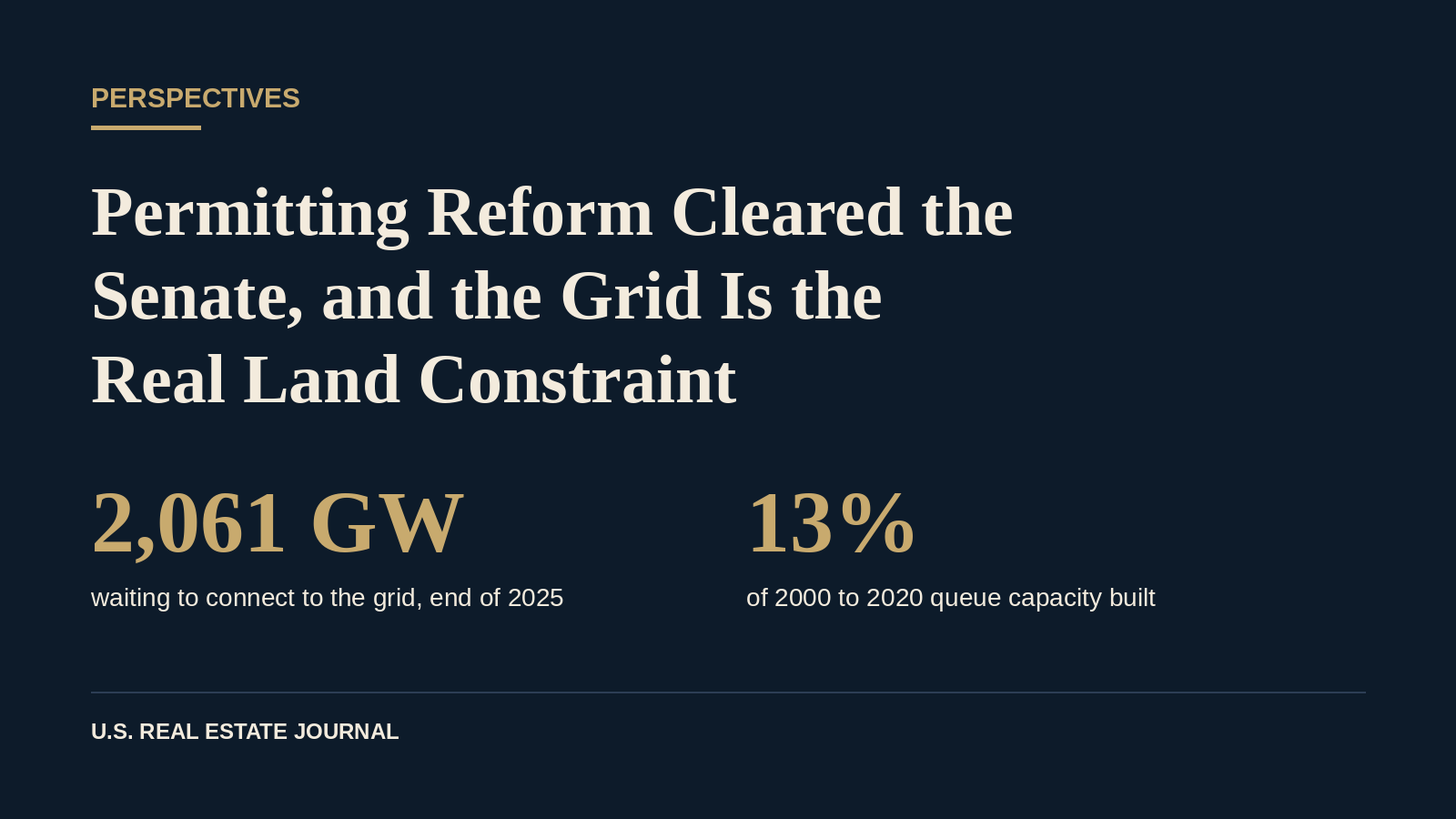
Where BAAJA could matter is upstream of the parcel. More and more, the scarce input in development is not acreage. It is acreage with power, water and road capacity that can be delivered on a schedule. Berkeley Lab's latest interconnection study found about 2,061 gigawatts of generation and storage waiting to connect to the grid at the end of 2025, with the typical project taking more than five years from request to operation. Of the capacity that applied from 2000 to 2020, only 13% has actually come online.
A parcel without a credible path to power is not a development site. It is a hope with a survey attached.
That is the constraint we run into on land again and again. A growth corridor can have the zoning, the jobs and the demand, and still sit idle because the utility cannot commit to service for four or five years. If faster federal review shortens the timeline for transmission and substations, it changes which land is buildable. That is a land value story more than a housing policy story.
Who is positioned, and who is exposed
The clearest winners are owners of land along infrastructure that is planned but stalled: corridors waiting on a transmission upgrade, a water line or a federal highway decision. When those projects move, the land beside them gets repriced from speculative to serviceable. Patient owners who already control those sites, and who can carry them, capture that shift. Buyers who wait until the line is energized will pay for the certainty.
The second group is anyone building large power users, which today mostly means data centers and AI infrastructure. That is also where the risk sits. Realtor.com noted that an amendment to bar data centers from public lands was blocked, and that a group of Senate Democrats released a report sharply criticizing data center incentives. Virginia spent more than $4 billion on those incentives over a decade, and Ohio gave up $2 billion in revenue in two years. Faster permits for power do not guarantee that new capacity serves housing. In many markets, the first new megawatts will go to the biggest and fastest buyer of load, and housing will wait behind it.
Housing developers in fast growing Southern metros should take note. The Southern Squeeze is not only about land prices and insurance. It is increasingly about who gets in line first for utility service, and residential projects rarely win that race on their own.
What could break
The bill is not law. The House still has to vote, and opponents there, including Rep. Melanie Stansbury of New Mexico, argue that it undermines tribal sovereignty and environmental law. Tribal and conservation groups kept opposing it even after amendments. That means litigation is likely even if it passes, and a reform that moves the fight from the permit desk to the courtroom does not always save time. I would not count on BAAJA shortening any specific site's timeline until we see how the first contested projects fare.
There is also a timing problem. Infrastructure built faster still takes years, and the White House estimate of $178 to $251 a year in lower household electric bills is a long run projection, not something a rent roll will see in 2027. Anyone selling land today on the promise of permitting reform is selling the headline, not the service date.
What we are watching
We are watching three things. First, the House vote and whether the data center language changes, because that will shape how new power capacity gets allocated. Second, the transmission and substation projects in the corridors we track, especially the ones stuck in federal review, since those are where the land math moves first. Third, the local response. Federal speed means little if counties answer data center growth with pauses like the one Loudoun County, Virginia recently approved on a 7 to 1 vote, as CRE Daily reported. Those pauses can spill onto every other large project seeking power.
The lesson is the one we keep returning to: data over emotion. The bottleneck in American development is land that can actually be served, and policy matters to the extent it changes that. BAAJA could be one of the more consequential real estate bills in years, but its effect will show up in utility timelines and land basis long before it shows up in housing starts.
If you follow land, entitlement and metro growth, the free watchlist at Land Briefing tracks the corridors where infrastructure decisions are changing what can be built.
Sources
- Senate Passes Controversial Permitting Bill Aimed at Speeding Construction and Lowering Costs, Realtor.com, November 20, 2026
- Apartment Starts Hit Lowest Level Since 2012 in Q3, CRE Daily, November 20, 2026
- CRE Sales Plunge 51% in October After Strong Q3 Rally, CRE Daily, November 20, 2026
- Backlog of power plants seeking transmission grid connection eased somewhat in 2025 amidst high withdrawals, Lawrence Berkeley National Laboratory, July 1, 2026