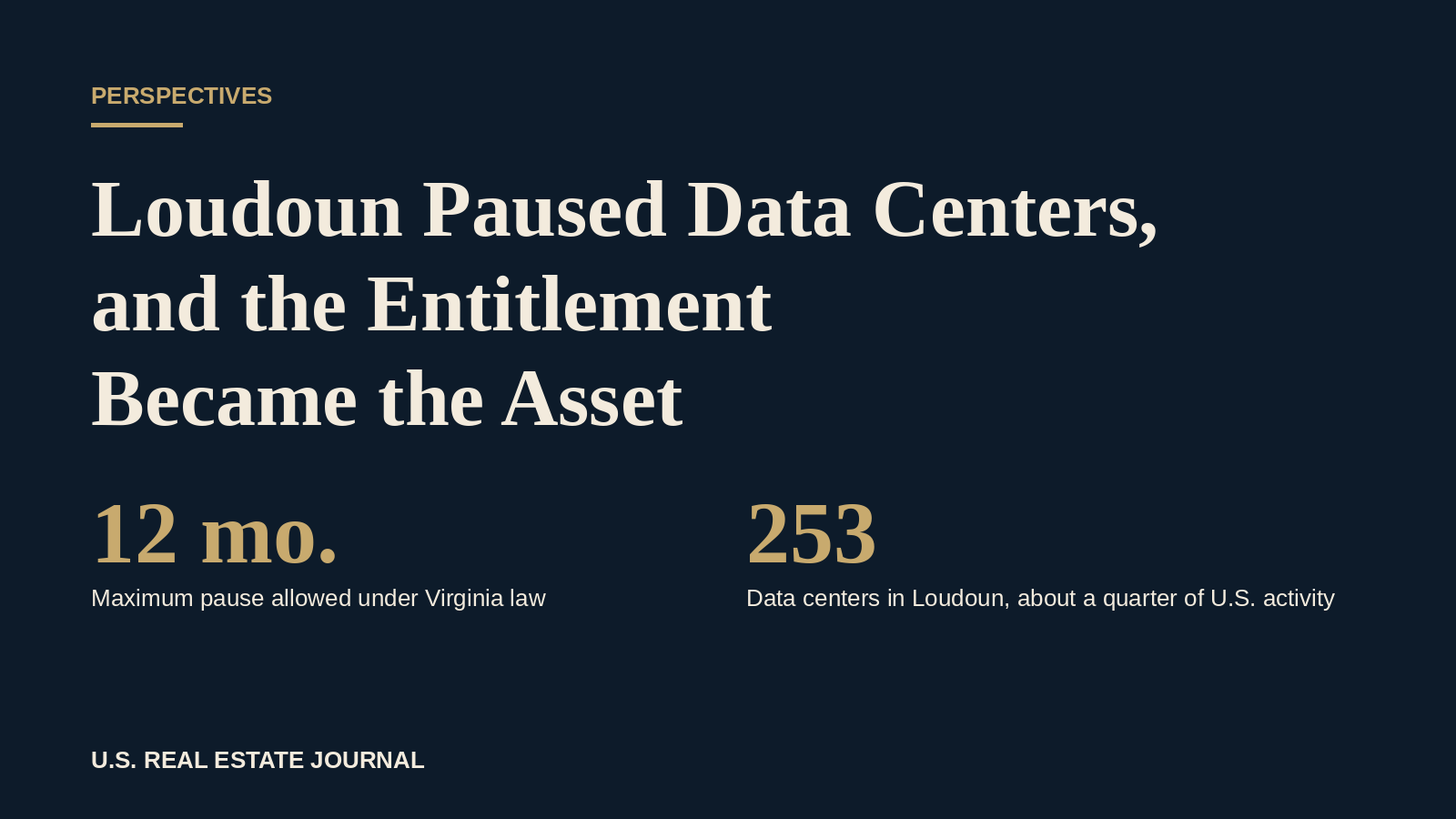

Loudoun County, Virginia, the largest data center market on the planet, has stopped voting on new data center and substation applications. CRE Daily, citing Commercial Observer, reported that supervisors approved the pause 7 to 1 on Tuesday, with one member abstaining, and made it retroactive to September 15. The county's own announcement says the pause runs for up to 12 months, the longest Virginia law allows, and ends when the board adopts new comprehensive plan and zoning rules for where data centers can go and how they must be built. That rewrite is expected to wrap up in the summer of 2027.
This is not a footnote. According to the CRE Daily report, Loudoun holds about 253 data centers covering 49 million square feet, roughly a quarter of U.S. activity, and the industry pays the county about $1.3 billion a year in local taxes. When the market that built the industry decides it needs a year to think, every other county with a power line and a farm field is watching.
What the Pause Actually Does
The details matter more than the headline. The county says developers can keep filing, staff will keep reviewing, and the Planning Commission will keep holding hearings. What stops is the final step: board hearings and board votes on applications that need legislative approval. The county attorney had already advised that an outright moratorium would not be legal, so the board used the one lever it had, which is the one year clock Virginia gives it to act once an application reaches the Planning Commission.
There are carve outs. The county says the board may make exceptions for grid reliability projects or where the statutory deadline is about to run out, that properties in the Route 28 Tax District are excluded, and that administrative approvals are unaffected. CRE Daily reported 33 active applications, with 15 to 17 projects approved or filed under older rules able to proceed. Once the pause lifts, staff expect four to six more months of hearings starting in fall 2027 to clear the queue.
Put those dates together and a site that was headed for a board vote this winter is now realistically looking at a decision in late 2027 or 2028, under rules that have not been written yet. That is the real cost. It is not a year of delay. It is a year of delay followed by a new rulebook.
The Entitlement Is the Asset
I keep coming back to the same point: land and entitlement are the true bottleneck in American real estate, and data centers are now proving it at industrial scale. Loudoun ended by right data center development in March 2025, according to CRE Daily, so every project already needed a special exception and a board vote. Prince William County next door tightened its zoning in September, and Montgomery County froze approvals for 18 months in July. The three jurisdictions that sit closest to the densest fiber and power in the country have now each made it harder to get a yes.
When the approval becomes the scarce thing, the parcel that already has one is worth more than the building that will sit on it.
That shifts value in a predictable direction. The 15 to 17 grandfathered projects and anything in the Route 28 district just became more valuable, because they are among the few places in the market where a timeline can still be underwritten. Sites with existing approvals, existing substations, or administrative paths are the winners. Owners of raw land who were counting on a rezoning to capture a data center premium are the ones exposed, because their exit depended on a vote that is now frozen and on rules that may shrink where the use is allowed at all.
The demand does not disappear. It moves. Developers who cannot get a vote in Loudoun will push further out, into counties and states that still want the tax base. That creates real opportunity in secondary markets with available power, a willing local government, and land that can be assembled. It also creates a familiar trap: places that court the industry today can turn just as quickly once residents start asking about transmission lines, noise, and water.
What the Headline Misses
The easy read is that local politics is getting in the way of the AI build out. The more useful read is that local governments have learned the value of what they control. A $1.3 billion tax stream gives a county leverage, and Loudoun is using that leverage to rewrite standards and locations on its own schedule. Developers have warned that stalling approvals shakes confidence and upends projects planned under current rules, and CRE Daily reported a lawsuit is possible. Even a successful challenge would take time, and time is exactly what a project with a utility commitment and a customer deadline does not have.
There is also a housing angle that gets lost. The same fights over power, land use, and homes near facilities shape whether surrounding land goes to housing, industrial, or nothing at all. When a county pauses one use, it often reopens the debate over what that land should be. For anyone who owns land near these corridors, the planning process over the next year will decide more about value than any lease signed today.
For our part at Kaufman & Company, this is why our ZeroPoint platform starts with power and entitlement rather than with the building. A site plan is easy. A site that can actually get approved, connected, and built on a known timeline is rare.
What We Are Watching Next
First, the draft standards. The location rules Loudoun writes will tell the rest of the country what a modern data center ordinance looks like, including setbacks, buffers from homes, and where substations can go. Second, whether a lawsuit is filed and how quickly. Third, the exceptions: how often the board uses the grid reliability carve out will show how firm the pause really is. Fourth, where the displaced demand lands. I expect more counties in Virginia, the Carolinas, Texas, and the Midwest to see applications in the next 12 months, and I expect several of them to adopt their own versions of this pause once they do.
The lesson is the same one we see in housing every day. Capital and demand are not the constraint. The approved, serviceable site is. If you track how land, zoning, and metro growth are shifting, our free watchlist at Land Briefing follows these entitlement fights as they develop.
Sources
- Loudoun County Pauses New Data Centers for 12 Months, CRE Daily, November 19, 2026
- Loudoun Board Pauses Legislative Data Center & Substation Applications, Loudoun County, November 18, 2026
- Board of Supervisors to Defer Discussion of Proposed Pause on Some Data Center Applications, Loudoun County, October 20, 2026