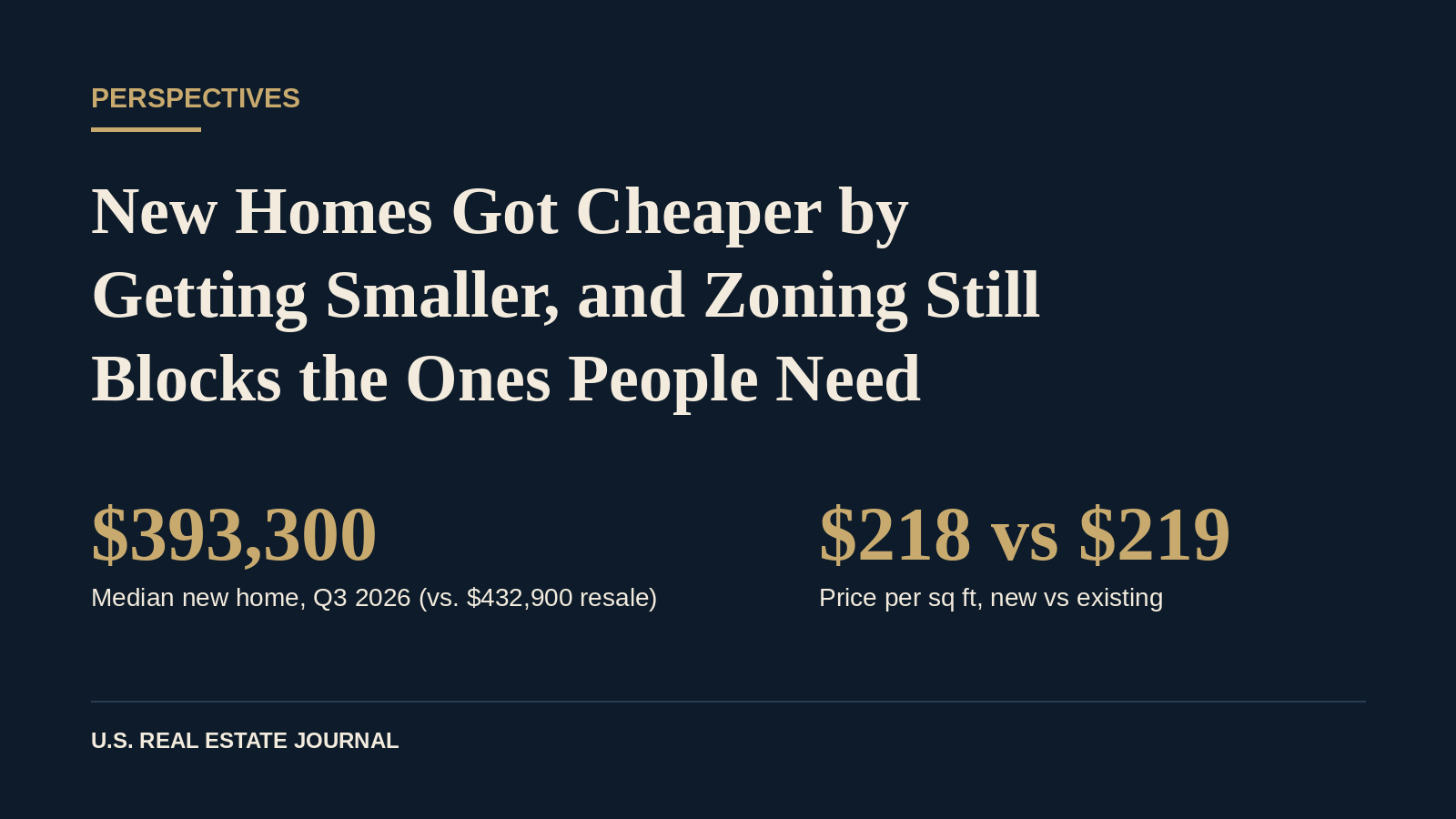

For the first time on record, a typical new home costs meaningfully less than a typical resale. Realtor.com reported this week that the NAHB/Wells Fargo Cost of Housing Index put the median new home at $393,300 in the third quarter, against $432,900 for a median existing home. The National Association of Home Builders says that is the widest gap it has ever tracked, and the new home median is down from $434,900 in the second quarter.
The easy read is that builders are discounting their way to affordability. Partly true. NAHB says 43% of builders cut prices in October, the highest share since 2020, and 65% offered incentives. But one line in the same Realtor.com story tells me more than the headline. Its quarterly construction report puts the price per square foot at $218 for new homes and $219 for existing ones. On a per foot basis, there is no discount at all.
So the new home did not get cheaper. It got smaller, simpler and further out. That is the real story, and it says a lot about where the housing problem actually sits.
The market is already voting for right sized homes
Builders are not shrinking product because they want to. They are doing it because the buyer who can still qualify at a 30 year rate of 7.28%, which Realtor.com cites from Freddie Mac for last week, needs a lower total payment, and the fastest lever a builder controls is square footage. NAHB's index shows the result: a typical family would need 33% of income for a median new home and 36% for a median existing one.
Those are still burdens. NAHB found the typical family is cost burdened in 95 of the 175 markets it studied, and severely burdened in eight. San Jose sits at 79% of income for an existing home. At the other end, Decatur, Illinois, needs 17%, and Wichita Falls, Texas, and Peoria, Illinois, sit under 20%. That spread is the K shaped housing economy in one table. The coastal markets get the attention, but the places where a paycheck still covers a mortgage are often the underpriced turnaround markets nobody is chasing.
The new home did not get cheaper. It got smaller, simpler and further out, and that tells you exactly where the housing problem sits.
The homes people need are the ones zoning makes hardest to build
Another piece of research, covered by Realtor.com last week, points at the same gap from the other side. The Federal Reserve Bank of Cleveland looked at who lives in the best performing school districts. Households over 65 make up 26.2% of households nationally and as much as 28.7% in the least affordable areas, while families with children hold 40% of the housing in the lowest quality districts. Older owners move at about the same rate everywhere, roughly 6.9% a year, so they are not the main thing freezing turnover. Income sorting is.
Realtor.com senior economist Jiayi Xu put the practical problem plainly: right sized, single level, accessible homes near family and doctors are scarce. NIC MAP has estimated the country needs about 1 million new senior housing units by 2040. Put the two studies together and you get a clear picture. The young family priced out of the good district and the empty nester who would sell if there were somewhere to go are looking for the same kind of home. Smaller, well located, close to services. Builders are drifting toward that product on the fringe, where the land math still works.
CRE Daily flagged a RealPage review this week finding that most neighborhood objections to apartments hold up poorly, and that units near jobs and transit generate fewer trips than single family homes. In entitlement work, the arguments against smaller lots, cottage courts and modest apartments near job centers are usually about change, not traffic or schools. Yet those are exactly the formats the data says the market wants.
Who is positioned, and what could break
The winners are not the builders with the biggest discounts. They are the owners and developers who control entitled land close to demand and can deliver smaller homes without fighting a rezoning for every lot. Land and entitlement remain the real bottleneck. A builder can cut square footage in a quarter. Changing what a parcel is allowed to hold takes years.
The risks are real, though. First, margins. Per foot pricing at parity with resale, while land, labor and materials keep rising, means builders are absorbing the squeeze. CRE Daily reported that single family permits fell 12.9% to 772,000 and that small builders are taking remodeling jobs to stay busy. Realtor.com economist Joel Berner noted builders are slowing activity at the top of their funnel, which shows up later as fewer starts and completions. Second, location. A cheaper home 40 minutes further from work can cost a household more once commuting, insurance and utilities are counted. Third, the existing market is stuck. Realtor.com notes pending sales hit a record low in October and existing sales are at their lowest since 2010. If rates stay near current levels, the price gap could widen further and pressure resale values in suburbs where new supply competes directly.
What the headline misses is that this is not a builder bargain cycle. It is a product correction that zoning has not caught up with. Where cities allow smaller lots and attached formats close in, the discount can come from efficiency. Where they do not, it comes from distance, and that is a weaker foundation. It is the gap we focus on with Haven, our attainable and workforce housing brand, because employer anchored, right sized homes near jobs are where the demand and the policy argument now point the same way.
What we are watching next
I am watching three things. Whether the per square foot gap between new and existing homes opens up, which would signal real discounting rather than smaller product. Whether the cities with the heaviest cost burdens start legalizing smaller lots and attached homes near job centers, or keep pushing new supply to the edge. And whether builder land pipelines keep shrinking this winter, because the sites not optioned now are the homes that will not exist in 2028. The market already knows what to build. The question is whether the rules will let it be built where people want to live.
If you are weighing whether a site can support smaller, attainable product under current rules, our Site and Feasibility Review is built for that question.
Sources
- New Homes Are Now $40K Cheaper Than Existing Homes, Realtor.com, November 23, 2026
- Why Do Empty-Nest Boomers Own So Many Homes in Top School Districts?, Realtor.com, November 20, 2026
- CRE Debt Is Back, But Equity Investors Aren't Buying In, CRE Daily, November 24, 2026